

It's 105 degrees on a Friday, the A/C is out, the tenant is upset, and your owner is on a plane or asleep in another time zone. That's not a “service issue.” That's the business showing you, in real time, whether it can keep a tenant, protect an asset, and earn the next renewal.
Most landlords think customer service excellence is about being polite. It isn't. In Fresno and Clovis, it's about running a property management operation that answers fast, fixes the right problem, keeps the owner informed, and doesn't let small misses turn into vacancy, friction, or repair blowback. The companies that do that well aren't just nicer, they're harder to replace, and the market rewards that kind of reliability because 68% of consumers say they'll pay more for brands known for good service, and 75% will spend more on brands that offer a good customer experience. Industry analysis also ties customer experience leadership to 4% to 8% higher revenue than competitors, which is exactly why service quality belongs in the same conversation as rent growth and renewal strategy, not after it. (Help Scout)
Why Customer Service Excellence Is What You're Actually Selling
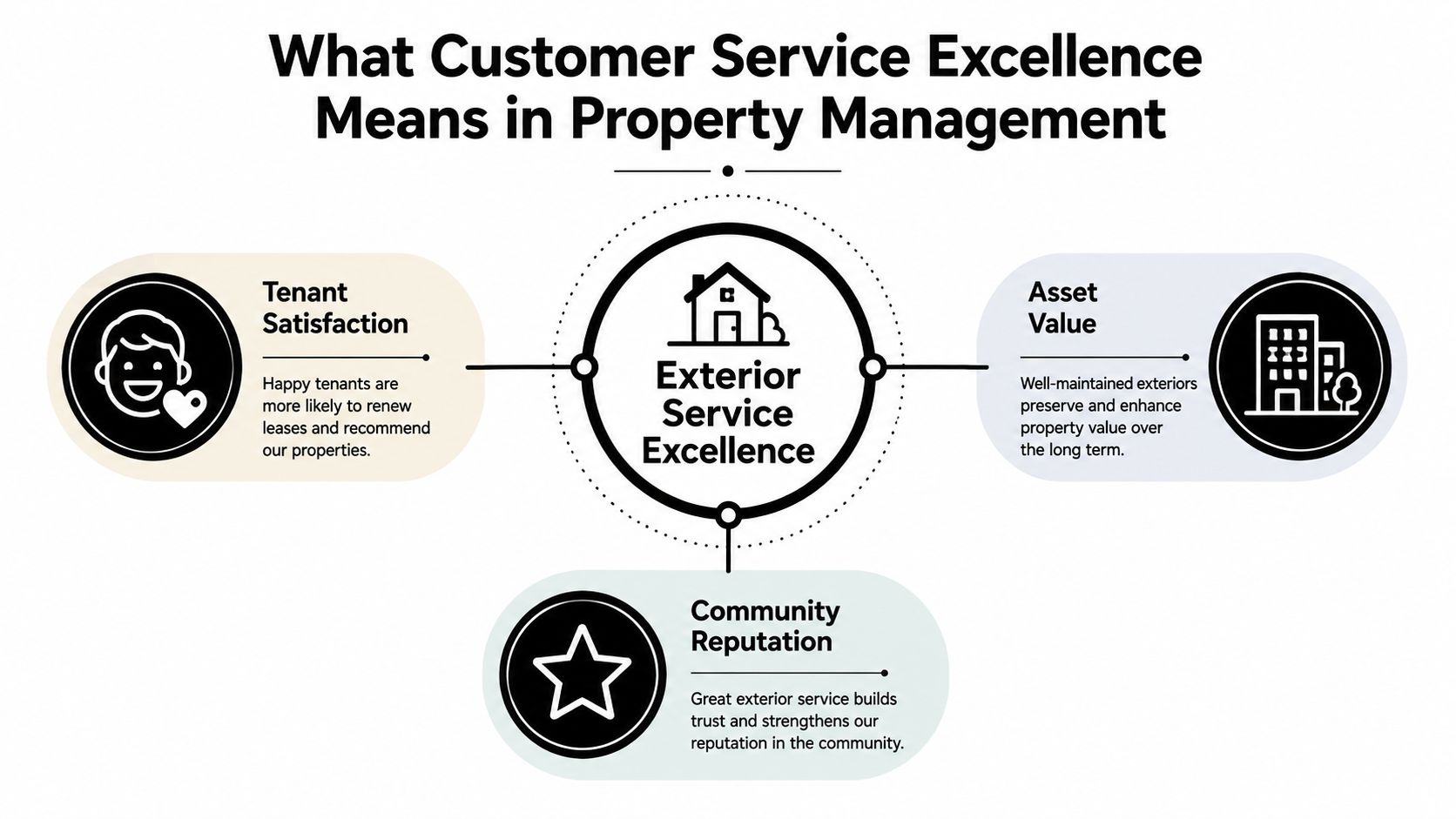
In Fresno and Clovis, customer service excellence means running a property management operation that answers fast, fixes the right problem, keeps the owner informed, and stops small misses from turning into vacancy, repair blowback, or a renewal headache. The tenant wants a livable home and a straight answer. The owner wants clean communication and proof that someone is protecting the asset.
The thermostat test for service quality
Good service has to stay inside a tight band, like a thermostat set correctly in July. If your team swings between heroics and silence, people notice fast. A frantic midnight rescue after three ignored messages is not excellence, it is damage control with a stopwatch.
Practical rule: if your team cannot describe the service promise in one sentence, your customers will not feel it in one interaction.
That promise has two sides in this business. Tenants want repairs, clarity, and respect. Owners want truth, speed, and evidence that someone is watching their asset instead of waiting for complaints to pile up. If you want a simple internal benchmark for that two-sided promise, start with the tenant-retention priorities in these retention strategies, because retention does not happen by accident. It happens when service feels predictable.
A property manager who understands this stops treating customer contact as overhead. Each call, text, portal message, and maintenance update either builds trust or spends it. In a market where owners can compare managers quickly, service becomes the thing that makes you worth more than the cheap alternative.
It also shows up in the tools you choose. If your team is still juggling scattered emails, missed follow-ups, and stale notes, a solid property management software comparison will show you which systems help service stay consistent.
This is also why discount landlords lose good tenants. They sell lower fees. You sell fewer surprises.
What Customer Service Excellence Means in Property Management
In property management, customer service excellence means consistent outcomes, clear communication, and follow-through that tenant and owner can both count on. The tenant's issue gets resolved on the first real contact when possible, the owner gets transparent reporting without having to chase it, and both sides see that you caught the next problem before it became theirs. That is the job.
A working definition for Fresno and Clovis portfolios
Customer service excellence is the habit of resolving problems quickly, communicating the facts clearly, and keeping both tenant and owner informed before they ask.
That definition matters because property management is a two-client system. If you keep the tenant happy but leave the owner confused, you have only solved half the job. If you over-communicate to the owner but leave the tenant waiting, you create churn risk and extra work for everyone.
The market already rewards this approach. By 2010, only 36% of businesses said they competed mainly on customer experience, but later research found that about two-thirds do, which shows a major shift in how firms win loyalty. In the same period, 85% of customer service decision-makers said customer experience would increasingly affect revenue. That is not a side note. That is the core business case. (Forbes)
Why vague empathy talk fails landlords
Owners do not renew management agreements because they heard “we care.” They renew because the reporting is clean, the maintenance trail is documented, the tenant stays calm, and the asset does not get neglected. Tenants do not stay because a manager sounds warm on the phone. They stay when the issue gets handled and the home feels looked after.
If you are comparing tools and workflows, start with this property management software comparison, because software should support your service model, not replace it. A system that does not help you see tenant issues, owner communication, and maintenance status in one place is not helping you deliver excellence.
The Five KPIs That Tell You If Service Is Working
If you only track feelings, you will miss the leak. Service quality needs a small, hard-edged KPI stack that shows whether the operation is working. In property management, the five numbers that matter most are First Response Time, First Contact Resolution, Average Resolution Time, Backlog, and CSAT.
The measurements that expose problems early
First Response Time shows how fast a tenant or owner gets an answer. First Contact Resolution shows whether the issue got handled without repeated back-and-forth. Average Resolution Time shows how long a problem stays open. Backlog shows how many unresolved items are sitting there and aging. CSAT shows whether the customer thought the experience was acceptable after it was over.
Industry guidance recommends tracking 5 to 7 core metrics closely, with common benchmarks like FCR of 70% to 80%, email first response under 1 hour, chat first response under 1 minute, and SLA compliance of 95%+. Miss those thresholds, and you usually get more repeat contacts, longer queues, and higher operating cost per ticket. (Fullview)
Practical rule: when backlog is rising, the root cause is usually a capacity gap or a triage gap, not a communication gap.
Five Core KPIs and Property Management Benchmarks
| KPI | What It Measures | Realistic Target | Owner or Tenant Signal |
|---|---|---|---|
| First Response Time | How quickly someone acknowledges the issue | Fast enough that the customer does not have to follow up | Tenant feels heard, owner sees control |
| First Contact Resolution | Whether the first real touch solves the problem | Aim to stay inside the common 70% to 80% range | Tenant sees competence, owner sees fewer escalations |
| Average Resolution Time | How long it takes to close the loop | Keep it short enough to avoid repeat pressure | Tenant gets relief, owner gets fewer open loops |
| Backlog | How many unresolved items are waiting | Keep it tight and aging cases visible | Owner sees discipline, tenant sees urgency |
| CSAT | Whether the customer liked the experience | Use it after repairs, renewals, and owner updates | Tenant renewal signal, owner referral signal |
If you want to tighten how calls are handled, the guide to call monitoring for SMBs is useful because call quality shows whether service is being delivered or just promised. That matters in small portfolios, where one sloppy handoff can poison the whole month.
The owner side and tenant side should never sit in separate silos in the manager's head. Tenant CSAT drives renewals. Owner CSAT drives referrals, additional doors, and the confidence to keep paying for management rather than switching to cheaper noise.
A manager who wants clean service data needs two habits. First, ask every team member the same questions about response, resolution, and follow-up. Second, train them on communication skills for managers so the answers sound consistent to both owners and tenants. That consistency is what keeps a Fresno or Clovis portfolio from turning into a pile of mixed messages.
Core Principles and Scripts You Can Use This Week
A tenant calls about a broken A/C on a hot Fresno afternoon, and the owner wants to know whether it is handled or still hanging open. The team that wins that moment does a few things right every time. It answers fast, takes ownership, updates the owner before they start chasing, records the handoff, and follows up after the repair.
Five operating rules that hold up under pressure
1. Speed with substance. Do not send a bare “we're looking into it” message. Send the next concrete step, who is doing it, and when the customer will hear back.
2. Own the problem. If a vendor caused the issue, the customer still sees your company. Treat it as your job to close the loop.
3. Update the owner proactively. Give the status before they ask, especially when repairs are moving slowly or the budget may change.
4. Document handoffs. Every transfer needs the same facts, photos, timestamps, and next action.
5. Follow up after resolution. Check whether the fix held and whether anything else needs attention.
The underused part is the second question. Frontline agents often hear the first sign of a bigger issue, and good service means solving the underlying problem, not only the stated one. If a tenant says the A/C is out, the problem might be airflow, a breaker, a clogged filter, or a unit that has been failing for weeks. Ask what else changed, then write it down.
Here's the kind of tenant reply that works in real life:
“Got it. I've logged the A/C issue as urgent, and I'm contacting maintenance now. I'll send you the next update as soon as I have the ETA, and if you notice any other problems in the unit, send them in the same message so we can bundle the visit.”
And here's the owner update:
“Your tenant reported an A/C failure, and we've already escalated it to maintenance. I'm tracking the repair as urgent, and I'll update you again with the technician ETA and repair outcome. If the vendor identifies a larger issue, I'll send photos and next steps right away.”
That beats polished filler every time. It gives both clients the facts they need.
For managers who need tighter internal wording, this communication skills guide for managers is useful because most service failures start as communication failures. If your team cannot write short, clean updates, every ticket turns into extra work.
A simple reply structure that keeps you honest
Use this sequence every time.
- Acknowledge the issue. Name the problem plainly.
- State the next action. Say who is doing what.
- Set the next update. Give the customer a time frame, not a vague promise.
- Close the loop. Confirm resolution and ask for follow-up concerns.
That structure keeps tenants calmer and owners more confident. It also forces your team to stop hiding behind generic phrases that sound polite but solve nothing.
A Fresno Story of Excellence in Practice
A Clovis duplex came into management with the usual mess, one frustrated out-of-state owner, one tenant already halfway through a lease, and a property that had been getting by on luck. The owner wanted fewer surprises. The tenant wanted reliability. The old system gave neither.
What changed in the first 30 days
The first move was a 24-hour maintenance triage call after intake. Not to impress anyone, just to find out what was already broken, what was about to break, and what could wait. That call uncovered issues that would have turned into repeat complaints if nobody had asked the right questions early.
Then came a written 30-day improvement plan to the owner, with photos, priority items, and a simple sequence of work. The owner didn't need drama. The owner needed evidence. Monthly photo-and-financial statements followed, which cut down on “what's happening over there?” messages and kept the relationship calm.
The owner relationship improved because the manager stopped making the owner chase the story.
How the KPI stack matched the outcome
The team watched First Response Time on tenant issues, pushed for higher First Contact Resolution on routine maintenance, and kept the Backlog from aging out. When the tenant had an issue, the response was direct. When the owner wanted an update, the answer was already prepared. That's what consistency looks like.
By month nine, the renewal conversation wasn't a rescue mission. It was a normal business call. The tenant renewed, then renewed again later in the portfolio relationship, and the owner referred a second property because the communication felt steady and the accounting felt clean. The point isn't that every duplex becomes a fairy tale. The point is that disciplined service reduces preventable pain and makes the book of business easier to hold.
In a market like Fresno, Clovis, or Friant, that kind of stability beats flashy promises. Owners remember who kept them informed. Tenants remember who handled the problem without turning it into a fight.
Beyond Speed The Selective Automation Advantage
A lot of managers still confuse customer service excellence with instant replies. That is too simple. Fast response times matter only when the process behind them is accurate, documented, and able to handle exceptions. If your team answers quickly but still needs a day and a half to solve a routine email, you have only improved the first line of the problem.
Automate the routine, keep humans on the exceptions
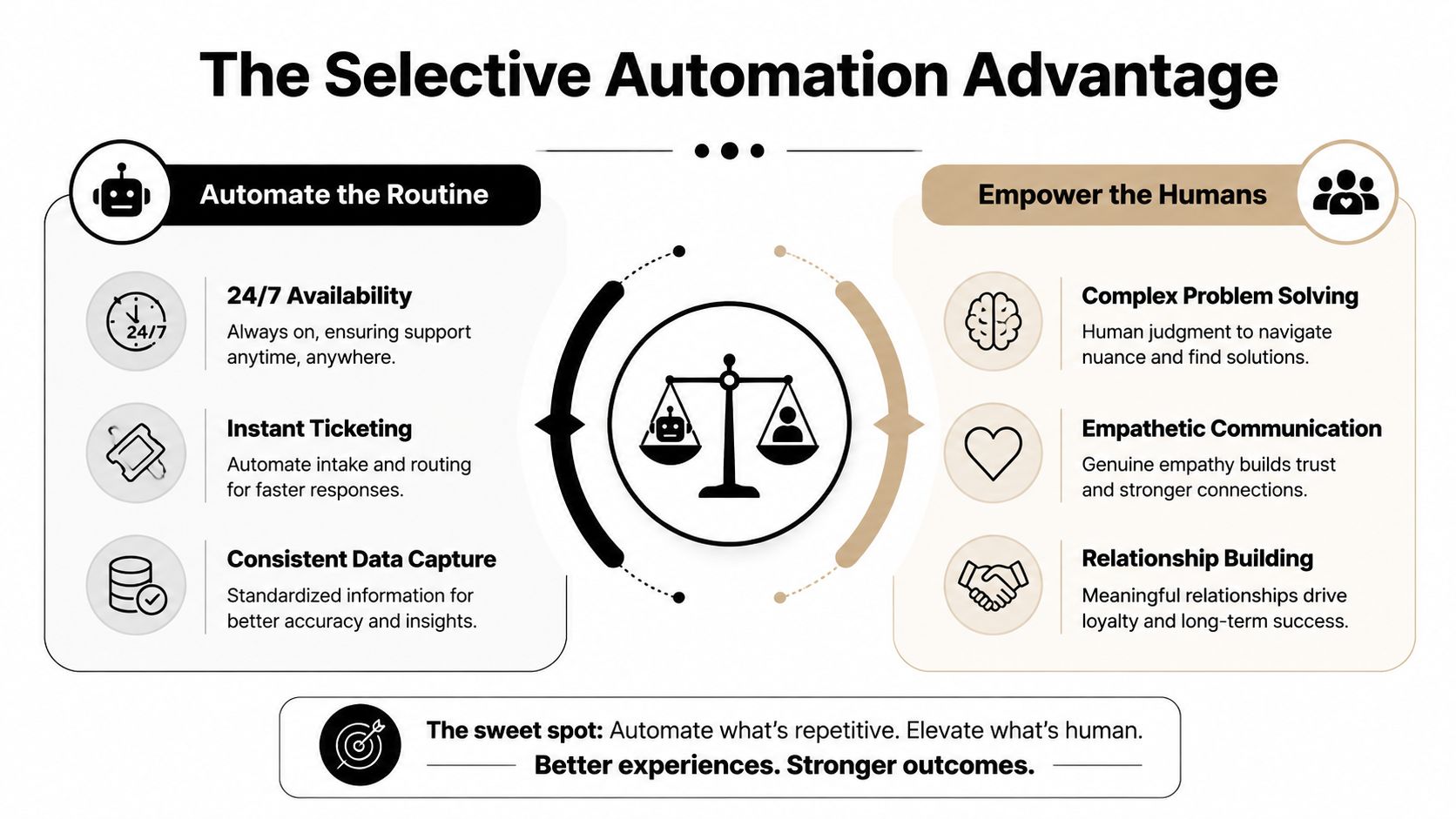
Use automation where it cuts out drag. Rent collection, maintenance intake forms, owner statement delivery, and lease renewal drafts can all be structured so staff spend less time retyping and more time solving. Selective automation supports the service model when it captures the right details at the start and routes work cleanly.
That logic sits behind the guide to AI agents for customer service, and the same thinking applies in property management. Automation should support the service model rather than replace human judgment. For a fuller look at that approach, see automation in property management.
The hybrid model is the right one for property management. AI and templates should handle routine intake and reminders. People should handle exceptions, empathy, lease tension, and owner reassurance. If a manager uses automation only to make slow service look organized, owners will catch on fast.
Edinhart Realty and Property Management fits that practical middle ground with full-service management, placement-only service, automated rent collection, repair coordination, tenant communication, lease renewals, and detailed accounting statements. That is the kind of structure that supports service instead of pretending service is just a faster inbox.
What not to automate
Do not automate ownership. Do not automate apology. Do not automate the final judgment on a delicate tenant issue. If a repair is expensive or a tenant is already frustrated, a real person needs to step in and explain the next move clearly. The machine should organize the work. The manager should own the relationship.
Your 90-Day Customer Service Excellence Rollout
The cleanest way to improve service is to stop guessing and start sequencing. You don't need a giant budget to do that. You need a baseline, a few rules, and the discipline to review what the numbers say.
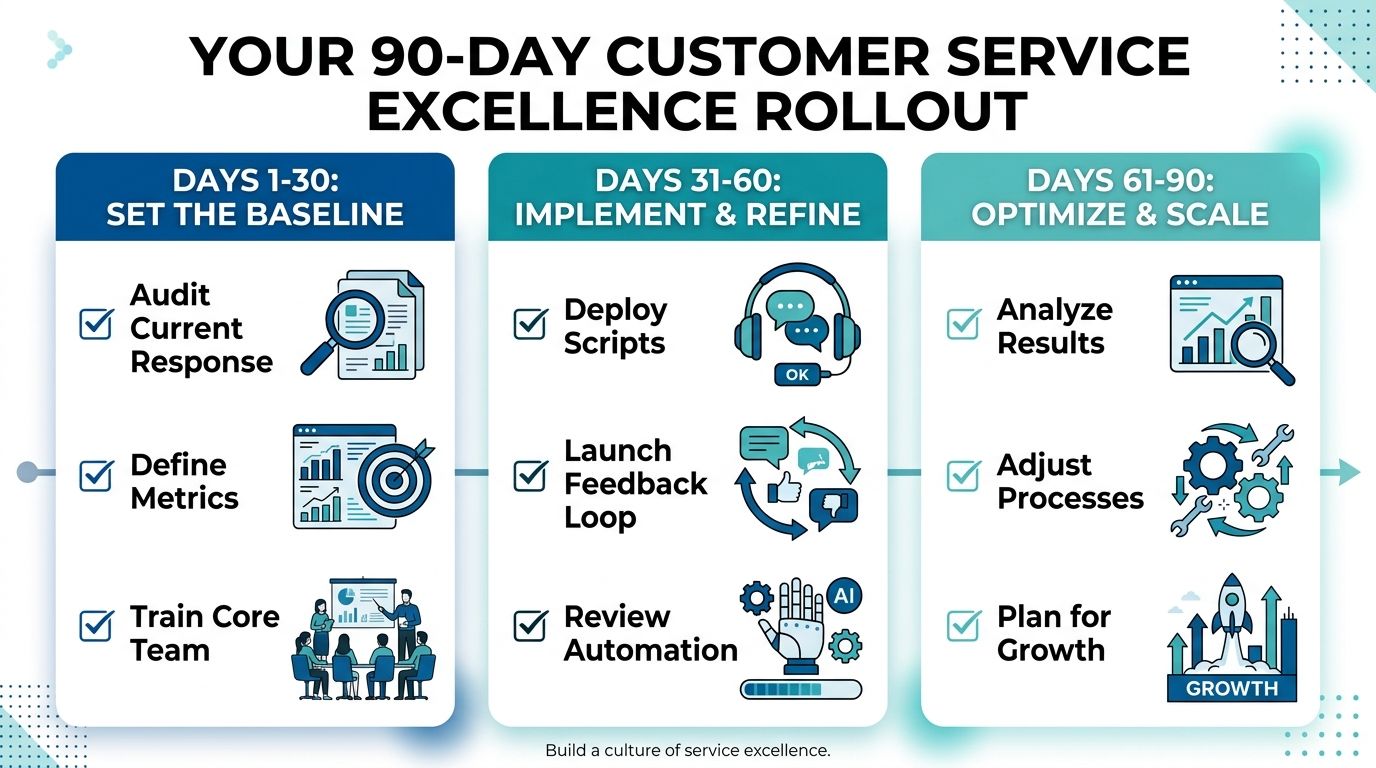
Days 1 to 30 set the baseline
Audit current response times for tenant and owner requests. Write down what happens from first message to final closeout. Define your five core KPIs, then write the three scripts every staff member should use, one for maintenance, one for owner updates, and one for renewal follow-up.
Days 31 to 60 install the systems
Turn on automated rent collection if you're still doing it manually. Build templated owner statements so reporting is consistent. Set escalation rules for maintenance, lease expirations, and any ticket that sits too long without movement. Review every place where a tenant or owner can get stuck waiting for a human to remember them.
Days 61 to 90 measure and adjust
Review the KPIs with the team, not just the final numbers. Ask which issue types create the most repeat work, which vendors miss the mark, and where the handoffs are weak. Run a short owner survey, then do a tenant renewal interview with one simple question, what would make it easier to stay. That answer will tell you more than a polished dashboard.
If you manage alone, start with response-time tracking, a repair script, and one owner update template. If you're ready to hire a full-service manager, look for someone who already runs rent collection, maintenance coordination, tenant communication, lease renewals, and accounting statements in one system. That's the difference between service that looks busy and service that holds the book together.
Edinhart Realty and Property Management handles the parts of this job that break most owners down, tenant communication, repair coordination, lease renewals, accounting, and day-to-day follow-through. If you want a Fresno-area team that runs property management as a service business, not a call-back game, visit Edinhart Realty and Property Management and see how their management models fit your portfolio.


