

The call usually comes after hours. A tenant hears dripping above the bathroom fan, or the kitchen sink backs up right before a holiday weekend, and suddenly you need a contractor now. If your plan is to search your phone for “a guy who did something once,” you don't have a plan. You have exposure.
California landlords feel this faster than most. You're not just trying to fix a leak. You're protecting habitability, tenant relationships, property condition, insurance position, and your paper trail if a dispute follows. The landlords who stay calm in these moments aren't luckier. They've built a repeatable contractor management process before the emergency happens.
Your Contractor Management System The Ultimate Landlord Insurance
A bad contractor story usually starts the same way. The vendor was available fast, the price sounded fair, and nobody slowed down long enough to document scope, verify coverage, or define who was responsible for what. Then the job drifts. The tenant gets frustrated. The invoice doesn't match the verbal quote. If damage spreads, you own the problem.
That's why contractor management matters so much for landlords. It's not a fancy corporate term. It's your operating system for repairs, turnover work, capital improvements, and emergency response. It tells you who gets called, what documents you collect, how work gets approved, how changes get handled, and when money gets released.
The financial drag from sloppy processes is real. Poor contractor management erodes approximately 9.2% of a company's annual revenue, according to CLM statistics summarizing Deloitte and DocuSign findings. For a landlord, that leakage shows up in overbilled jobs, repeat repairs, vacancy drag, preventable damage, and time lost chasing paperwork.
What a real system includes
A usable contractor management system for a California landlord has a few moving parts:
- A vetted bench: plumbers, electricians, HVAC techs, roofers, restoration vendors, handymen, cleaners, and turnover crews.
- Standard intake: a way to log the issue, urgency, tenant access needs, and owner approval threshold.
- Written work orders: not texts, not vague calls, not “just take care of it.”
- Change order rules: extra work doesn't start until scope and price are updated.
- Closeout requirements: invoices, photos, and lien protection before final payment.
Practical rule: If the job isn't documented before it starts, it will be argued about after it ends.
Landlords who self-manage can build this with a spreadsheet, shared folders, saved templates, and consistent habits. If you want a sense of what a more structured workflow looks like, this kind of process is what property maintenance management software is designed to organize.
The point isn't software by itself. The point is removing improvisation from a part of the business that gets expensive when handled casually.
Building Your Vetted Vendor Network
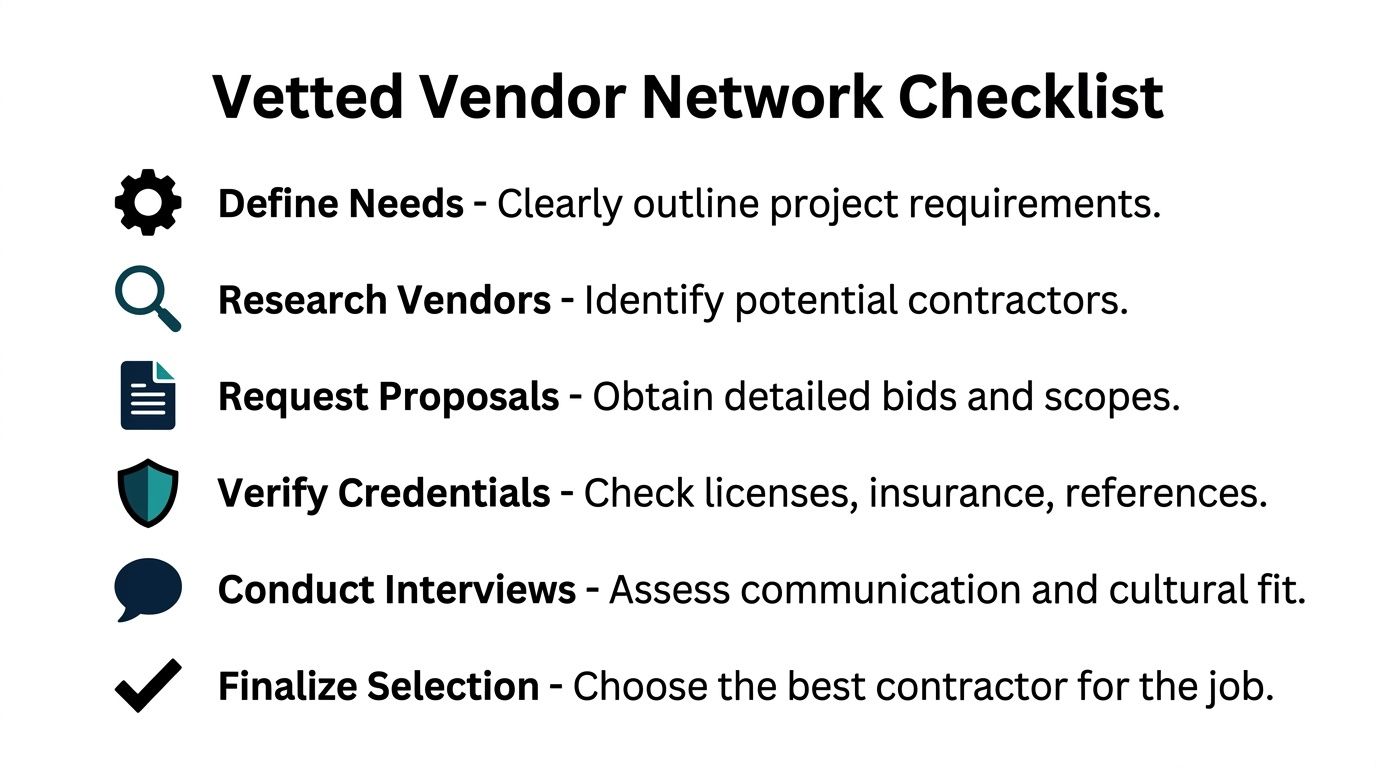
The strongest contractor management decision is made before a repair request ever comes in. You build a bench first. Then when a toilet supply line fails or a tenant reports a dead GFCI in the kitchen, you're choosing from approved vendors instead of gambling under pressure.
Start with California non-negotiables
In California, “seems trustworthy” is not a vetting standard. Check the basics first.
- License status: Verify active licensing through the CSLB for any trade that requires it. Don't rely on a business card or truck decal.
- Insurance documentation: Ask for a current certificate of insurance. Review general liability and workers' compensation information carefully.
- Business identity: Make sure the company name on the bid, invoice, and insurance paperwork matches the actual entity doing the work.
- Complaint history: Review available complaint or disciplinary information. Patterns matter more than excuses.
For landlords, this is less about bureaucracy and more about loss control. If a worker gets hurt, a tenant claims damage, or the work fails inspection, your file needs to show you acted prudently.
Vet by risk, not by category alone
A smart network isn't just a contact list. It's tiered by risk. A groundskeeper trimming shrubs at the perimeter is not the same risk as a roofer on a two-story slope or a plumber opening walls in an occupied unit.
The Campbell Institute's best-practice framework recommends a rigorous prequalification process followed by risk-based categorization using a matrix based on work location and job function to screen out high-risk contractors, as outlined in its best practices in contractor management paper.
A simple landlord version looks like this:
| Risk tier | Typical work | What to require |
|---|---|---|
| Low | Cleaning, basic landscaping, minor touch-up work | Basic insurance review, references, written scope |
| Medium | Handyman repairs, appliance swaps, interior painting, flooring | License review where applicable, detailed bid, scheduling rules |
| High | Plumbing behind walls, electrical, roofing, structural, mold or water restoration | Full credential file, stronger contract terms, tighter supervision, closeout photos |
That matrix helps you avoid a common mistake. Owners often apply the same process to every vendor, which means they either overcomplicate small jobs or under-control risky ones.
Reference checks that actually help
Most landlords ask, “Would you hire them again?” That question is too soft. Ask narrower questions.
- Scope control: Did the final invoice stay aligned with the original quote?
- Communication: Did they call before showing up, update delays, and respond promptly?
- Cleanliness: Did they protect finishes and leave the unit tenant-ready?
- Callbacks: Did the repair hold, or did the issue return?
Listen for hesitation. A reference who says, “They do great work, but you really have to stay on them,” is warning you about management overhead.
The best vendor isn't always the cheapest. It's the one you can trust to enter an occupied property, communicate clearly, and finish without creating a second problem.
A reliable bench usually includes at least two options per major trade. Not because you want to shop every job endlessly, but because people get booked, emergencies overlap, and even strong vendors sometimes slip.
Onboarding Contracts and Setting Expectations
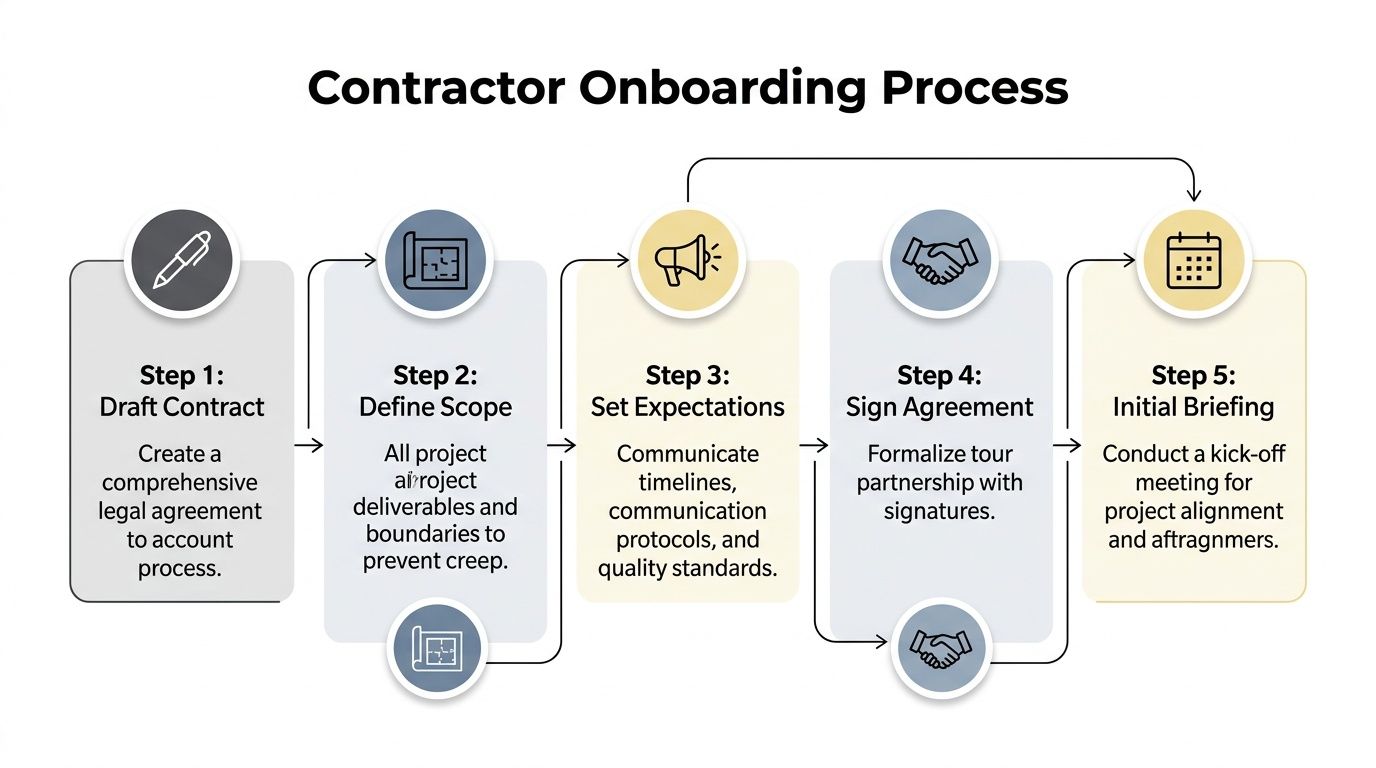
Once a vendor clears your vetting process, the next failure point is documentation. At this stage, many landlords lose control. They find a decent contractor, then manage the relationship through calls and text messages. That works until there's a delay, a quality dispute, or an invoice that doesn't match what was discussed.
Use two levels of paperwork
For recurring vendors, keep two documents in play.
The first is a Master Service Agreement. That handles the standing rules of the relationship: insurance requirements, indemnity language, basic compliance obligations, invoicing standards, dispute handling, and who can approve work.
The second is the work order or job-specific authorization. That document should deal with the actual assignment in front of you, not general terms.
A solid work order should include:
- Exact scope: “Replace failed angle stop under hall bath sink and supply line” is better than “fix plumbing issue.”
- Materials standard: Brand, finish, model, or performance requirement when it matters.
- Access details: Tenant name, contact process, approved entry window, lockbox or key protocol.
- Timeline: Start date, expected duration, and when updates are required.
- Price control: Fixed amount or not-to-exceed cap.
- Definition of completion: Photos submitted, area cleaned, fixtures tested, debris removed.
When landlords skip that last item, arguments start. Contractors think they're done when the installation is complete. Owners think they're done when the repair is functional, cleaned up, documented, and tenant-ready.
A quick technical review can also prevent confusion before materials hit the property. On plumbing work especially, a useful primer is this plumbing submittal guide, which helps explain how product and installation details should be reviewed before work proceeds.
Put consequences in writing
Friendly relationships don't replace enforceable terms. Vendors need to know what happens if they miss insurance renewals, bypass approval rules, fail to communicate, or produce unsafe or deficient work.
According to Vector Solutions' contractor safety program discussion, 74% of contractors fail to meet compliance expectations without clear early exit rights and documented consequences for non-compliance tied to audit findings or worsening safety performance. For landlords, that doesn't mean writing hostile contracts. It means your paperwork needs usable remedies.
Include terms covering:
| Clause | Why it matters |
|---|---|
| Early termination rights | Lets you stop work cleanly if performance slides |
| Insurance maintenance | Keeps coverage current through the job |
| Change order approval | Prevents surprise invoices |
| Lien protection language | Supports clean closeout |
| Property rules | Addresses tenant interaction, cleanup, keys, parking, and site conduct |
A good contract doesn't create conflict. It reduces the amount of guessing that usually causes conflict.
If you use a repeatable intake process for vendor onboarding, keep your paperwork centralized so every approved contractor submits the same information. A standardized property management vendor application setup can make that collection process much easier to manage.
A short kickoff conversation still matters. Written terms are the backbone, but alignment happens when you confirm the job in plain language: what's being fixed, what is not included, who approves extras, and when the tenant should expect the unit back in normal condition.
A brief visual walkthrough can help owners think through that kickoff process:
Managing Projects and Quality Control
A mid-size repair is where contractor management stops being theory. Take a common California rental problem: a tenant reports soft flooring around a hall bathroom toilet. The leak is old enough that the vinyl has lifted and the subfloor feels spongy. This isn't a simple service call anymore. You now have plumbing, demolition, flooring, scheduling, tenant notice, and likely one surprise waiting once the floor opens.

Run the job in phases
The landlords who keep control break the work into clear stages.
First comes diagnosis and access. You coordinate lawful entry with the tenant, confirm who is attending, and make sure the vendor knows whether the toilet will be out of service temporarily. If the unit has only one bathroom, timing gets tighter and communication needs to be sharper.
Then comes demolition and exposure. Once the toilet is pulled and damaged material is visible, you often learn whether this is a small patch or a larger repair. At this juncture, weak systems fail. Contractors keep going, assuming the owner will approve the extra work later.
That's exactly when you pause the job and require documentation.
Change orders are not optional
If the plumber or flooring contractor finds more damage than expected, get three things before the work expands:
- Photos of the newly discovered issue
- A revised scope of work
- A written price adjustment or new not-to-exceed amount
Without that, you lose influence. You also lose clarity for your accounting and your tenant communications.
Stop work on the extra scope until the change order is approved. That one pause saves more disputes than any speech about professionalism.
In occupied units, quality control also means tenant management. Tell the resident when vendors are arriving, what rooms are affected, whether water will be off, and how long disruption should last. A good contractor can perform the work. A good landlord can choreograph the work around an occupied home.
Inspect like an owner, not like a spectator
At closeout, don't stand in the doorway, nod, and release payment. Walk the repair.
For the bathroom subfloor example, inspect the basics in sequence:
- Fixture function: Flush the toilet, run nearby faucets, and confirm there are no active drips.
- Finish quality: Check flooring edges, caulking, transitions, and visible fastener issues.
- Cleanup: Look behind the toilet, inside the vanity, and in common paths used by the crew.
- Tenant impact: Confirm the bathroom is fit for use, not just technically repaired.
A punch list should be short, written, and immediate. If touch-up caulk, trim correction, debris removal, or a missing escutcheon still needs attention, note it on the spot and hold final payment until it's completed.
The biggest quality-control mistake I see from self-managing owners is confusing activity with completion. A contractor can spend all day at the property and still leave you with an unfinished job. Your standard is not effort. Your standard is documented, working, clean completion.
Streamlining Invoicing and Payment Workflows
A clean repair process can still end badly if payment handling is sloppy. Here, many landlords create their own bookkeeping problems. They approve work casually, get vague invoices later, and then can't match what was billed to what was authorized.
Good contractor management treats payment like closeout, not like an afterthought.
Match every invoice to a job record
Require itemized invoices. Not “repair completed, $850.” You want enough detail to tell what labor was performed, what materials were used, and which work order or property issue the bill belongs to.
At minimum, every invoice should show:
- Vendor identity: matching the entity you approved
- Property address and unit
- Date or service window
- Scope performed
- Material and labor breakout when appropriate
- Reference to your work order number or approval record
This becomes critical at tax time, during owner reporting, and when a tenant later says the issue was never fixed correctly. If the paper trail is thin, you'll reconstruct the story from memory. That's a bad system.
Structure payments to protect leverage
Small repairs usually don't need progress payments. The cleaner approach is simple: authorize the work, inspect the result, clear any punch items, then pay.
Larger jobs are different. If a project spans multiple days or requires substantial material ordering, staged payments can make sense. The key is tying each payment to a visible milestone, not just time passing. “Demo complete,” “rough completed,” and “final punch list cleared” are meaningful triggers. “Half now, half later” often isn't.
A practical payment workflow looks like this:
| Stage | What you verify before paying |
|---|---|
| Approval | Written scope and price are authorized |
| Mid-project draw if needed | Milestone completed and documented |
| Final invoice | Scope matches approved work and any signed change orders |
| Final release | Punch list complete and lien paperwork collected |
This is also where supply management affects billing. Contractors who track parts and consumables well tend to invoice more clearly and create fewer surprises. If you want a practical look at that side of the business, these inventory tips for contractors and DIYers are a useful reference.
Don't skip lien protection
For California landlords, the final payment stage should include lien protection documents where appropriate. If the job justifies it, get the proper waiver paperwork before you consider the file closed. That matters most on larger jobs, but the discipline is useful across the board.
You also want to confirm that all change orders have been incorporated and that no one is expecting a “small extra bill” later. Loose ends tend to arrive after ownership has mentally moved on.
One more rule helps keep disputes down. Never pay from memory. Pay from documents. The approved scope, the change order if any, the completion evidence, and the final invoice should all agree. If they don't, stop and reconcile the file before money moves.
That kind of discipline may feel heavy for a single repair, but it scales well. And once you manage more than one property, repeatability matters more than speed.
Emergency Response and Performance Tracking
The two moments that reveal whether your contractor management system works are the worst repair night of the year and the day you decide who gets the next job. Those are really the same issue. Fast emergency response only works when you already know which vendors deserve the call.
Build an emergency lane separate from regular maintenance
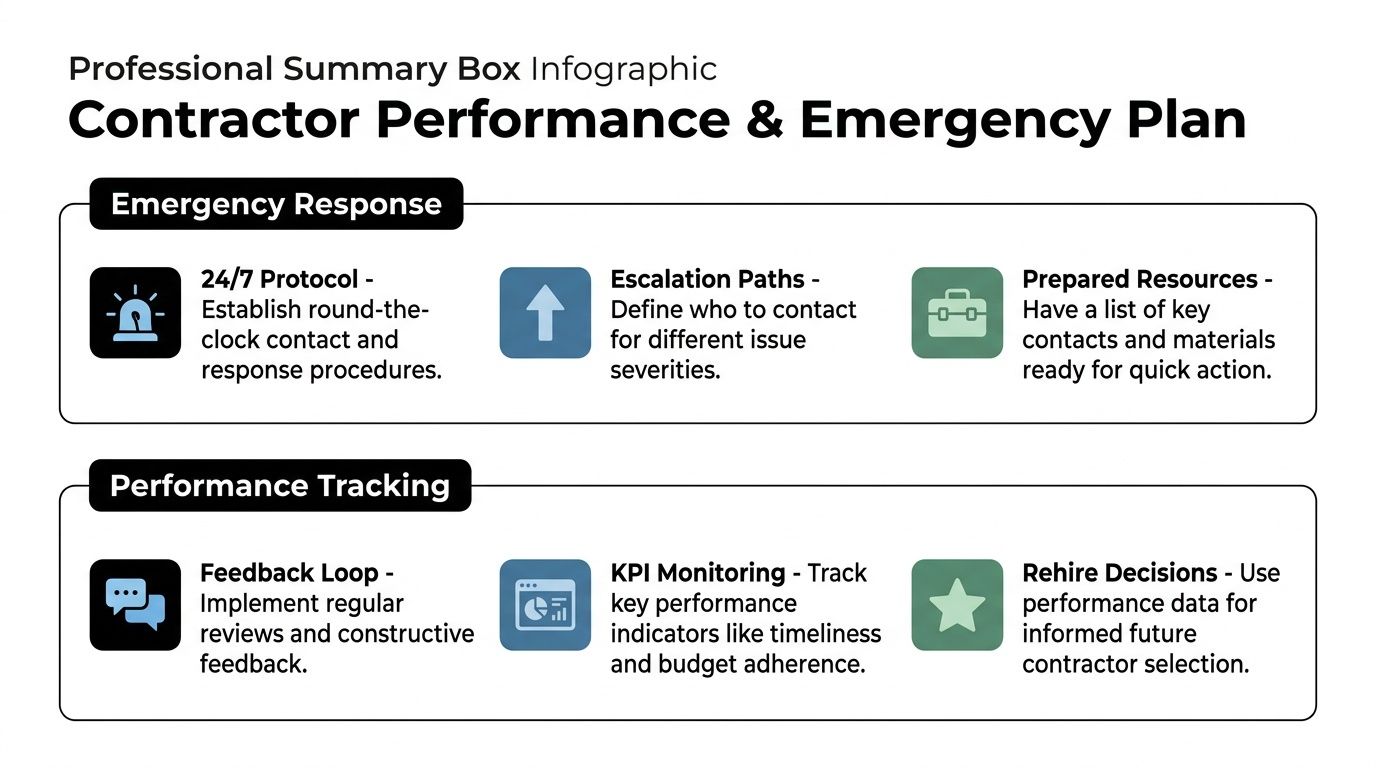
Your emergency process should be narrower and faster than your normal repair workflow. Don't force a midnight leak into the same approval lane as a routine disposal replacement.
A landlord-ready emergency plan should define:
- Who receives the first call: tenant, answering service, owner, or manager
- Which issues qualify as urgent: active leaks, no heat where habitability is affected, electrical hazards, sewer backups, unsecured entry
- Which vendors are pre-cleared: at minimum plumbing, electrical, and HVAC
- What the vendor is authorized to do immediately: stop loss, make safe, restore basic function if possible
- When owner approval is required: permanent repair beyond emergency stabilization
The best emergency vendors understand phase one. They don't remodel the bathroom at midnight. They stop the water, protect the property, document conditions, and get the unit to a safer, more stable state.
Score vendors after every job
Most landlords remember extremes. They remember the awful contractor and the hero who saved a weekend. The middle group gets judged emotionally, which leads to inconsistent hiring.
A basic scorecard fixes that. After each job, rate the vendor on the same criteria every time:
| Category | What to ask |
|---|---|
| Quality | Did the repair hold and meet finish expectations? |
| Communication | Did they update clearly and respond promptly? |
| Timeliness | Did they arrive and complete work as promised? |
| Documentation | Did they provide photos, invoices, and change orders properly? |
| Tenant interaction | Were they respectful and professional on site? |
You don't need complicated software to start. A shared spreadsheet works. What matters is consistency.
Vendors should compete for repeat work with performance, not with promises.
Once you track a handful of jobs per vendor, patterns become obvious. One contractor is excellent in emergencies but weak on paperwork. Another is slower to schedule but finishes cleanly with almost no callbacks. That helps you dispatch the right person for the right job instead of pretending one vendor should handle everything.
Automation is becoming normal
This is one area where the industry is moving toward more structured systems. By 2025, AI-driven automation is projected to be implemented in 75% of organizations for business-critical operations, according to contract management statistics and trends compiled by Fynk. For landlords, the practical takeaway isn't that you need flashy technology. It's that organized dispatching, documented workflows, and performance data are becoming standard operating practice.
If your system still depends on memory, text threads, and searching old invoices, it will eventually break under volume or stress.
A strong emergency process and a simple vendor scorecard solve that. One protects the property tonight. The other protects every repair decision after that.
Essential Checklists and Landlord FAQs
Most landlords don't need more theory. They need a short operating checklist they can use on the next repair call.
Quick-use landlord checklists
Keep a simple contractor file for each approved vendor. It should include current license information where applicable, insurance documents, contact names, after-hours numbers, trade category, service area, and notes from past jobs.
For each new job, run this short checklist:
- Issue captured clearly: what failed, where, when, and whether the tenant can still safely use the area
- Vendor selected by trade and risk: not by whoever texted back first
- Written authorization sent: scope, price limit, access instructions, completion standard
- Progress documented: photos, updates, and any change approvals
- Closeout completed: final inspection, invoice match, payment record, and file notes
For ongoing property upkeep, pair that repair workflow with a seasonal maintenance routine. A broad homeowner reference like this 2025 home maintenance guide can help you think through preventive tasks, and a rental-specific rental property maintenance checklist is useful for keeping recurring inspection items organized.
Landlord FAQs that come up all the time
What's the difference between a handyman and a licensed contractor?
For a landlord, the practical difference is scope, risk, and legal exposure. Small basic tasks may fit a handyman. Trade work, higher-risk work, permit-sensitive work, or anything that could create bigger liability should push you toward a properly licensed contractor. When in doubt, verify rather than assume.
Should I pay for materials up front?
Sometimes, but don't do it casually. For routine jobs, it's usually cleaner to have the contractor purchase materials and bill against the approved scope. If a larger special-order item requires a deposit, document exactly what is being purchased and how it ties to the work order.
How do I handle a quality dispute?
Start with the file. Compare the finished work to the written scope, approved materials, photos, and completion standard. Be specific. “Looks bad” goes nowhere. “Baseboard not painted, outlet cover cracked, and vanity not level” is actionable.
What if the contractor damages the tenant's personal property?
Document immediately. Get photos, statements, and contractor notice in writing. Then review the contractor's insurance information and your own policy position. Don't improvise blame on the phone. Preserve facts first, then route the claim correctly.
Keep your process boring. The more routine your contractor management becomes, the fewer emergencies turn into expensive stories.
Edinhart Realty and Property Management helps California owners take this entire maintenance burden off their plate, from tenant repair coordination and vendor oversight to documentation, accounting, and compliance-minded follow-through. If you want full-service support or a practical management partner in the Fresno area, visit Edinhart Realty and Property Management.


