

Selling your home should be a moment of excitement, not a reason to stress about taxes. For most people, the thought of a huge tax bill on their sale is a myth. The reality is much better, thanks to a generous tax break that lets you keep up to $250,000 of the profit (or $500,000 for married couples) completely tax-free.
What Are Capital Gains, Anyway?
When you sell your house for more than you paid for it, that profit is called a "capital gain." It's the same idea as buying a stock for $100 and selling it for $150—you have a $50 gain. The government only taxes that profit, not the entire sale price of your home.
But the IRS gets that your primary residence isn't just another asset; it's home. That’s why they created the home sale exclusion, a powerful rule designed to shield the profit most people make when they sell. Honestly, this is the single most important tax concept for homeowners to wrap their heads around.
Here’s What We’ll Break Down
The rules can feel a little intimidating, but we’re going to walk through it step-by-step. You'll leave feeling totally confident about where you stand.
We'll cover how to:
- See if you qualify: We'll go over the simple "Ownership and Use Tests" that unlock that big $250k/$500k exclusion.
- Calculate your actual profit: You'll learn how to find your home's "adjusted basis" by factoring in major improvements. This one trick can slash your taxable gain.
- Keep what you owe to a minimum: We’ll share smart, legal strategies—like timing your sale and keeping good records—to reduce any potential tax hit.
- Deal with unique situations: Get clear answers for trickier scenarios, like selling after a divorce, inheriting a property, or offloading a former rental.
The big idea is simple: You're taxed on your net profit. And for most homeowners, a huge chunk of that profit—if not all of it—is completely tax-free. Knowing how this works gives you control.
Selling your home is a major financial milestone. Especially here in Fresno and Clovis, where property values have climbed, understanding the capital gains tax on a home sale is key to walking away with the most money in your pocket. This guide will give you the clarity you need, starting with the basic rules that could save you tens of thousands. By the end, you'll have a clear roadmap, so there are no nasty surprises come tax time.
How to Qualify for the Home Sale Tax Exclusion
When it comes to minimizing your capital gains tax on a home sale, the primary residence exclusion is easily the most powerful tool in your toolbox. This IRS rule is a game-changer, allowing you to potentially shield up to $250,000 of your profit if you’re a single filer, or a whopping $500,000 if you're married and filing jointly.
But this incredible benefit isn't automatic. You have to qualify.
Think of it as a simple, two-part checklist from the IRS: the Ownership Test and the Use Test. You’ve got to check both boxes to get the full exclusion.
This flowchart gives you a great visual starting point.
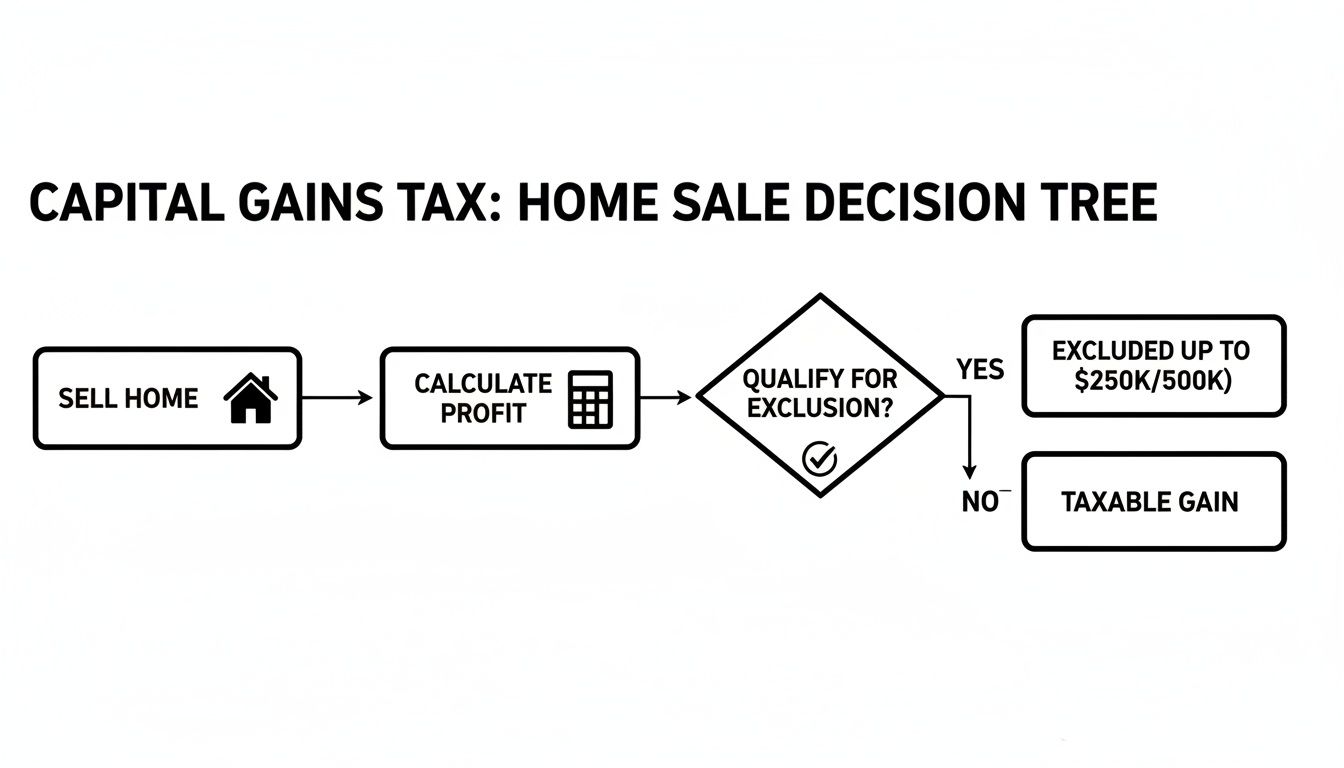
As you can see, right after you figure out your profit, the very next question is whether you qualify for this exclusion. It’s the core of your tax-saving strategy.
The Ownership Test Explained
First up is the Ownership Test. This one is pretty straightforward: you must have owned the home for at least two years (730 days) during the five-year period that ends on the day you sell.
The good news is that these two years don't have to be continuous. Let’s say you owned your Fresno home from 2018 to 2020, then decided to rent it out for three years before selling it in 2025. You’d still pass the test because you owned it for the first two years of that five-year window.
The Use Test Explained
Next on the list is the Use Test. This part is all about how you actually lived in the home. You must have lived in the property as your main home for at least two of the five years leading up to the sale. And just like the ownership rule, these two years don’t need to be back-to-back.
So, what counts as a "main home"? It’s simply the primary place you live. If you have a few properties, the IRS will look at things like where you're registered to vote, where your car is registered, and where you spend most of your time. That vacation spot you visit for a couple of months each year? That won't qualify.
The 2-out-of-5-Years Rule: At its heart, the rule for both tests is the same. You need to have owned the property and lived in it as your main home for a combined total of two years within the five-year period right before the sale.
This flexibility is a huge help. Maybe you lived in your home for a year, took a temporary work assignment out of town for another year, and then moved back in for a final year. You would still meet the two-year use requirement.
Navigating the Rules for Married Couples
For married couples filing taxes jointly, the rules are even more accommodating when aiming for that full $500,000 exclusion:
- Ownership: Only one spouse needs to pass the two-year Ownership Test.
- Use: Both spouses must meet the two-year Use Test.
- Look-Back: Neither you nor your spouse can have used this exclusion on another home sale in the two years just before this sale.
This means if you marry someone and they move into a house you've owned for years, you can sell fairly soon after and still potentially qualify for the bigger exclusion—as long as your new spouse also lives there long enough to meet their Use Test.
While these exclusion amounts have been the same since 1997, skyrocketing home values are pushing more and more sellers past these limits. A recent study revealed that 34% of homeowners already have enough equity to blow past the $250,000 single-filer exclusion. This is creating what some call a "capital gains cliff" for millions of people. You can dig deeper into how these outdated tax rules are impacting the market in research from the National Association of REALTORS®.
Passing these two tests is the first, and most critical, step toward managing your capital gains tax bill.
Calculating The Taxable Gain From Your Home Sale
Now that we’ve covered the basic rules, let's get down to the numbers. Figuring out your potential taxable gain isn't as scary as it sounds. It really just comes down to a simple formula, but the trick is knowing exactly which numbers to use.

At its heart, your gain is simply your home's final selling price minus your selling expenses and what's called your adjusted basis. Let’s unpack each piece of that puzzle.
Step 1 Start With Your Sale Price
This part is easy. Your starting point is the official price the buyer paid for your home. If you sold your Fresno property for $500,000, that’s your sale price. Simple as that.
Step 2 Subtract Your Allowable Selling Expenses
Here's some good news: you don’t get taxed on the gross sale price. The IRS lets you subtract a whole range of costs that are directly tied to selling your home. Tallying these up reduces your total gain, which can seriously lower or even completely wipe out your capital gains tax on a home sale.
Common deductible selling expenses include:
- Real estate agent commissions: This is usually the biggest single cost.
- Legal fees: Money paid to attorneys or transaction coordinators.
- Advertising costs: Any cash you spent marketing the property.
- Escrow and title insurance fees: These are standard closing costs.
- Staging costs: Expenses for a professional to make your home look its best for buyers.
These costs can add up fast. To get a better idea of what sellers in our area typically pay, you can use a seller closing costs calculator for California to see a more detailed breakdown for your specific situation.
Step 3 Figure Out Your Adjusted Basis
This is the step where many homeowners accidentally leave money on the table. Your "basis" is what the home originally cost you. But your adjusted basis is that initial price plus all the money you’ve put into major capital improvements over the years.
Think of it this way: your basis isn't set in stone. It grows every time you make a significant, value-adding upgrade to your property. This is a crucial distinction from routine repairs.
Key Distinction: A capital improvement adds lasting value, extends the home's life, or adapts it for a new use (like a kitchen remodel or a new roof). A repair just keeps the home in good working order (like fixing a leaky faucet or painting a room).
Only true capital improvements increase your basis, which in turn lowers your taxable gain. It’s absolutely vital to distinguish between the two.
Capital Improvements vs. Home Repairs
To help clear things up, here’s a quick comparison of what typically counts as a deductible capital improvement versus a non-deductible repair.
| Type of Expense | Examples | Effect on Tax Basis |
|---|---|---|
| Capital Improvement | New roof, kitchen/bath remodel, adding a deck, new HVAC system | Increases your basis |
| Home Repair | Fixing a broken window, painting a room, replacing a faucet | No effect on your basis |
Keeping good records of your improvements is one of the smartest things you can do as a homeowner. For more ideas, you might find a comprehensive guide to prioritizing home improvement projects helpful.
Putting It All Together A Practical Example
Let’s walk through a real-world scenario to see how this works. Imagine a married couple, the Garcias, who are selling their long-time home in Fresno.
Original Purchase Price: They bought their house back in 2010 for $250,000. This is their starting basis.
Capital Improvements: Over the years, they invested in several big upgrades and, importantly, they kept every single receipt.
- Kitchen Remodel: $40,000
- New Roof Installation: $15,000
- HVAC System Replacement: $10,000
- Total Improvements: $65,000
Calculate Adjusted Basis:
- Original Price ($250,000) + Improvements ($65,000) = $315,000 Adjusted Basis
Now, let's jump ahead to the sale.
Final Sale Price: They sell their home for $650,000.
Selling Expenses: Their total costs to sell, including agent commissions and closing fees, come out to $35,000.
Calculate the Total Gain:
- Sale Price ($650,000) – Adjusted Basis ($315,000) – Selling Expenses ($35,000) = $300,000 Total Gain
Finally, they see if they owe any tax.
- Determine the Taxable Gain:
- The Garcias are married and have easily met the ownership and use tests, so they can exclude up to $500,000 of their gain from taxes.
- Their total gain is $300,000, which is well under their $500,000 exclusion.
- Taxable Gain: $0
Because they carefully tracked their capital improvements, they were able to maximize their adjusted basis and show that their entire profit was covered by their tax-free exclusion. What could have been a messy tax situation became a clear, stress-free outcome.
Special Circumstances That Can Change Everything
Life rarely sticks to a simple script, and the tax code has all sorts of special rules to account for that. While the basic ownership and use tests cover most home sales, some situations can completely change the math on your tax bill.
These exceptions are absolutely critical to understand, especially when you’re navigating big life events like an inheritance, a divorce, or the sale of a property that was once a rental. Let’s break down a few of the most common scenarios that can affect the capital gains tax on your home sale.
Selling an Inherited Home
Inheriting a property is always an emotional process, but the tax rules offer a surprisingly helpful silver lining. When you inherit a home, you benefit from what’s called a “stepped-up basis.”
What is a Stepped-Up Basis?
Instead of using the original purchase price as your cost basis, the property’s value gets a fresh start. It’s "stepped up" to its fair market value on the date the original owner passed away. This one rule can dramatically reduce—or even completely eliminate—your capital gains tax.
Here’s a real-world example: Say your parents bought their home for $100,000 decades ago. When you inherited it, the home was appraised at $600,000. That $600,000 is now your new cost basis.
If you decide to sell it quickly for $610,000, your taxable gain is only $10,000—not a massive $510,000! This provides huge relief for heirs. Getting this right is key, and you can dive deeper into the process in our guide on how to sell inherited property.
Navigating Divorce and Home Sales
When a home is sold during a divorce, the tax rules are built to be flexible and fair. If one spouse transfers the home to the other as part of the settlement, there’s no tax event at that moment. The spouse who keeps the house also keeps the original cost basis.
Things change when the house is sold to a new buyer. In that case, both ex-spouses can often each claim their own $250,000 exclusion, adding up to a potential $500,000 tax-free gain, as long as they both meet the use test. The rules for the ownership test are also flexible, often accommodating the spouse who moved out but still has an ownership stake.
The Rules for Former Rental Properties
The tax situation gets a lot more complex if the property was ever used as a rental, even if it was your main home at one point. Two important concepts you need to know are depreciation recapture and 1031 exchanges.
Depreciation Recapture: When you owned the property as a rental, you probably took depreciation deductions on your taxes each year. The IRS wants that money back when you sell. You’ll have to "recapture" that depreciation, which is taxed separately from your capital gains, usually at a maximum rate of 25%.
1031 Exchanges: You may have heard of a 1031 exchange, which lets investors defer capital gains by rolling the proceeds from one investment property into another. It’s a powerful strategy, but it’s strictly for investment properties—you can’t use it on the sale of your primary residence.
How a country taxes real estate gains can say a lot about its market. In Japan, for instance, capital gains tax on real estate can climb as high as 39.63%. That kind of steep tax rate heavily influences selling decisions and is a major reason why short-term flipping isn't common there. It’s just another reminder of why understanding both federal and local rules is so important.
Actionable Strategies to Minimize Your Tax Bill
Knowing the rules is half the battle. Putting them into practice to legally protect your profit is where the real magic happens. With a bit of proactive planning, you can dramatically shrink—or even completely wipe out—your capital gains tax on home sale.
The simplest yet most powerful strategy is all about timing your sale. I’ve seen homeowners rush to sell just a few weeks too early and end up losing thousands of dollars. Before you even think about listing, pull out a calendar and confirm you’ve hit both the two-year ownership and use tests. Waiting just a little longer to cross that 730-day finish line could be the difference between a huge tax bill and owing absolutely nothing.
Meticulously Track Your Capital Improvements
Another fantastic way to lower your tax burden is by boosting your home's adjusted basis. Think of it this way: every dollar you add to your basis is a dollar of profit the IRS can’t touch. This is where becoming a meticulous record-keeper really pays off.
From the day you get the keys, start a "home improvement file." Keep every single receipt, contract, and permit for major upgrades.
- Kitchen or Bathroom Remodels: These are huge basis boosters.
- New Roof or HVAC System: Major system replacements add serious value.
- Room Additions or Deck Installations: Anything that expands your usable living space is a win.
- Major Landscaping Projects: Significant overhauls to your yard can also count.
Your adjusted basis is essentially the running total of your real investment in the property. The higher you can push that number, the lower your taxable gain will be.
Pro Tip: It's crucial to know the difference between a repair and an improvement. Patching a leaky pipe is a repair; it doesn't increase your basis. Replacing the entire plumbing system? That's an improvement, and it absolutely does.
Understand the Partial Exclusion of Gain
What happens if life throws you a curveball and you have to sell before hitting that two-year mark? Fortunately, the IRS has a safety net for certain unforeseen circumstances. If a job change, health crisis, or another qualifying event forces you to move, you might still be eligible for a partial exclusion.
Instead of the full $250,000/$500,000 exclusion, you get a prorated amount based on how long you were in the home. For instance, say you lived there for one year (50% of the two-year requirement) before a mandatory job relocation. You could potentially exclude up to 50% of the maximum—that’s $125,000 for a single filer or $250,000 for a married couple.
This rule offers critical relief when you have to sell unexpectedly. It’s not the full exclusion, but it can still make a massive difference in your tax outcome.
For those of you with investment properties, another powerful tool for deferring taxes is a 1031 exchange, although its application for personal homes has become more limited. You can dive deeper into how this works by reading about the specifics of a 1031 exchange on our blog.
How to Report Your Home Sale for Tax Purposes

You've calculated your gain and figured out your exclusion. Now for the final step: telling the IRS and the state of California what happened. Getting the paperwork right is the key to a stress-free tax season, and it's honestly more straightforward than most people fear.
Here’s a common point of confusion: even if you owe $0 in tax because your profit falls entirely within the exclusion, you might still have to report the sale. The big trigger is whether you receive a Form 1099-S, Proceeds From Real Estate Transactions, from the escrow company or closing agent.
If that form lands in your mailbox, you have to report the sale on your tax return, no matter what. You'll typically get a 1099-S if you don't meet every single requirement for the full exclusion or if you didn’t certify this to the real estate professional at closing.
The Key Federal Tax Forms
When it's time to report, you'll be working with two main forms to detail your capital gains tax on a home sale. Think of them as a team—one shows the work, and the other shows the final answer.
- Form 8949, Sales and Other Dispositions of Capital Assets: This is where you lay out all the details. You’ll list when you bought and sold the home, the final sale price, and your calculated cost basis.
- Schedule D, Capital Gains and Losses: The totals from Form 8949 get transferred right over to Schedule D. This form summarizes all your capital gains and losses for the year into one neat number.
Basically, Form 8949 is your detailed worksheet, and Schedule D is the summary page that gets attached to your main tax return. To keep things accurate and compliant, an AI Tax Document Analyzer can be a helpful tool for understanding and preparing these forms.
State Reporting Requirements for California Sellers
Here in California, things are a little different. The California Franchise Tax Board (FTB) doesn't have a special, lower tax rate for capital gains like the IRS does.
Instead, your profit from a home sale is treated just like regular income. It gets added to your other earnings and is taxed at your standard state income tax rate, which can climb as high as 13.3%.
This makes it absolutely critical to get your adjusted basis right and claim every penny of the federal exclusion you're entitled to. The goal is to lower your overall taxable income as much as possible.
Your Document Checklist for a Smooth Filing
Want to make tax time easier? Get organized ahead of schedule. Gathering all your documents beforehand saves you from that last-minute scramble and ensures you don’t overlook any important details.
Here’s what you’ll want to have on hand:
- Final Closing Statement (HUD-1): This document shows the final sale price and lists many of your selling expenses.
- Original Purchase Documents: These are essential for establishing your initial cost basis.
- Records of Selling Expenses: Pull together receipts for agent commissions, legal fees, and staging costs.
- Proof of Capital Improvements: This is your detailed list of all major upgrades (with receipts!) that increased your basis.
- Form 1099-S: If you received one, have it ready.
With this paperwork in order, you or your tax professional will have everything needed to report your home sale accurately and put your tax obligations to bed.
Common Questions About Home Sale Taxes
Even after you've got the basics down, you're bound to have questions when it's time to apply these tax rules to your own sale. Let's tackle some of the most common scenarios we see.
Can I Deduct Losses on a Home Sale?
This is a frequent question, but unfortunately, the answer is no. If you sell your main home for less than what you've put into it (your adjusted basis), the IRS won't let you deduct that loss on your tax return.
They view it as a personal loss, not a business or investment one. It's a tough pill to swallow, but it’s a hard and fast rule for primary residences.
What if I Lived in My Home for Less Than Two Years?
Life happens. Sometimes a job change, health issue, or another unexpected event forces you to sell sooner than planned. If you have to sell before hitting that two-year mark, you might still catch a break.
The IRS allows for a partial exclusion in these specific "unforeseen circumstances."
You basically get a prorated tax break. For instance, if you lived in the home for 18 months—that’s 75% of the two-year requirement—you could exclude up to 75% of the full amount. For a single person, that comes out to a healthy $187,500 exclusion.
How Do Gifts or Inheritances Affect My Basis?
How you got the house in the first place makes a huge difference in your tax calculation down the road. The rules for gifts and inheritances are completely different.
- Inherited Property: When you inherit a home, you get what’s called a "stepped-up basis." This is great news for you. Your basis becomes the home's fair market value on the date the original owner passed away, which often erases years of potential gains.
- Gifted Property: If you're given a home, you usually inherit the original owner's adjusted basis. If they paid $100,000 for it years ago, your starting basis is also $100,000, no matter what the home was worth when they handed you the keys.
Getting this right is absolutely critical for figuring out your potential tax bill when you decide to sell.
Navigating these specific scenarios requires careful planning and local expertise. At Edinhart Realty and Property Management, we help Fresno and Clovis homeowners understand every aspect of the selling process to ensure a smooth, profitable transaction. Contact us today to learn how we can help you.


