

You're probably in one of two positions right now. Either you've looked at coastal California pricing and decided the numbers no longer make sense, or you own property in the Central Valley and want to know whether “prime” means something more useful than expensive finishes and a good ZIP code.
That's the right question.
In practice, California Prime Properties is an interesting phrase because it can mean two very different things. It can describe a long-established Modesto-area property management firm that says it has served Modesto and surrounding areas since the 1960s on its company website, and it can also describe the broader idea of what a prime California investment property really is. For investors, the second meaning matters more. Prime isn't just luxury. Prime is strategic value.
That distinction matters most in Central California. In Fresno, Clovis, Friant, and the surrounding region, some of the strongest opportunities don't look “prime” in the glossy coastal sense. They look stable, rentable, well-located, operationally manageable, and positioned for demand that comes from real household budgets rather than trophy-buyer emotion.
What Truly Defines a Prime Property in California
A prime property isn't automatically a mansion on the coast, a penthouse in a marquee city, or anything with a premium list price. Investors get in trouble when they confuse high cost with high quality income potential.
A better definition starts with utility. Prime property is the asset that holds up under pressure. It leases faster because the location works for actual residents. It costs less to keep in service because the construction and layout make sense. It attracts a broader pool of qualified tenants or buyers because the product matches the market.
Prime starts with function, not prestige
The old coastal definition of prime came from scarcity and status. That still matters in some submarkets, but it's incomplete. In California, a strategic investor should test a property against five questions:
Does the location solve a real daily need?
Near jobs, schools, shopping, transportation routes, or medical services usually beats purely cosmetic prestige.Is the asset physically durable?
Roof age, systems, deferred maintenance, floorplan efficiency, and parking matter more than designer finishes that age poorly.Can the property compete for renters or buyers without heroic marketing?
If a listing only works when everything is perfect, it isn't prime. It's fragile.Will ownership stay manageable?
Hard-to-maintain lots, unusual construction, and chronic repair patterns can crush returns even when headline rent looks fine.Does the property fit its local market?
The best house on the block isn't always the best investment.
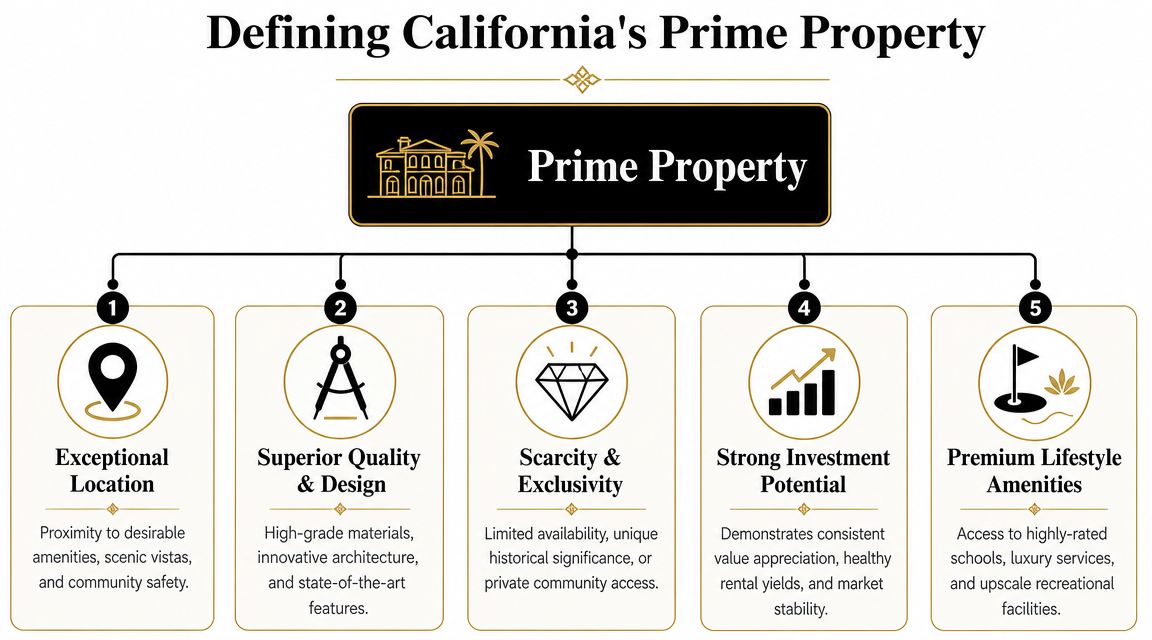
The three filters investors should use
A practical way to evaluate prime property is to run every deal through three filters.
| Filter | What to check | Why it matters |
|---|---|---|
| Location quality | Access, neighborhood stability, demand drivers | A good location protects occupancy and resale options |
| Asset quality | Condition, layout, maintenance history | Better assets produce fewer expensive surprises |
| Financial quality | Net income potential, turnover risk, ownership costs | Gross rent alone doesn't tell you whether the property works |
Practical rule: If a property needs rent growth, perfect tenants, and low repair activity just to pencil out, it isn't prime. It's speculative.
Prime in Central California looks different
That's where many investors miss the opening. In Fresno and the surrounding Valley, a prime property often means a clean house in a dependable neighborhood, a sensible multifamily asset, or a rental with strong day-to-day livability. It may not win on glamour. It can still win on operating performance.
This is also why broad checklists help more than hype. If you want a useful framework for screening rentals, this guide on what makes a good rental property is a solid companion to the prime-property lens.
The point is simple. In California, prime should be defined by resilience, rentability, and long-term usefulness. Once you start looking at property that way, Central California stops looking secondary and starts looking early.
Uncovering California's Emerging Prime Market Hotspots
Coastal California still gets most of the attention. That's understandable. Those markets have name recognition, long-established prestige, and a permanent place in the state's housing narrative.
But attention isn't the same thing as opportunity.
When investors say a market is “prime,” they often mean it's already been discovered, heavily competed over, and priced with little room for operational mistakes. That's one version of prime. The more attractive version for many owners is emerging prime. Markets where demand is durable, acquisition logic is still grounded, and the asset can perform without needing luxury-buyer psychology.

Why the Central Valley deserves a harder look
Fresno, Clovis, and Friant fit that emerging-prime profile better than many investors realize. These areas attract buyers and renters who care about space, practicality, school access, commute patterns, and relative value. That demand base is often steadier than markets driven mostly by image.
The Central Valley also rewards operators who know the block-by-block differences. A property can look comparable on paper and perform differently in the field because tenant profile, turnover timing, and neighborhood expectations vary more than out-of-area investors expect.
That's why local specialization matters. Directory data on California Prime Properties places the firm in Modesto's 95355 ZIP code and among real-estate-related activities, reinforcing how dedicated local firms anchor themselves in specific communities instead of trying to act like statewide platforms. That kind of neighborhood knowledge matters in markets like Modesto and Fresno, where rent levels, vacancy cycles, and tenant profiles differ substantially from coastal California, as reflected in the Dun & Bradstreet business profile.
What emerging prime looks like on the ground
In the Valley, strong opportunities usually share a few traits:
- Bread-and-butter housing demand that isn't dependent on luxury absorption
- Neighborhoods with stable owner and renter appeal, not one-season momentum
- Homes with usable layouts instead of over-improvement
- Manageable operating complexity for investors who care about cash discipline
- Multiple exit paths, whether that means holding, refinancing, or selling to owner-occupants later
Prime in Central California often means a property ordinary households can realistically afford, qualify for, and stay in.
Fresno, Clovis, and Friant as an investor map
These submarkets don't all serve the same strategy. Fresno offers range and scale. Clovis often attracts buyers and tenants looking for a more defined suburban profile. Friant can appeal to owners targeting a different lifestyle mix and a narrower but distinct demand base.
That variety matters because investors shouldn't treat the Central Valley as one big interchangeable market. The key advantage comes from matching asset type to submarket behavior. A rental that performs well in one area may feel overpriced, under-amenitized, or mismatched in another.
For investors priced out of coastal competition, this is the key reframing. “Prime” doesn't have to mean legacy luxury. In Central California, it can mean buying where the fundamentals still have room to work.
The Investor's Toolkit for Valuing Prime Properties
A property's financial story usually gets distorted at the listing stage. Gross rent gets highlighted. The nicest photos get pushed to the top. Repair risk, management drag, and downtime get buried.
That's why serious investors need a simple toolkit. Not complicated spreadsheets first. Just the right sequence of questions.
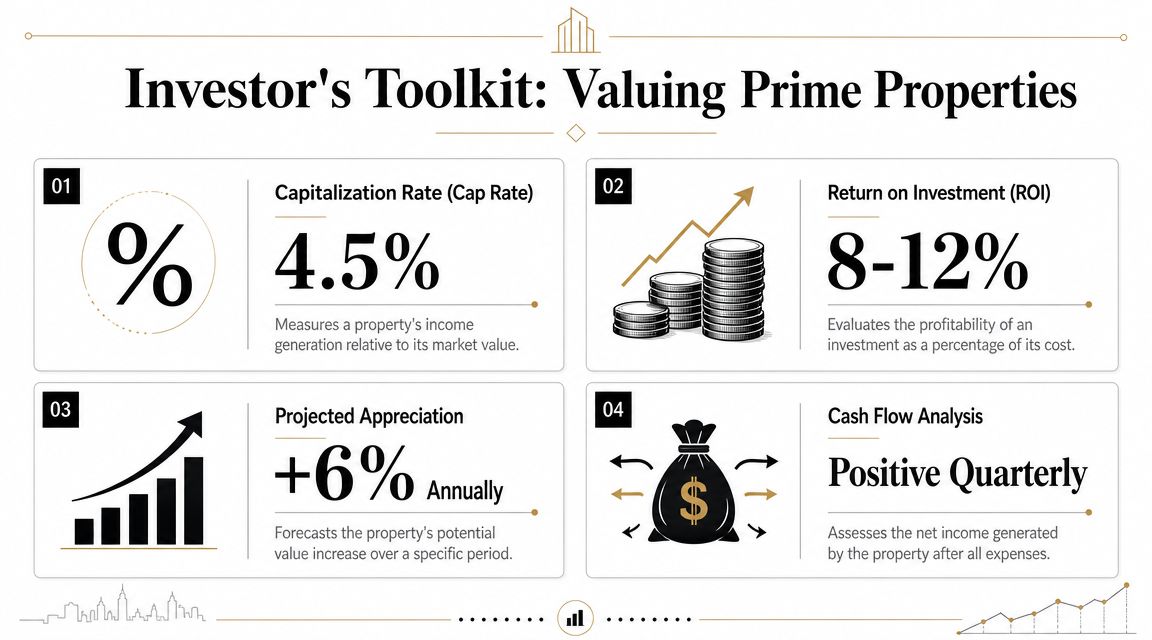
Start with net, not gross
The most useful question is not “What will it rent for?” It's “What will it leave after the costs of ownership?”
A public property-management page tied to this topic puts the issue plainly: owners need to understand net yield after all costs, not just gross rent, because California's operating environment can turn a strong asking rent into a weak return once repairs, vacancy, insurance, and compliance costs are counted, as noted in this discussion of net yield versus gross rent.
That's the right lens.
Here's the working order I use when reviewing an income property:
Estimate realistic income
Not best-case rent. Market-supported rent.Subtract predictable operating costs
Maintenance, turnover exposure, insurance, and management need to be treated as normal, not optional.Stress test vacancy and repairs
If one turnover wrecks the year, the deal is too thin.Check financing impact separately
Don't let loan structure hide a weak asset.
A deeper calculator-based approach helps too. If you want a practical companion for that analysis, use this guide on how to calculate rental property value.
Know the language, but keep it practical
You don't need to turn every deal review into a finance seminar. You do need to know what the common terms tell you.
| Metric | What it helps answer |
|---|---|
| NOI | What the property earns before debt service |
| Cap rate | How the asset performs relative to price |
| Cash-on-cash return | How your invested cash is working |
| Cash flow | Whether the property is actually supporting ownership month to month |
The labels matter less than the discipline behind them. If you skip operating assumptions, every metric looks better than reality.
Before you finalize numbers, it's smart to get expert guidance on property potential assessment from Domicile Construction Inc. A contractor's pre-purchase assessment can expose layout limitations, hidden repair scope, and renovation costs that a spreadsheet won't catch.
For a visual walk-through of valuation thinking, this video is a useful break from static formulas:
The cleanest-looking property on paper can be the weakest investment if the expense side has been sanitized.
What works and what doesn't
What works is disciplined underwriting, conservative assumptions, and a willingness to walk away from properties that need perfect execution.
What doesn't work is buying off listing emotion, projecting rent first and reality later, or assuming all California appreciation stories justify thin current performance.
In emerging prime markets, the investor advantage usually comes from seeing ordinary assets more clearly than everyone else.
Strategic Pathways Buying Selling and Renting
Owners usually approach California property from one of three positions. They want to buy, they want to sell, or they want to hold and rent. Each path demands a different kind of discipline.
Buying with an investor mindset
Buyers need to separate “good house” from “good acquisition.” A property can be attractive and still fail as an investment if the neighborhood ceiling is low, the maintenance burden is high, or the expected tenant base is too narrow.
A practical buyer screen looks like this:
- Check the exit options. Can you sell later to both investors and owner-occupants?
- Test the floorplan. Awkward layouts reduce appeal faster than cosmetic issues.
- Review the maintenance profile. Old systems and deferred repairs can overwhelm early returns.
- Look at neighborhood fit. The asset should match what local renters or buyers already want.
Selling for maximum value
Sellers need a different playbook. The goal isn't just listing. It's packaging.
That means presenting the property so buyers can understand it quickly and trust the condition story. Strong photography, smart staging, realistic pricing, and clear disclosure preparation usually do more than vague “upgrades” that don't match the neighborhood. In many Central Valley markets, over-improving right before sale doesn't pay back the way sellers hope.
Clean presentation, credible pricing, and a short repair list usually outperform flashy but mismatched renovations.
Renting as an operating business
Landlords face the sharpest decision of the three. They must choose between self-management and professional support.
| Path | Best fit | Main risk |
|---|---|---|
| Self-management | Owners with time, local presence, and process discipline | Delayed response, inconsistent screening, compliance mistakes |
| Professional management | Owners who value systems, documentation, and distance management | Added operating cost if the service isn't well matched |
Hands-on management can work. It usually works best when the owner has a small portfolio, lives nearby, and treats tenant communication, accounting, and maintenance coordination like a real operating function.
Professional support tends to make more sense when the owner is remote, scaling, or trying to protect time and consistency. The right answer depends less on ideology and more on whether the property is being run with repeatable standards.
Navigating California's Complex Real Estate Regulations
California rewards operators who stay organized. It punishes owners who improvise.
That's especially true in screening, leasing, disclosures, habitability issues, and transaction risk. Many owners can handle the day-to-day mechanics of rent collection. Fewer can keep up with documentation standards, fair-housing boundaries, changing forms, and the practical consequences of one mistake made at the wrong moment.
Where owners usually underestimate risk
The biggest compliance mistakes often start with good intentions. An owner wants a reliable tenant, moves quickly, asks for “extra” proof, applies an unwritten rule inconsistently, or handles a complicated application informally.
That's where trouble starts.
A verified public note relevant to California Prime Properties highlights why transparent tenant qualification matters. While a 2.5x income-to-rent rule can serve as a strong baseline, a professional process also has to explain how applicants with nontraditional income, vouchers, or multiple roommates are handled while maintaining fair-housing compliance, as discussed on the company's contact-related public information.
That principle applies statewide. A rule is only safe if it's documented, consistently applied, and compliant.
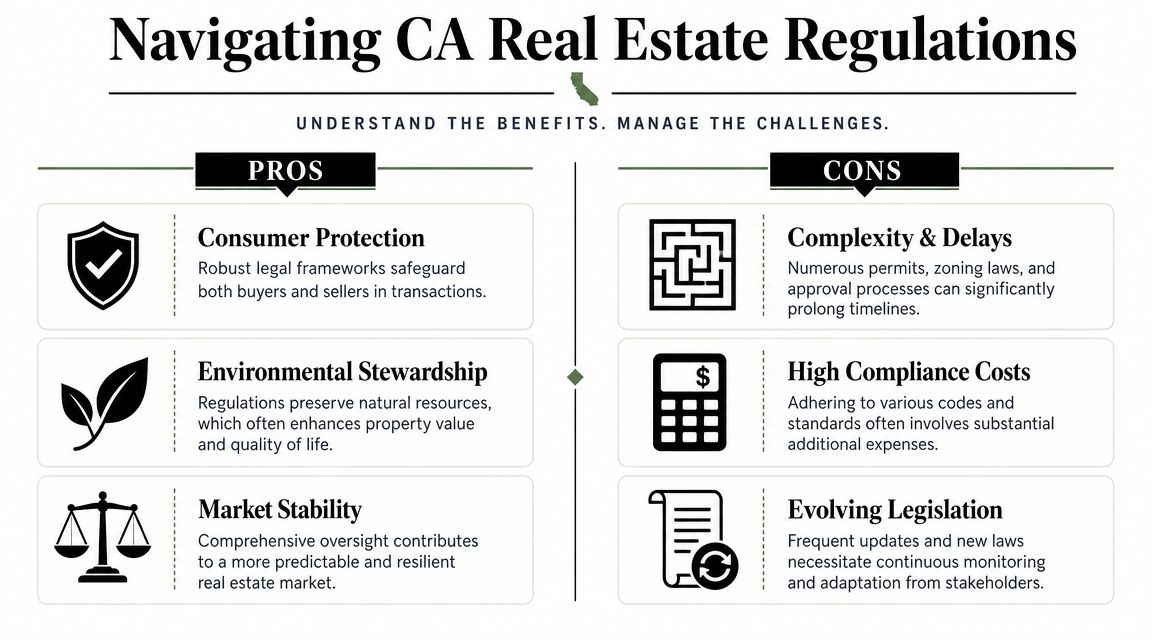
Regulations create both protection and friction
There's a reason California attracts both caution and frustration from investors.
- Consumer safeguards can reduce abuse and improve transaction clarity
- Environmental and disclosure rules can preserve long-term property quality
- Oversight can make the market more structured
But owners also face:
- Longer process timelines
- More documentation
- Higher compliance costs
- Constant need to stay current
That last point matters in acquisitions too. During purchase, title review is one of the least glamorous but most protective parts of the process. Buyers who want a plain-English refresher can use 24hourEDU's title insurance resource to understand what title insurance does and why it matters before closing.
Compliance isn't just legal overhead. It's operational risk control.
Why DIY breaks down
Self-management usually fails at the edges. Not in the easy month when the tenant pays on time. In the month when income documentation is irregular, maintenance turns into a habitability issue, or a notice needs to be correct the first time.
One poorly handled screening decision, one bad file, or one missing disclosure can wipe out the margin owners thought they had. In California, that's reason enough to treat procedure as part of the investment itself, not an afterthought.
Partnering for Success with Edinhart Realty and Property Management
Investors don't need more slogans about California real estate. They need a repeatable operating model.
That model has to do four things well. It has to identify the right asset, price risk accurately, screen tenants with discipline, and keep the property running without chaos. Most ownership problems come from weakness in one of those four areas, not from the original purchase thesis.
Matching service model to owner type
A local operating partner can make sense, especially in Fresno, Clovis, Friant, and the broader Central California region. Edinhart Realty and Property Management offers two management structures rather than forcing every owner into the same setup: a full-service monthly management model for owners who want ongoing coordination, and a placement-only option for owners who want professional marketing, applicant screening, and lease drafting but prefer to handle the property afterward. Those service details are outlined on its Fresno property management page.
That split matters.
Some owners need full operational support because they're out of town, short on time, or managing multiple units. Others are capable self-managers but still want a stronger front-end leasing process. A firm that recognizes that difference is usually more useful than one that treats all owners the same.
What disciplined management actually looks like
A good management process isn't mysterious. It's structured.
Based on the publisher information provided, the functional pieces include:
- Professional marketing with strong photography and presentation
- Applicant screening and lease drafting
- Rent collection systems and accounting statements
- Repair coordination and tenant communication
- Move-in, move-out, and lease-renewal handling
That kind of system matters because prime investing in Central California is often won through execution, not novelty. The property doesn't need to be glamorous. It needs to stay occupied by qualified tenants, be maintained without drift, and produce reporting an owner can use.
Screening is where many returns are protected
The front end of management is where a lot of ownership outcomes are decided. A weak screening process can create months of downstream issues. A rigorous one can protect both occupancy standards and income stability.
Relevant public information tied to California Prime Properties shows a baseline qualification standard of verifiable monthly gross income of at least 2.5 times the rent, presented as part of the application FAQ on the published screening criteria page. As a management principle, that's a useful benchmark because it ties tenant qualification to documented affordability instead of guesswork.
For landlords, that kind of discipline tends to work better than casual screening, inconsistent exceptions, or decisions made under vacancy pressure.
The best management systems reduce avoidable drama. They don't eliminate risk, but they keep small issues from becoming expensive ones.
Why this matters in emerging prime markets
Central California rewards local judgment. The best opportunities often aren't obvious from a statewide dashboard. They're the homes and rental properties that fit their submarket, attract stable demand, and can be operated with consistency.
That's also why the phrase California Prime Properties is worth reframing. Prime doesn't have to mean coastal luxury or prestige branding. In Fresno and the surrounding region, prime often means strategic positioning, realistic underwriting, and management that respects compliance, tenant quality, and long-term asset condition.
Owners who approach the Valley with that mindset usually make better decisions. They buy more carefully, renovate more selectively, screen more consistently, and hold with clearer expectations. That's how emerging-prime property becomes real investment value instead of just marketing language.
If you own a home, rental, or investment property in Central California and want a clearer plan for buying, leasing, selling, or management, Edinhart Realty and Property Management offers local real estate and property management services across Fresno, Clovis, Friant, and the surrounding region.


