

A lot of Fresno and Clovis owners hit the same wall at the same moment. A tenant gives notice, the property needs to be turned fast, and suddenly you're hunting for a lease, an application, a move-out form, and the right disclosures. If you grab a random template online, you may get a document that looks professional but misses something California law expects you to handle clearly.
That's where California Association of Realtors forms matter. In day-to-day Central Valley property management, they're the working documents brokers, agents, and many serious landlords rely on because they're built for California transactions, not for some generic national audience. In practice, that means less guesswork, cleaner files, and fewer preventable disputes over deposits, repairs, disclosures, and agency duties.
Navigating Fresno Real Estate with Confidence
A Fresno landlord gets the call on a Monday. The resident is leaving sooner than expected. Showings need to start right away, repair vendors need access, and new applications are already coming in from prospects with different income sources, pets, and occupancy questions.
The pressure is not the problem. Sloppy paperwork is.
An incomplete application makes a screening decision harder to justify later. Loose lease terms create avoidable disputes over repairs, utilities, yard care, and possession. Poor move-out documentation turns a routine security deposit itemization into a demand letter or small claims problem.
California Association of Realtors forms give Fresno and Central Valley owners a usable structure for those moments. They are the standard forms many California brokers, agents, and property managers work from because they are built around California practice, statewide disclosures, and the way real files are reviewed after a dispute.
That matters in this market. Fresno-area owners are often dealing with older homes, deferred maintenance, accessory dwelling units, rural parcels, or out-of-area investors who need clear documentation from day one. A form set that handles the transaction cleanly helps the owner, the manager, and the next professional who touches the file.
Practical rule: The right form will not rescue a poor decision. It will document a sound decision clearly enough to enforce it.
I see the same issue across Fresno, Clovis, and nearby Central Valley submarkets. Owners often focus on rent amount first and paperwork second. In practice, the form package is what controls the details that usually trigger conflict later, entry notices, maintenance responsibility, habitability questions, deposit deductions, and disclosure language. If those terms are unclear at the start, the problem usually gets more expensive at turnover, during a repair dispute, or when the property goes up for sale.
Why CAR Forms Are Essential for Fresno Landlords
Generic templates usually fail in one of two ways. They're too thin, or they're too broad. A thin template leaves out terms you should have nailed down at the start. An overly broad one throws in language that doesn't fit California practice and creates a false sense of protection.
They create a cleaner legal baseline
CAR forms are built for California use and updated as legal and practice standards change. That's the main difference. A downloadable lease from a random website may look fine until you try to enforce it after a dispute over notice, possession, deposits, alterations, or habitability responsibilities.
For Fresno landlords, a clean baseline matters because local inventory is mixed. You may be renting a newer home in north Clovis, an older house near Fresno High, a rural property with extra land, or a small investment with deferred maintenance. The paperwork has to fit the property and the relationship without drifting into homemade legal drafting.
They standardize expectations
A standardized form helps everyone read from the same page. Owners know where to find the rent terms. Tenants know where pet rules, maintenance duties, and occupancy limits are stated. Agents, brokers, and transaction coordinators can review the file faster because the layout is familiar.
That familiarity saves time in real operations:
- Tenant screening: You can compare applications consistently.
- Turnover coordination: Move-in and move-out documentation stays organized.
- Sales crossover: If you later list the property, your existing file is easier to review for disclosures and occupancy details.
They reduce avoidable risk
Risk in property management often comes from omissions, not dramatic mistakes. A missing advisory. A skipped signature. An outdated clause. A custom addendum that sounded reasonable when written but creates ambiguity later.
The strongest file is usually the one that leaves the least room for interpretation.
That's why serious landlords don't treat forms as paperwork clutter. They treat them as operating controls. In California, that mindset is much closer to professional asset management than to casual landlording.
Quick Reference Guide to Essential CAR Forms
When owners ask about California Association Realtors forms, they usually don't need a law lecture. They need to know which document handles which task. The table below is the practical starting point.
Common CAR forms for Fresno property owners
| Category | Form Acronym | Full Form Name | Primary Use |
|---|---|---|---|
| Rental and Leasing | LR | Residential Lease or Month-to-Month Rental Agreement | Sets core tenancy terms, rent, deposits, maintenance, rules, and occupancy |
| Rental and Leasing | LRA | Application to Rent | Collects applicant information for screening and qualification review |
| Rental and Leasing | MIMO | Move-In Move-Out Inspection Form | Documents property condition to support turnover records and deposit handling |
| Purchase and Sale | RPA | Residential Purchase Agreement | Establishes the purchase contract terms for residential sales |
| Disclosures | TDS | Transfer Disclosure Statement | Used for seller disclosures about property condition |
| Disclosures | SPQ | Seller Property Questionnaire | Expands on seller knowledge about the property and known issues |
| Property Management | PMA | Property Management Agreement | Defines the relationship, authority, and duties between owner and manager |
| Advisory | NSFA | Use of Non-Standard Forms Advisory | Required when a non-CAR form is introduced into the transaction |
Statewide forms versus local forms
Most Fresno and Central Valley owners will be dealing with statewide CAR forms, not local Bay Area sets. That matters because owners sometimes hear about another form package from San Jose, Palo Alto, or the Peninsula and assume it's interchangeable.
It usually isn't. CAR forms are the common working set across most of the state. In practical terms, if you're operating rentals or sales in Fresno, Clovis, Friant, Madera, or nearby Central California markets, CAR forms are the documents most professionals expect to see.
A basic understanding is this:
- CAR forms fit most statewide residential transactions.
- Local forms may supplement or replace them in specific regions.
- Custom forms need special caution and, in some cases, an additional advisory.
Deep Dive Into Rental and Lease Forms
The forms that matter most to a Fresno landlord are the ones used before move-in, during occupancy, and at turnover. Those are the forms that shape your relationship with the tenant and determine whether a dispute stays small or becomes expensive.
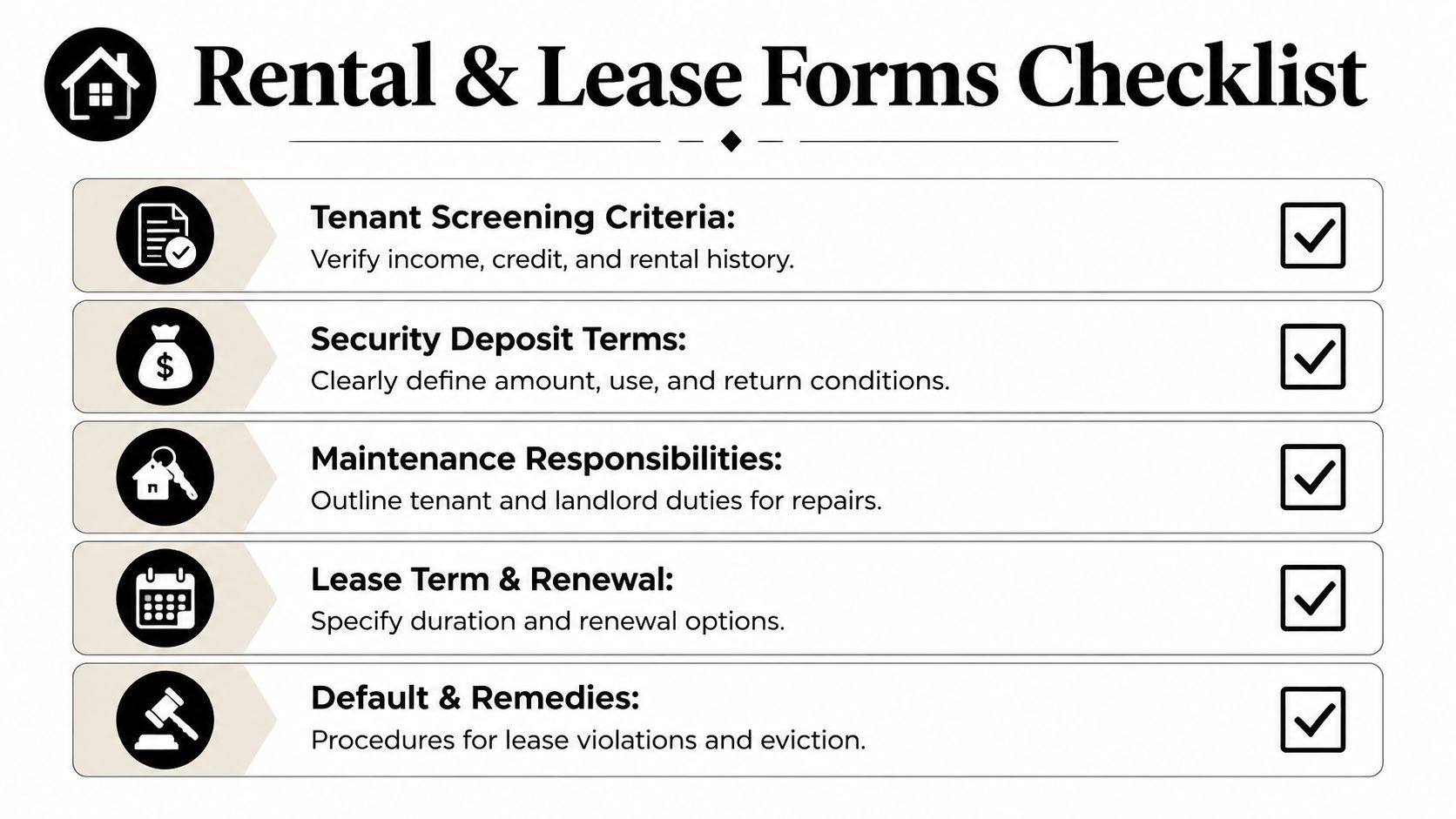
The LR form is where most landlord mistakes start or stop
The LR, or Residential Lease or Month-to-Month Rental Agreement, is the backbone. If it's filled out casually, the file gets weak fast. If it's completed carefully, most routine disputes become manageable because the expectations were stated upfront.
Pay close attention to these areas:
- Rent terms: State the amount, due date, acceptable payment methods, and any late-charge language exactly as intended. If your actual collection practice differs from the written lease, you're creating confusion.
- Security deposit language: Be clear about what the deposit is for and how damages, cleaning, keys, or unpaid obligations will be handled within lawful limits.
- Maintenance responsibilities: Spell out who handles yard care, filter changes, reporting of leaks, and tenant-caused damage. Fresno summers put real stress on HVAC systems, and unclear maintenance language invites finger-pointing.
- Occupancy and use: If the property has garages, sheds, side yards, or detached structures, don't assume shared understanding. State what is and isn't included.
- Rules and default provisions: Noise, pets, unauthorized occupants, and smoking are common flashpoints. Vague house rules are hard to enforce later.
If you need a starting point for comparing structure and terminology, this rental lease agreement template guide is useful for seeing how the major lease components are typically organized.
The LRA needs consistency, not improvisation
The LRA, or Application to Rent, is where screening begins. The biggest practical issue isn't just collecting information. It's applying your standards consistently and documenting your process.
A strong application review focuses on verifiable items such as income, rental history, identity, and authorization to run screening checks. What doesn't work is changing standards from applicant to applicant because a showing went well or someone seemed trustworthy in person.
Good screening files don't rely on memory. They rely on complete applications and consistent criteria.
MIMO protects you at turnover
The MIMO, or Move-In Move-Out form, is one of the most underrated documents in residential management. It creates a condition record that you can compare later if a tenant disputes cleaning charges, damage claims, or missing items.
For Central Valley owners, this form is especially useful because turnover issues often involve practical wear items:
| Common turnover issue | Why MIMO helps |
|---|---|
| Wall marks and nail holes | It separates prior condition from new damage |
| Landscaping decline | It clarifies whether exterior condition changed during tenancy |
| Appliance condition | It documents whether items were functional and present at possession |
| Garage or storage contents | It shows what areas were delivered empty or occupied |
Without a detailed move-in record, deposit disputes often become your word against the tenant's.
Navigating Purchase Agreements and Disclosures
Investors in Fresno often move between rental ownership and resale. A house that worked as a rental for years may be sold to an owner-occupant. A buyer may purchase a single-family home intending to hold it as a long-term rental. In both cases, the paperwork has to do more than close the deal. It has to allocate risk.
The RPA controls the transaction timeline
The RPA, or Residential Purchase Agreement, is the center of the sale file. The most important parts aren't the headline terms alone. Key pressure points are contingencies, deadlines, and performance obligations.
Three areas deserve close reading:
- Inspection contingencies: These define how and when the buyer investigates the property.
- Appraisal and loan contingencies: These matter if financing or value comes into question.
- Contract timelines: A missed date can weaken one's bargaining position or create unnecessary conflict.
In Fresno-area transactions, I see problems when parties agree casually in conversation but fail to capture that agreement properly in writing. If a buyer expects repairs, credits, personal property, or occupancy arrangements after closing, those terms need to be documented precisely.
Disclosures are where many sellers get into trouble
The TDS and SPQ are critical because sellers often underestimate what they need to disclose. Owners don't have to diagnose every issue like a contractor or engineer. They do need to disclose what they know.
For Central Valley properties, that can include facts tied to the property's actual condition and setting, such as:
- Water systems: Private wells, water pressure issues, or known water-quality concerns
- Waste systems: Septic location, backups, repairs, or maintenance history
- Agricultural surroundings: Nearby farming activity, dust, odors, or spraying concerns if known
- Past repairs: Roof leaks, plumbing failures, electrical work, or foundation cracking the owner is aware of
A seller usually gets in more trouble by minimizing a known issue than by disclosing it plainly.
Local conditions shape what buyers ask about
A Fresno buyer may care less about a basement and more about HVAC age, irrigation setup, roof heat exposure, drainage after heavy rain, or whether a detached structure was finished with permits. Rural-edge properties raise even more questions. Access roads, fencing, barns, propane, septic, and shared easements all deserve closer review.
Here's a practical distinction:
| Document | Main purpose | Common mistake |
|---|---|---|
| RPA | Sets the deal terms and deadlines | Parties rely on side conversations instead of written terms |
| TDS | Discloses known property condition issues | Seller answers too narrowly or too casually |
| SPQ | Expands on seller knowledge and history | Seller forgets prior repairs, claims, or neighborhood issues already known |
A clean Fresno transaction usually isn't the one with zero defects. It's the one where the parties documented the deal clearly and disclosed known facts before those facts became a closing fight.
Property Management Agreements Explained
A Fresno owner hires a manager, assumes repairs up to a certain dollar amount will be handled automatically, then gets upset when a weekend HVAC failure sits until Monday because no approval limit was clearly written. That dispute usually starts with the Property Management Agreement, not the lease.
The PMA is the contract that defines what the manager can do, what the owner must do, and where authority stops. In the Central Valley, those lines matter quickly. Summer heat, older plumbing, deferred maintenance, and rural-edge properties can turn a vague management agreement into an expensive problem.
What the PMA should answer clearly
A workable PMA should spell out a few points without room for guesswork:
- Scope of authority: Whether the manager can advertise, screen applicants, sign leases, renew tenancies, coordinate repairs, serve notices, and communicate directly with tenants
- Repair authority: The dollar threshold for emergency and non-emergency work, and whether separate owner approval is required
- Fee structure: Whether the service is full-service monthly management, tenant placement only, lease-up support, or a mix of services
- Owner responsibilities: Funding maintenance, keeping insurance in place, making habitability repairs, and giving accurate information about the property
- Trust funds and records: How rent is handled, when owner disbursements go out, and how statements, invoices, and tenant files are maintained
- Termination terms: How the relationship ends and who keeps records, keys, deposits, vendor information, and open maintenance files
Miss one of those, and the conflict usually shows up later in a place that costs real money.
Where Fresno-area owners get into trouble
Local owners often focus on rent collection and leasing but overlook maintenance authority. That is a mistake in this market. In Fresno and nearby Central Valley cities, air conditioning failures, irrigation leaks, roof issues, and older sewer lines are common pressure points. If the PMA does not clearly authorize action, a manager may hesitate. If it gives too much unchecked authority, the owner may be surprised by repair bills or vendor choices.
The same problem shows up with tenant communication. Some owners want a manager to handle every notice, renewal, and complaint. Others expect to stay involved in approval decisions. The agreement needs to match that operating style, or the manager ends up carrying liability for a job the owner did not fully delegate.
For a practical breakdown of what a property management agreement covers for California rentals, review the authority, fee, and termination language before signing anything.
Match the agreement to the service model
A full-service PMA should read differently from a placement-only agreement. If the manager is only finding a tenant and preparing lease documents, the contract should say that plainly. If the manager is expected to oversee notices, inspections, vendors, and ongoing compliance issues, the PMA should say that too.
Edinhart Realty and Property Management is one Fresno-area company that offers both full-service monthly management and placement-only service. That distinction matters. Owners should not assume they are buying ongoing management when the written agreement only covers leasing, or assume a placement contract includes post-move-in enforcement.
The best PMA is specific, boring, and easy to enforce. That is what keeps a repair call, a tenant dispute, or an owner-manager disagreement from turning into a claim.
How to Access and Correctly Fill Out CAR Forms
One of the most confusing parts of California Association Realtors forms is access. Owners assume that if the forms are commonly used, they must be publicly downloadable. That's not how it works in practice.
The forms are widely used, but access is controlled. A key distinction discussed in this explanation of the issue is that the Department of Real Estate states CAR forms are free and non-mandatory, while CAR, as a private entity, restricts access to members, which means non-members often need to work through a member to obtain current forms through regular professional channels, as described in this discussion of DRE guidance and CAR access limits.
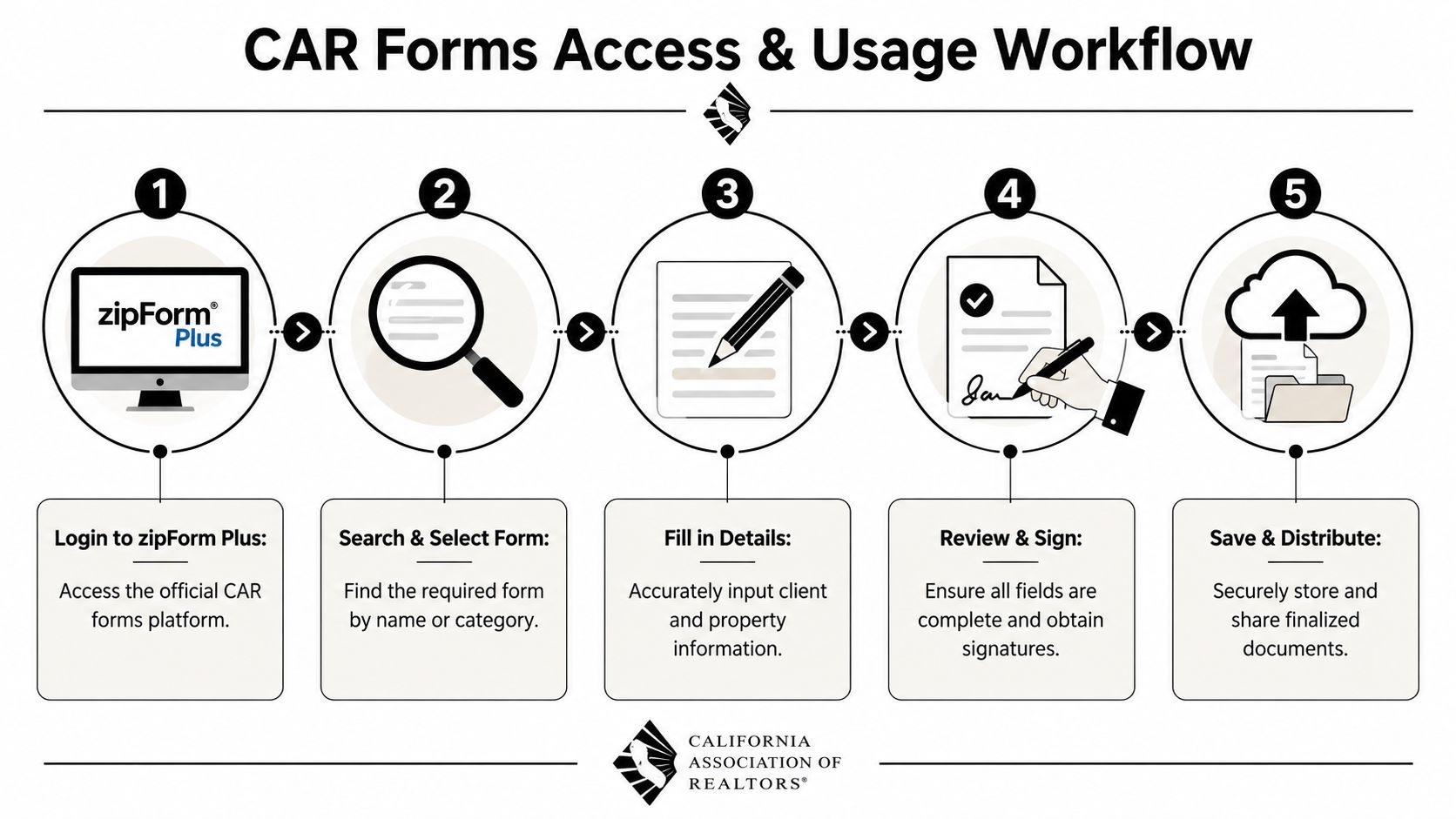
The practical access path
Most active professionals use a form platform such as zipForm Plus. For an owner, the practical path is usually one of these:
- Work with a REALTOR® or broker who has access to the current form library.
- Have the professional prepare the correct form set for the transaction, tenancy, or listing.
- Review every populated field before signing, especially names, dates, rent amounts, property address, and addenda references.
- Keep a clean final copy with all signatures and attachments together.
That process is more reliable than piecing together saved PDFs from old files.
A useful reference if you're trying to tighten your paperwork process is this guide to real estate compliance documentation.
For owners who want to see a general workflow, this video is a helpful visual:
Filling them out without creating problems
The most common errors are basic but costly:
- Incomplete fields: Blank sections create ambiguity. If a field doesn't apply, address it intentionally instead of leaving it hanging.
- Missing addenda: If the main form references an addendum, attach it. If it was intended but never included, the file becomes harder to enforce.
- Inconsistent names or dates: Ownership vesting, tenant names, and effective dates should match across the packet.
- Outdated saved forms: Reusing an old PDF can expose you to changes that were already addressed in a newer revision.
When paperwork is challenged, the problem is rarely that the form was too formal. The problem is usually that someone assumed a missing detail wouldn't matter.
Recent CAR Form Updates and Legal Changes for 2026
A Fresno owner pulls a listing agreement from a 2023 file, changes the address, and assumes it is still usable. That is how avoidable contract problems start. The forms changed because California sales practice changed, especially around buyer representation and broker compensation.
C.A.R. made a large round of form revisions in 2024, and those changes still matter in 2026 because many owners, agents, and even some experienced investors keep old PDFs in circulation. The Sacramento Association of REALTORS summarized that release in C.A.R. releases new forms. The practical point is simple. If your file library was not updated after those revisions, your paperwork may no longer match current transaction practice.
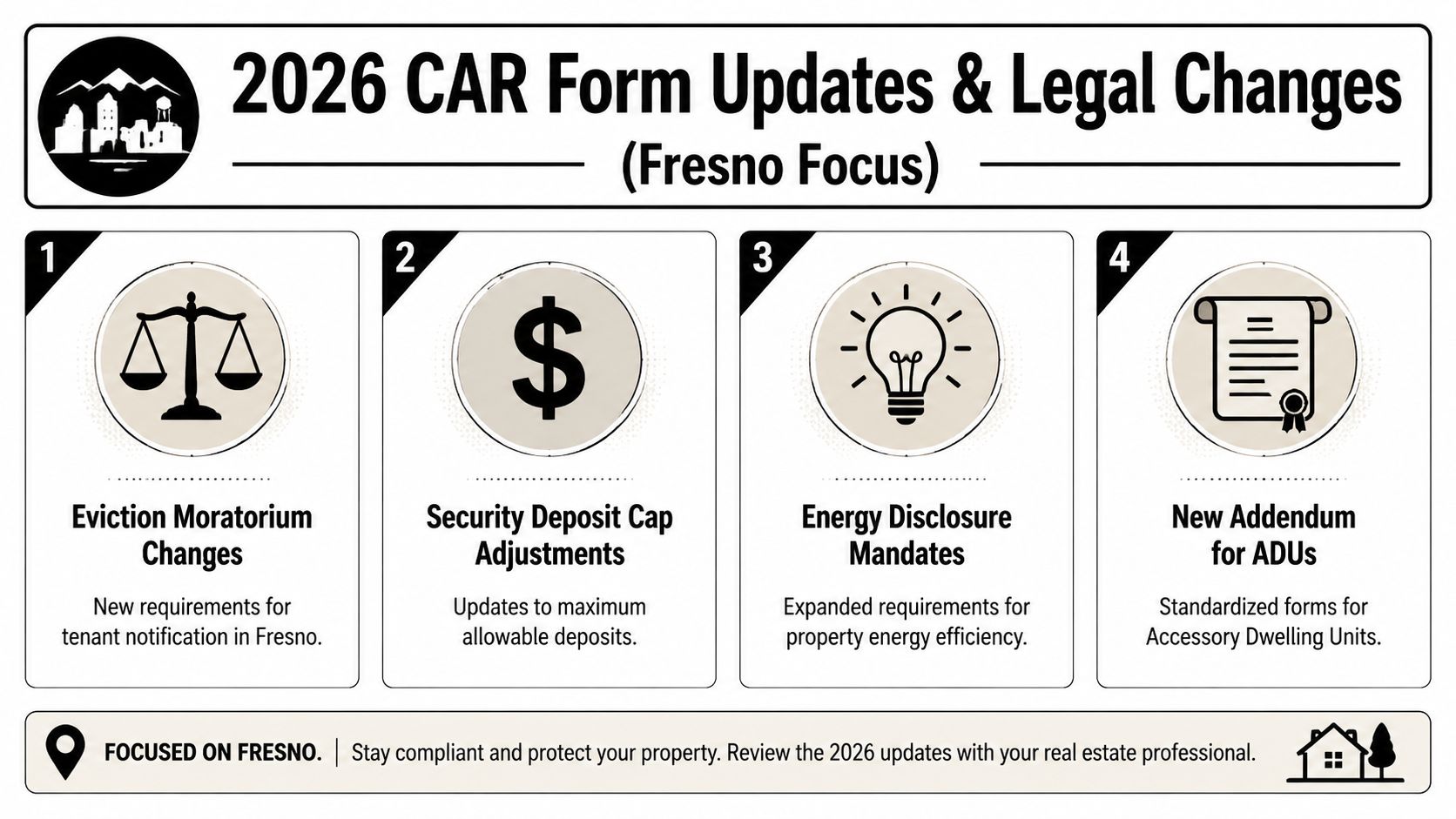
What changed in daily practice
The biggest field change was the removal of MLS-based offers of compensation to buyer brokers. C.A.R. revised its listing forms to reflect that shift, including removal of the prior optional compensation language from the residential listing package. That affects how listing brokers explain fees, how buyer brokers document representation, and how sellers evaluate net proceeds.
It also changed timing. Buyer representation paperwork now needs attention earlier in the process, before property tours in situations where those rules apply. In practice, that means fewer casual showings and more front-end documentation. For Fresno investors buying small multifamily property, rural homes with acreage, or scattered single-family rentals, that extra paperwork step is easy to miss if they are used to older habits.
Why Fresno owners should care in 2026
This matters in the Central Valley because owners here often wear two hats. They lease property, then sell it. They buy a replacement rental while still managing the current one. They inherit a house in Fresno County, place a tenant, then decide to list it six months later. Once rental activity and sales activity overlap, stale forms create risk fast.
I see the problem most often with owners who keep a folder of "good old forms" from prior escrows or management files. A document that worked a few years ago can now create confusion about compensation, representation, or disclosure timing. That is not a technical issue. It can affect enforceability, negotiation posture, and whether the deal file holds up if a dispute lands on an attorney's desk.
The risk is higher in our market because Central Valley transactions often involve added wrinkles. Occupied property sales, seller-held repairs, well and septic issues outside city limits, and contractor access during turnover all create more points where the wrong form set or an outdated revision can cause trouble. If repair work is part of the transaction, owners should also vet who is entering the property and what protections are in place. HomeProBadge's guide for homeowners is a useful reference on the contractor side of that risk.
C.A.R. also rolled out member education alongside the revised forms. That alone tells owners these were operational changes, not cosmetic edits. The safest approach in 2026 is to treat every older saved form as suspect until it is confirmed against the current C.A.R. library.
Avoiding Liability with Non-Standard Forms
A lot of owners think the risky form is the sloppy homemade lease. Sometimes it is. But I also see trouble with documents that look polished because they came from a software package, investor forum, contractor packet, or out-of-state website. The issue isn't appearance. The issue is whether the document fits California practice and whether it's being introduced correctly.
The NSFA is not optional when a non-CAR form is used
The C.A.R. Form NSFA, or Use of Non-Standard Forms Advisory, requires the agent to attach the advisory when a non-C.A.R. form is used, describe the form, obtain the client's signature, and refer legal interpretation to an attorney to avoid the unauthorized practice of law, as explained in the NSFA advisory overview.
That matters for landlords who like custom addenda. Common examples include:
- Contractor work acknowledgments drafted outside the main lease package
- House rules copied from another owner's file
- Special rural property terms for gates, pumps, storage yards, or shared acreage
- Vendor forms attached during repair or turnover work
If you're hiring vendors while preparing a property, it also helps to understand how to evaluate who's working on the home. A practical homeowner resource is HomeProBadge's guide for homeowners, especially when vendor paperwork and liability questions start crossing into your transaction file.
The real trade-off
Sometimes a non-standard form is necessary. That can be reasonable. The mistake is pretending that a custom document carries no extra compliance burden.
Custom paperwork increases your drafting risk the moment you move beyond standard language.
In practice, if a form needs interpretation, that's the warning sign. Once you're explaining what a custom clause "really means," you're already in dangerous territory. Standard forms are not perfect, but they're usually easier to administer, easier to explain, and less likely to create avoidable liability.
Frequently Asked Questions About CAR Forms
Are digital signatures valid on CAR forms
Yes, digital signatures are commonly used in California real estate practice. The practical concern isn't whether e-signing exists. It's whether every signer received the full packet and whether the final signed version includes all pages and addenda.
Can I use an older saved CAR form I already have
That's risky. Forms change for a reason. If you use an older version, you may miss revised language, updated advisories, or changed transaction practices. In active brokerage and property management work, current forms are the safer choice.
What's the difference between an addendum and an amendment
An addendum adds terms, often at the time the agreement is being created or when additional terms are attached to it. An amendment changes terms in an agreement that already exists. If the lease is already signed and the parties later change a term, that's generally amendment territory.
Are CAR forms legally required in California
No. They are not legally mandatory. The practical issue is that they are widely used and professionally maintained, which is why so many brokers and managers rely on them.
Can a landlord fill out CAR forms without a broker
A landlord can sign documents relating to their own property, but access to the current CAR library is a separate issue. Many owners end up working through a licensed professional because that's the realistic path to obtaining current, properly prepared forms.
When should I worry most about paperwork mistakes
Two moments. At move-in and before listing or selling. Move-in documents control the tenancy file. Sale documents and disclosures control transaction risk. If those stages are handled carefully, many later disputes become easier to manage.
If you need current California Association Realtors forms prepared correctly for a rental, listing, sale, or management relationship in Fresno, Clovis, Friant, or the surrounding Central California market, Edinhart Realty and Property Management can help you work through the paperwork, disclosures, and compliance steps with current California forms and transaction-ready documentation.


