

Flipping a house is a business, plain and simple. Before you even think about scrolling through property listings, you need to build a solid foundation. This means getting crystal clear on your goals, nailing down your budget, and, most importantly, putting together a team of pros who can guide you from purchase to profit. Getting this groundwork right is what separates the successful flippers from the ones who tell horror stories.
Building Your Foundation for a Successful Flip

The first and most critical step is to treat this like a startup, not a hobby. Success in this game is rarely an accident; it’s born from a calculated plan and having the right people in your corner from day one.
So, your first move is to create your personal flipping playbook. What does a "win" actually look like for you? Are you targeting a specific profit margin? Or is your goal to knock out a certain number of flips per year? These goals will be your North Star for every decision that follows.
Defining Your Financial Framework
Your budget is the bedrock of your entire project. And I’m not just talking about the purchase price and renovation costs. A real-world budget goes much deeper.
It has to include:
- Acquisition Costs: The sale price, plus all those closing costs, inspection fees, and any upfront legal bills.
- Renovation Budget: A detailed, line-by-line breakdown of every single material and labor cost. Get specific.
- Holding Costs: This is what kills rookies. These are the expenses that pile up every single month you own the property—loan payments, property taxes, insurance, utilities. They don't stop.
- Selling Costs: Don't forget you have to sell it! Factor in agent commissions, professional staging, and any concessions you might give the buyer.
- Contingency Fund: This is non-negotiable. Set aside 15-20% of your total renovation budget for the things you can't see coming. Trust me, they're there.
Let’s say you estimate your reno will cost $50,000. That means you need an additional $7,500 to $10,000 sitting in a separate account, ready to go. This fund is your savior when you open up a wall and find termite damage or when lumber prices suddenly spike. Without it, one surprise can sink your entire project.
Underestimating holding costs is a classic newbie mistake. A project you thought would take three months suddenly stretches to six. That’s three extra mortgage payments, three more insurance bills, three more utility bills… it all adds up, eating directly into your profit.
Assembling Your A-Team
You can't do this alone. I’ll say it again: you can't do this alone. Building a network of reliable professionals isn't an expense; it’s the single best investment you’ll make in this business.
Your core team needs to include:
- A Real Estate Agent: Not just any agent. You need someone who lives and breathes investment properties. They know how to spot an undervalued deal and can give you a rock-solid after-repair value (ARV) estimate.
- A Go-To Contractor: Get multiple bids for your first few projects and check every single reference. A great contractor is worth their weight in gold—they communicate, they stick to the schedule, and they give you a clear scope of work so there are no surprises.
- A Real Estate Attorney or Title Company: These are the people who protect your investment. They handle the title search, make sure the transaction is legally sound, and get you through closing without a hitch.
The key is to build these relationships before you find a deal. When a great property hits the market, you have to move fast. Having your team already in place and ready to pounce gives you a massive competitive advantage. It's what allows you to analyze deals quickly and pull the trigger with confidence.
Reading the Signals of Today's Flipping Market
If you want to succeed in flipping houses, you have to move beyond gut feelings and start making decisions powered by cold, hard data. The market is always in flux, and picking up on the subtle signals—everything from interest rates to local inventory levels—is what separates a profitable project from a financial nightmare. It’s all about being a strategic, informed investor.
The game today is more calculated than the frenzied market we saw a few years back. Profit margins have tightened up considerably, which means you need a sharper pencil and a much deeper understanding of what’s happening right now. The days of throwing a dart and hitting a high return are over; success now demands precision and a very clear-eyed view of the numbers.
Understanding Current Flipping Dynamics
Looking at recent data, it's clear there's been a noticeable slowdown in house flipping activity across the United States. In the first quarter, the total number of single-family homes and condos flipped was 67,394, making up just 8.3% of all home sales. That’s the lowest quarterly volume we’ve seen since 2018, which paints a pretty clear picture of a more cautious market. You can dig into a more detailed market analysis from World Property Journal.
Profit margins have also shrunk for investors. The typical gross profit on a flip has dipped to $65,000, based on a median resale price of $325,000 and a median purchase price of $260,000. That pencils out to roughly a 25% return on investment before you factor in all your costs—a major adjustment from the post-pandemic peak ROI, which was pushing nearly 49%.
The table below breaks down the key market indicators from the first quarter, giving you a snapshot of what’s really going on.
US House Flipping Market Snapshot (Q1 Data)
A summary of key performance indicators for the house flipping market, illustrating recent trends in volume, profits, and ROI.
| Metric | Q1 Figure | Context/Trend |
|---|---|---|
| Homes Flipped | 67,394 | Lowest quarterly volume since 2018, indicating a more selective market. |
| Gross Profit | $65,000 | Profit margins are tightening as acquisition and resale prices converge. |
| Gross ROI | 25% | A significant decrease from the post-pandemic peak near 49%, demanding better budgeting. |
| Share of Sales | 8.3% | Flipping represents a smaller portion of total home sales, reflecting investor caution. |
This data confirms what experienced flippers already feel: the easy money is gone, and success now relies on strategy, not just market momentum.
Below, you can see how financing plays a huge role in these outcomes, from how investors are funding their deals to the average loan values they're taking on.
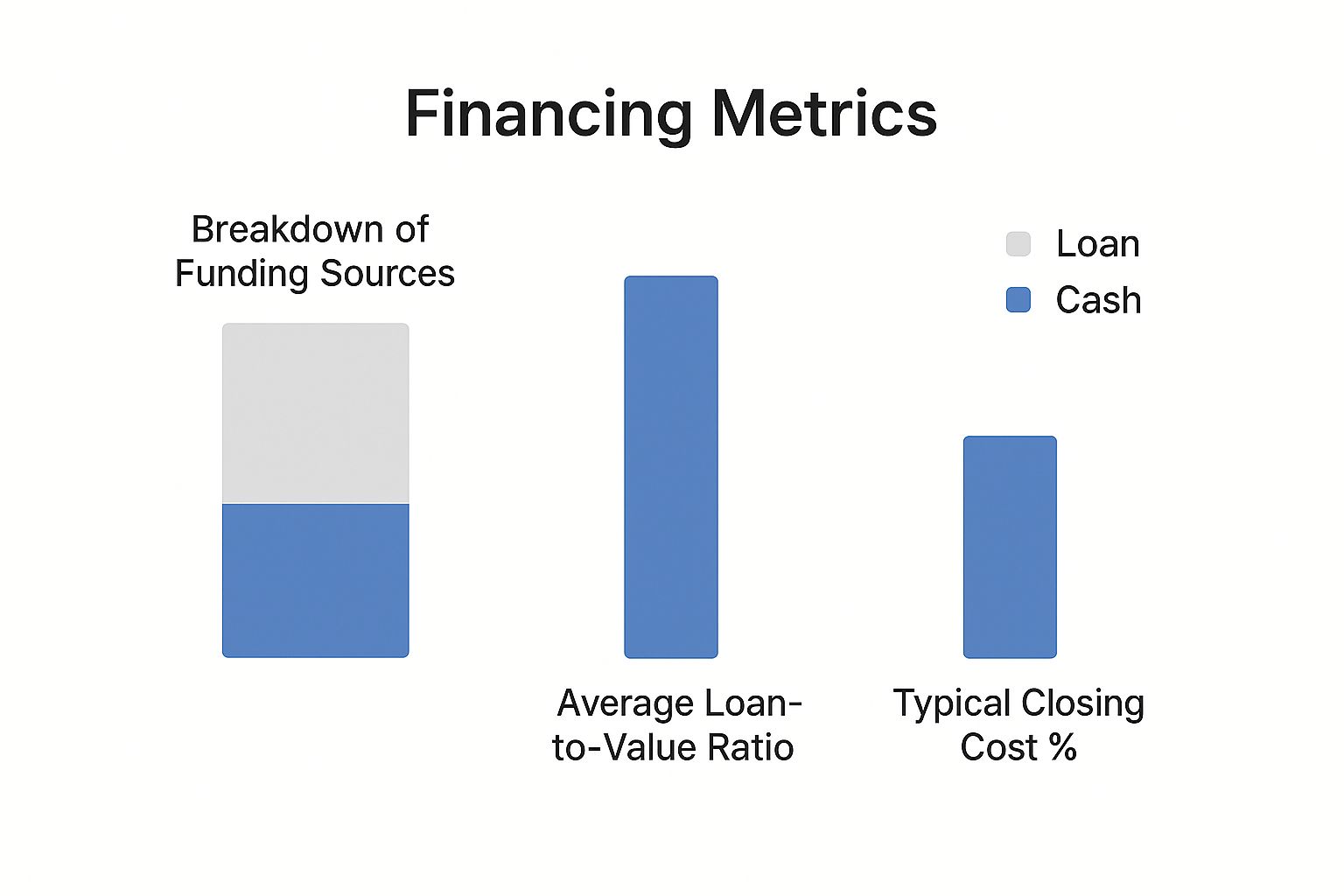
It’s a market where your financing choices are absolutely critical. Things like loan-to-value ratios and closing costs have a direct and immediate impact on your initial cash outlay and, ultimately, your bottom line.
Key Market Indicators to Watch
To navigate this environment, you need to become a student of the market. I'm talking about constantly monitoring a few key metrics that act as your early warning system. These numbers tell a story about where things are heading and where the real opportunities are hiding.
Days on Market (DOM)
How long are renovated homes in your target neighborhood just sitting there before they sell? A rising DOM can be a red flag for a cooling market. It can jack up your holding costs and even force you to drop your price. You want to be in neighborhoods with a consistently low DOM.
Inventory Levels
This one’s just simple supply and demand. Low inventory means more buyers fighting over fewer houses, which can drive up your final sale price. But if inventory is high or climbing, you could see prices stagnate, making it a lot harder to hit your profit target.
Local Price-to-Rent Ratio
This ratio gives you a sense of the local housing economy. A high ratio suggests it’s way more expensive to buy than to rent, which might mean that the market is getting a bit overheated. It's a great metric for gauging how stable home values are in a particular area.
A savvy investor I know keeps a simple spreadsheet tracking these three metrics for three target zip codes. He updates it every single week. By doing this, he spots trends before they become obvious to everyone else, which lets him shift his focus to neighborhoods with the strongest fundamentals before the competition does.
Adapting Your Strategy to the Numbers
So, what does all this mean for your flipping strategy? It means you can't just count on broad market appreciation to rescue a bad deal anymore. Your success now hinges on being disciplined from the absolute beginning.
- Buy Deeper Discounts: With margins this tight, you have to acquire properties at a lower price point. Your profit is made on the purchase, and in today's market, that’s truer than ever. Stick to formulas like the 70% Rule like it's your religion.
- Focus on Speed: Time is money, especially with higher holding costs breathing down your neck. Your renovation has to be efficient and your timeline has to be tight. Delays that were just an annoyance a few years ago are now absolute profit killers.
- Renovate for the Buyer, Not for You: You need to know exactly what local buyers want and what they're willing to pay for. Don't over-improve a property for the neighborhood. Focus on high-impact, cost-effective upgrades to the kitchen, bathrooms, and curb appeal—that's where you'll get the highest ROI.
This data-driven approach isn't meant to scare you off. It’s about empowering you to make smarter, more confident decisions. If you learn to read the market signals correctly, you can still find some incredible opportunities out there, even in a more challenging environment.
How to Secure Smart Financing for Your Flip
Long before you swing a single hammer, the way you fund your project can make or break the entire deal. Getting smart financing isn't just about grabbing a check. It’s about securing capital with terms that actually protect your profit margin and work with the aggressive timeline a flip demands.
The wrong loan will saddle you with crippling holding costs that bleed you dry. The right one, however, gives you the breathing room you need to execute your vision. It all starts with understanding your options, which means looking beyond the traditional mortgages you'd get for your own home and diving into the world of investor-focused lending.
Comparing Your Primary Lending Options
When it comes to paying for a flip, your main choices fall into a few distinct buckets, each with its own pros and cons. A huge part of successful flipping is knowing how to go about securing an investment property loan that’s built for your specific project.
Here’s a practical look at the most common ways flippers get their funding:
- Hard Money Loans: These are short-term loans from private investors, not big banks. They’re wildly popular because they fund fast—sometimes in just a week—and often cover both the purchase price and a chunk of your reno budget. The catch? They're expensive. Expect higher interest rates and fees.
- Private Money Lenders: This is just borrowing from people you know—friends, family, or other investors. The terms can be incredibly flexible because you negotiate them directly. But this requires a massive amount of trust and, crucially, legally sound agreements to protect everyone involved.
- Traditional Bank Loans: While a conventional mortgage or HELOC has the lowest interest rates, they are slow. The underwriting process for investment properties is strict, and banks get nervous about financing a home that’s in rough shape. This makes them a tough fit for most major rehabs.
For most flippers, especially when you're just starting out, hard money gives you the speed you need to jump on good deals. You just have to be certain your projected profit can easily absorb those higher financing costs.
Navigating Today's Economic Headwinds
Let's be real: getting a loan today is a lot harder than it was a few years ago. Flippers are up against some serious economic headwinds. Mortgage rates are hovering around 7% for 30-year fixed loans, which hikes up your financing costs and eats directly into your bottom line.
In this climate, lenders are tightening their belts, asking for stricter criteria and bigger down payments. These high rates also reduce what buyers can afford, which can mean your flipped house sits on the market longer, putting even more pressure on your final sale price. If you want to explore your options, you can find different types of investment homes to diversify your strategy.
In a high-rate environment, speed is your greatest ally. Every day you hold the property, interest accrues and eats into your profit. A project that takes six months instead of three can see its entire profit margin wiped out by financing costs alone.
This challenging market means you have to be sharper than ever. Focus on properties in high-demand areas where you can get in and out quickly. Building relationships with lenders before you find a deal is no longer a "nice to have"—it's a necessity.
What Lenders Really Want to See
To get a lender on board, you have to present your project like the solid business investment it is. They're not just lending to you; they're underwriting the entire deal.
You need to walk in with a professional loan proposal that has all the bases covered:
- Deal Analysis: A clean breakdown of the numbers. This includes the purchase price, a detailed reno budget, the after-repair value (ARV), and your projected profit.
- Scope of Work: A line-by-line list of every single planned repair and upgrade. If you have contractor bids, even better.
- Your Experience: Have you done this before? Show it off with before-and-after photos and the final numbers from past flips. If you're new, highlight any relevant construction or project management skills you have.
- Exit Strategy: Be crystal clear. Are you selling to a homeowner or another investor? Lay out the plan.
When you present a thorough, well-researched package, it shows the lender you've done your homework. It dramatically lowers their perceived risk, which makes them far more likely to say yes and fund your deal.
Finding and Analyzing Deals Like a Pro
If you talk to any seasoned flipper, they'll tell you the same thing: you make your money when you buy, not when you sell. This isn't just a catchy phrase; it's the golden rule of this business.
Finding a genuinely good deal is the single most critical step. It’s not about luck. It’s about a proactive, almost detective-like approach to uncovering properties the average homebuyer will never even see.
While the Multiple Listing Service (MLS) is an obvious starting point, the truly great deals are almost always found off-market. When a property is on the MLS, you're immediately competing against every other investor and retail buyer in town. To get a real edge, you have to dig deeper.
Think like a marketer. Act like a networker. The most successful investors create their own opportunities instead of waiting for them to pop up on a website.
Where to Uncover Hidden Gems
Your mission is to find and connect with motivated sellers before their property ever hits the open market. This requires expanding your search beyond the usual online portals.
Here are a few proven ways to find these off-market properties:
- Property Wholesalers: These are investors who are experts at finding distressed properties. They get them under contract and then assign that contract to another investor (like you) for a small fee. Building solid relationships with a few reputable wholesalers in your area can become a consistent source of potential flips.
- Property Auctions: Foreclosure and estate auctions can be a fantastic place to find deeply discounted homes. But be warned: this is not a playground for beginners. You often need to buy with all cash and have very little time to do your homework, making it a high-risk, high-reward strategy.
- Direct Mail Campaigns: It's an old-school tactic because it works. Sending targeted, personal letters to owners of distressed-looking homes, absentee owners, or those facing foreclosure can yield incredible results. A simple, well-crafted message can open doors that would otherwise stay shut.
I know an investor who drives his target neighborhoods once a month, looking for the classic signs: overgrown lawns, boarded-up windows, mail piling up. He jots down the addresses and sends a simple, handwritten letter. His response rate is low, but the 2% of owners who call back often lead to his most profitable flips of the year.
Mastering the Back-of-the-Napkin Math
When you're out in the field and a potential deal pops up, you don't have time for complex spreadsheets. You need to analyze it almost instantly. A few key formulas are your best friend here, helping you quickly decide if a property is even worth a closer look.
The most famous of these is the 70% Rule. It's a simple guideline stating you should pay no more than 70% of the After-Repair Value (ARV) of a property, minus the cost of the repairs.
The formula is straightforward:
(ARV x 0.70) – Estimated Repairs = Maximum Offer Price
Let's say you find a house you think will be worth $300,000 once it's fixed up. You walk through and estimate it needs about $40,000 in work.
Here's the math:
($300,000 x 0.70) – $40,000 = $170,000
That means $170,000 is the absolute highest you should offer. That other 30% isn't just profit; it's your buffer to cover financing costs, insurance, taxes, selling fees, and your actual take-home pay. Sticking to this rule is your best defense against overpaying. While there are many sound strategies, you can learn more about why buying single-family homes can be a good investment in our related guide.
From Quick Math to Full Deal Analysis
Once a property passes that initial gut check with the 70% Rule, it's time to sharpen your pencil. A full analysis is where you account for every single dollar to project your real net profit.
Your detailed breakdown must include:
- Purchase Price & Closing Costs: The price you pay for the house, plus all the associated fees, which typically run 2-5% of the purchase price.
- Detailed Repair Estimate: A rough guess isn't good enough. Get a licensed contractor to walk the property with you and provide a line-item bid.
- Holding Costs: This is the cost of owning the property during the renovation. Calculate your monthly loan payments, property taxes, insurance, and utilities. Multiply that by your estimated project timeline—and always add a month or two as a buffer.
- Selling Costs: Don't forget this! Budget for realtor commissions (usually 5-6% of the final sale price), closing costs for the buyer, and potential staging fees.
Only when you subtract all these expenses from your projected ARV can you see your true potential profit. This disciplined, numbers-first approach separates the pros from the amateurs. It’s how you confidently spot a diamond in the rough while sidestepping the money pits that look good on the surface but are financial disasters waiting to happen.
Get Ready to Manage Your Renovation for Maximum ROI
Once you’ve got the keys in your hand, the real race begins. This is where your ability to manage a project and a budget gets put to the ultimate test. A well-run renovation means a faster, more profitable sale. A chaotic one? Well, that’s how a promising flip turns into a money pit.
You have to be intentional. Every single choice, from the paint color in the guest room to the contractor you hire for the roof, needs to be seen through the lens of Return on Investment (ROI). Remember, you’re not building your personal dream home. You're creating a product designed to attract the largest possible pool of buyers in your target market.
Create a Bulletproof Scope of Work
Before you even think about swinging a sledgehammer, you need a rock-solid scope of work (SOW). This document is the bible for your project. It needs to detail every task, every material, and every finish, leaving zero room for interpretation. A vague note like "update kitchen" is just asking for budget overruns and arguments with your crew.
You have to get granular. A strong SOW looks something like this:
- Kitchen: Demolish and remove existing laminate countertops. Install Calacatta Laza quartz countertops with a 4-inch backsplash. Replace existing faucet with a Delta Trinsic single-handle pull-down model (matte black finish). Paint all lower cabinets in Sherwin-Williams’ Iron Ore (SW 7069).
- Flooring: Tear out and dispose of all carpeting on the main floor. Install Lifeproof Luxury Vinyl Plank flooring in Sterling Oak throughout the living room, hallway, and all bedrooms.
This level of detail is non-negotiable when you start getting bids. It forces every contractor to price out the exact same job, so you can compare their quotes on an apples-to-apples basis. It also becomes your most powerful tool for holding them accountable to the plan, schedule, and budget. To really succeed in flipping, you need to have your financials locked down; this comprehensive construction budget management guide is a great place to start.
Focus on Upgrades That Actually Make You Money
I see this all the time with new flippers—they "over-renovate" for the neighborhood. Putting a professional-grade Viking range in a small, starter-home community is a perfect example of lighting money on fire. You will never get that investment back.
Your rehab plan should be driven by the market, period. Pour your time and money into the areas that buyers care about most:
- Kitchens: This is the heart of the home, and it’s where you’ll see your best ROI. You don't always need a full gut. Clean countertops, refreshed cabinets with new hardware, and a matching set of stainless steel appliances can completely transform a dated space.
- Bathrooms: Nobody wants to see a grimy, old bathroom. A new vanity, modern light fixtures, a re-glazed tub, and a new toilet can make a bathroom feel brand new for a fraction of the cost of a full demolition.
- Curb Appeal: First impressions are everything. A freshly painted front door, modern house numbers, some simple landscaping, and a power-washed driveway create that "wow" factor that gets buyers excited before they even walk inside.
The goal is to deliver a clean, modern, and move-in-ready house. Stay away from your own personal tastes or hyper-trendy finishes that might turn off a huge chunk of buyers. Neutral paint, durable flooring, and classic fixtures are always a safe—and profitable—bet.
Understanding Profitability in Today's Market
Executing a smart, efficient renovation is more critical now than ever. While flipping houses is still a great way to build wealth, the market has definitely shifted. The wild ROI we saw at its 2016 peak of 49.2% has settled into a more realistic average of around 28-30% in recent years.
Interestingly, the average gross profit per flip has held pretty steady, hovering between $65,000 and $75,000. These numbers tell a clear story: even though the feeding frenzy has calmed down, strategic investors are still making good money by running their projects like a business. You can dive deeper into these house flipping statistics to see the trends for yourself.
This new reality just hammers home how important it is to control every dollar and every day of your renovation. With tighter margins, you have no room for costly mistakes or avoidable delays. Staying on schedule and on budget isn't just a nice goal—it’s a requirement for survival in this market. Your ability to manage your crew, source materials, and stick to your SOW will be the single biggest factor determining your final profit.
Answering Your Top House Flipping Questions
Jumping into the world of flipping houses always brings up a ton of questions. I get it. From the anxiety about funding to the real fear of making a costly mistake, these are the thoughts that can keep a new investor staring at the ceiling all night. Let's walk through some of the most common questions and get you some clear, straight-up answers.
How Much Money Do I Really Need to Start Flipping Houses?
This is the big one, isn't it? Everyone wants to know the magic number. Let’s just cut through all the "no money down" hype you see on late-night TV. In the real world, you need cash—real, liquid capital—to play the game.
I tell new investors to think about their starting money in three separate buckets:
- Acquisition Funds: This is for your down payment and closing costs. On most investment loans, you’re looking at putting down 20-25% of the purchase price. Then, budget another 2-5% on top for closing costs.
- Renovation Budget: This is the entire estimated cost to get the renovation done. You need this in cash or fully secured through your loan before a single hammer swings.
- Contingency Fund: This is your “uh-oh” money. It’s a non-negotiable safety net. Plan on setting aside an extra 10-20% of your total renovation budget for surprises. So, if your reno is $50,000, you need another $5,000 to $10,000 sitting in a separate account, just in case.
In a lower-cost market, you might get in the door with $50,000 cash. But if you’re in a pricier area, that number could easily be $100,000 or more. Hard money loans can lower your initial cash needed, but you'll pay for that convenience with much higher interest rates and fees.
What Are the Biggest Mistakes First-Time Flippers Make?
Trust me, learning from someone else's mistakes is a whole lot cheaper than making them yourself. While there are a million ways a flip can go sideways, I see new flippers stumble on the same few things over and over again.
These are the blunders that can absolutely torpedo a project:
- Underestimating Repair Costs: A beautiful spreadsheet means nothing if your plumbing estimate is off by $10,000. You have to get multiple, detailed quotes from contractors you trust before you close. A vague guess is just a recipe for financial disaster.
- Overpaying for the Property: It’s so easy to get swept up in the chase and let your emotions take over. You can’t. You have to be disciplined and let the numbers drive your decisions. Never, ever be afraid to walk away if the deal doesn’t work on paper.
- Taking Too Long to Finish: Time is the silent killer of your profits. Every single day you own that house, you’re burning cash on holding costs—loan interest, insurance, utilities, taxes. A project you planned for four months that drags on for eight can easily wipe out your entire profit.
A successful flip is really just a masterclass in project management. The investors who make money consistently are the ones who obsess over their budget and timeline. They know that every delay and every dollar over budget comes directly out of their own pocket.
Which Renovations Actually Add the Most Value?
Your renovation budget needs to be a strategic weapon, not a shopping spree. The goal is to focus on upgrades that will appeal to the largest pool of buyers and give you the best return. You have to forget about niche trends or your own personal taste; think universally appealing and market-smart.
You'll get the most bang for your buck by focusing on the "money rooms" that buyers inspect the closest:
- Kitchens: This is almost always the heart of the home. I recommend clean quartz or granite countertops, freshly painted cabinets with modern hardware, and a new set of matching appliances.
- Bathrooms: A sparkling, clean bathroom is a huge selling point. You can make a massive impact with a new vanity, modern tile, and updated fixtures without having to do a full gut job.
- Curb Appeal: The first impression is everything. A new front door, a fresh coat of exterior paint, and simple, clean landscaping are some of the most cost-effective upgrades you can make.
Great lighting and durable, neutral flooring throughout the house also do wonders for making a space feel new. The objective is to create a clean, modern, move-in-ready vibe that lets buyers immediately picture themselves living there.
Is It Still Possible to Profit with High Interest Rates?
Absolutely, but the game has definitely changed. When interest rates are high, your margin for error gets razor-thin. The higher cost of borrowing puts huge pressure on your timeline and budget, which means you have to be more efficient than ever.
Higher rates directly pump up your monthly holding costs. You simply have to be faster and smarter to protect your profit. Success in this market comes down to a few key adjustments. First, you have to buy the property at a steeper discount to make up for the higher financing costs. Second, your renovation budget must be airtight—there is zero room for overages. To dig deeper into getting a property ready for sale, check out our guide on how to sell your house quickly for some great insights.
In this kind of environment, delays become exponentially more expensive. The investors who are winning right now are masters of efficiency. They get in, execute the plan flawlessly, and get the house back on the market before those borrowing costs eat their entire profit margin.
At Edinhart Realty and Property Management, we provide the expert guidance and market insights you need to make smart real estate decisions. Whether you're buying, selling, or investing, our team is here to help you maximize your returns. Explore our services today!


