

The call usually comes at the wrong time. You're finishing dinner, settling in for the night, or finally getting through your own work, and then the phone rings. A tenant can't get the AC to cool. Rent still hasn't come in. A small leak under the sink has turned into cabinet damage because nobody reported it early enough.
That's when a lot of Fresno landlords realize they don't just own a rental. They're running a small housing business.
A good building management company takes that business off your shoulders in a structured way. Not by doing one or two tasks, but by putting systems around the whole property so rent comes in, repairs get handled, tenants get screened properly, and you stop making expensive decisions in a rush. If you're trying to decide whether to keep managing yourself, hire full-service help, or use a placement-only model, the right answer depends on your time, your risk tolerance, and the kind of property you own.
Your Partner in Profit and Peace of Mind
A new landlord often starts with good intentions. You'll answer texts quickly. You'll keep records in a folder. You'll handle maintenance as it comes up. For a while, that can work.
Then the actual pattern shows up. One late payment turns into a conversation you don't want to have. One maintenance issue leads to two vendor calls and a missed invoice. One tenant move-out means cleaning, showing, screening, paperwork, keys, deposits, and a vacancy clock that starts the moment the home goes dark.
In Fresno and the surrounding Central California market, the stress usually isn't one giant problem. It's the steady pileup of small operational problems. Summer heat makes HVAC response time matter. Older homes need sharper maintenance follow-through. Landlords who live out of town can't easily check a turnover, meet a vendor, or verify whether the repair was done right.
That's where a building management company becomes more than a convenience. It becomes your operating partner. The job isn't only to collect rent or send a repair person. The job is to create consistency, because consistent leasing, maintenance, communication, and documentation protect your income and your time.
Most rental headaches don't start as disasters. They start as tasks that nobody handled quickly enough.
If you're comparing options, it helps to think like an investor instead of a stressed owner. Tools and education platforms that focus on landlord decision-making, such as InvestorMode, can be useful because they frame rentals as systems, not side projects. That shift in mindset matters. Owners who treat management as a real business usually make better choices about pricing, screening, repairs, and when to delegate.
Peace of mind isn't soft value. It's what you get when the property has a process instead of depending on your availability.
The Core Services of Building Management
A rental property needs an operating system. If that system is weak, the owner feels it everywhere. Rent gets inconsistent, maintenance drags, tenant communication gets messy, and records become hard to trust. A competent building management company keeps those moving parts connected.
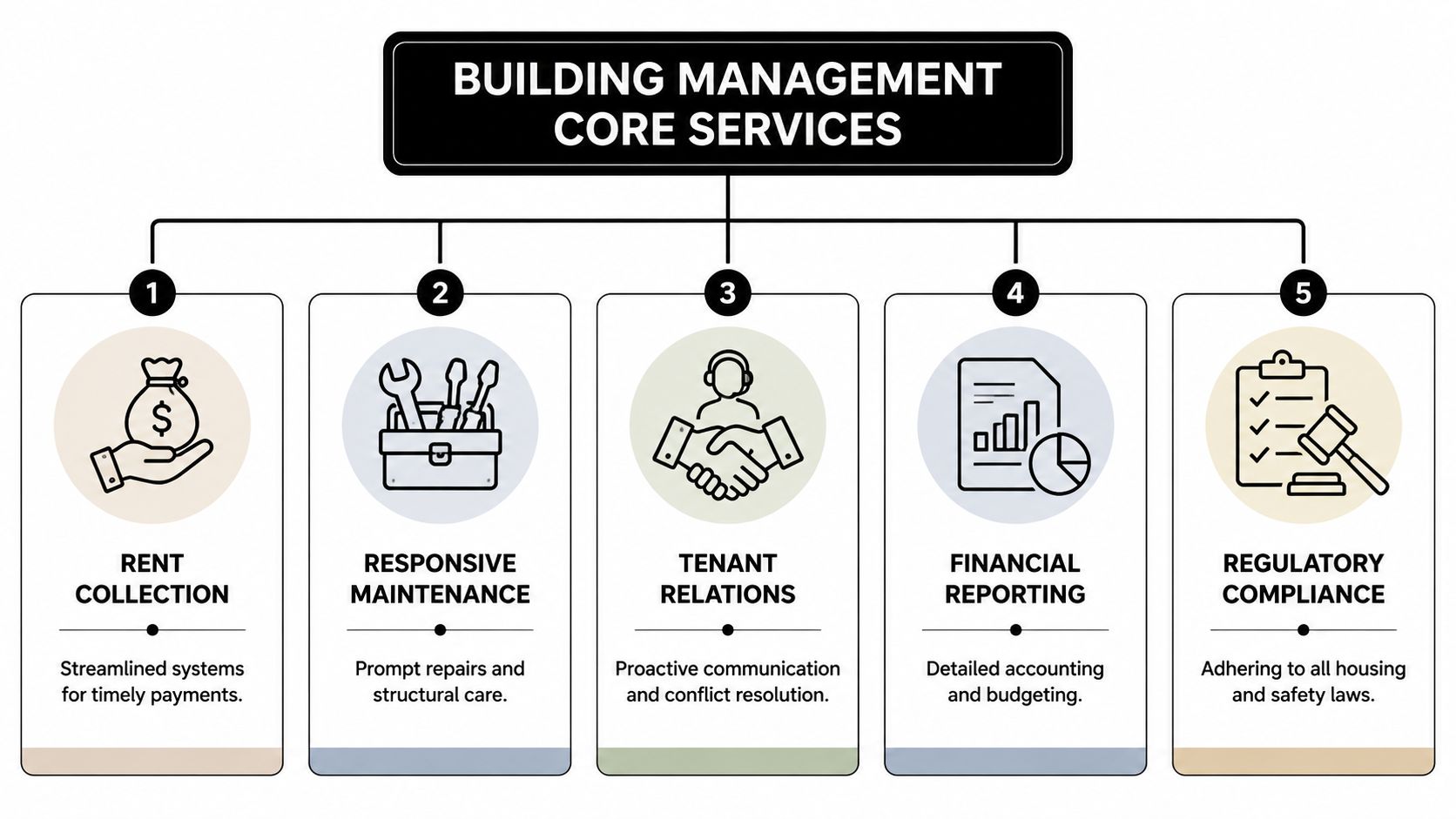
Rent collection and cash flow discipline
Rent collection sounds simple until it's not. The essential work involves setting payment expectations, enforcing lease terms, documenting communication, and keeping owner disbursements clean.
A weak process invites delay. A strong process uses clear due dates, consistent notices, online payment systems, and immediate follow-up when something is off. The goal isn't to be harsh. The goal is to remove ambiguity so tenants know exactly how payment works and owners aren't chasing money every month.
Maintenance coordination and response speed
Maintenance is where many self-managed rentals break down. Owners either overreact and spend too much, or they wait too long and let a small issue spread. Good management means triaging correctly, dispatching the right vendor, documenting the work, and checking whether the repair solved the problem.
This matters more in Central California than many national guides admit. In hot weather, delayed HVAC response can push good tenants toward moving out. Industry benchmarks note that properties resolving urgent requests in under four hours see 15 to 20% higher tenant satisfaction and 10% lower turnover rates, and unresolved summer AC issues can raise move-out probability by 30% in a hot climate like Central California, according to work order resolution benchmarks for property management.
For local owners trying to avoid deferred maintenance, practical checklists on topics like flooring, wear, and turnover prep can help. This guide on essential property upkeep for local landlords is a useful example of the kind of maintenance planning that prevents cosmetic issues from becoming leasing problems.
Practical rule: If a vendor fixes the symptom but not the cause, you didn't save money. You delayed the real invoice.
Tenant screening and lease setup
Finding a tenant isn't the same as placing the right tenant. Screening is where income protection starts. A building management company should verify identity, review application history, evaluate income, check prior housing behavior, and apply lease standards consistently.
Then comes the lease itself. Terms need to be clear, enforceable, and tied to how the property will be managed. Utility responsibility, maintenance expectations, pet rules, late fees, move-out standards, and notice procedures all need to be spelled out cleanly.
If you want a plain-language overview of how these moving parts fit together, this explanation of what property management involves is a solid starting point.
Tenant relations and issue control
Tenant relations isn't about being informal or overly available. It's about being responsive, documented, and consistent. When communication is sloppy, small disputes grow. When communication is professional, most issues stay manageable.
That includes handling routine questions, setting boundaries, coordinating entries, documenting complaints, and resolving conflicts before they become turnover events.
Accounting and compliance
Owners need reliable numbers. Not rough estimates. Not text-message accounting. Monthly statements, maintenance invoices, rent records, reserve tracking, and year-end documentation all need to line up.
Compliance matters too. Fair housing practices, notices, lease forms, and property procedures need to follow current rules. This is the quiet part of management that saves owners from expensive mistakes later. It may not feel urgent on a normal Tuesday, but it becomes urgent the moment a dispute starts.
Maximizing Your Return on Investment
A lot of landlords look at management as a fee line. That's too narrow. The better question is whether management improves the property's actual performance.

In practice, return comes from four places. Better leasing speed. Better tenant quality. Lower operational waste. Fewer expensive mistakes. If your manager improves those areas, the fee is part of the asset strategy, not just an expense.
The broader market shows how established this business has become. The U.S. property management industry generated an estimated $119.1 billion in 2024, with residential management accounting for 84.6% of total revenue, and the sector employs over 875,000 workers. California leads the nation with 79,061 residential property managers, according to property management industry statistics. That scale matters because it shows owners aren't outsourcing fringe tasks. They're using a professional operating layer for a major asset class.
Vacancy control pays first
The fastest way to hurt returns is to let a property sit. Every extra day without a tenant is lost income, but the cost goes beyond rent. Vacant homes still need utilities, oversight, cleaning coordination, and protection from deterioration.
A manager who knows the Fresno and Clovis market can usually make better pricing calls than an owner relying on guesswork or emotion. Overpricing creates stale listings. Underpricing fills the property fast but leaves money on the table. Strong marketing, better showing coordination, and sharper screening reduce the total vacancy cycle.
Good management protects the owner from false savings
Some owners save money by doing everything themselves until one legal or operational issue wipes out months of that savings. That's common with lease language, notice handling, fair housing mistakes, security deposit disputes, or maintenance delays that should have been addressed earlier.
For owners thinking beyond monthly rent, legal and estate planning considerations matter too, especially when the property is part of a larger family or investment strategy. This expert guide for California property owners is a practical companion resource if you're looking at ownership structure, succession, or broader asset planning.
A property doesn't become more profitable because the owner stays busy. It becomes more profitable when the work is done consistently and documented properly.
There's also the personal return. If you're handling calls, notices, vendors, leasing, accounting, and tenant follow-up yourself, you're investing real time whether you count it or not. For some owners, self-management still makes sense. For others, the time drain is the first sign that a different model would produce a better result. If you're weighing that trade-off, this discussion of whether property management is worth it is worth reviewing.
This short overview is useful if you want to see how owners think through management value in practice.
ROI is often hidden in the problems that never happen
The strongest management companies rarely look dramatic from the outside. You don't notice the fair housing issue that never developed. You don't notice the roof leak that got caught before interior damage spread. You don't notice the applicant who looked fine on first pass but failed deeper screening.
Owners usually feel return in the form of stability. More predictable rent. Fewer avoidable repairs. Cleaner turnovers. Better records. Less emotional decision-making.
That's what improves the asset over time.
Choosing Your Management Model Full-Service vs Placement-Only
Most landlords don't need a generic answer. They need the right service model for the way they operate. In Fresno, that choice usually comes down to full-service management or placement-only service.

The mistake is assuming one model is always smarter. It isn't. The right fit depends on distance, time, maintenance comfort, tenant communication style, and how disciplined you are with follow-through.
When full-service makes sense
Full-service works best for owners who want the property to function as a passive investment. The manager handles rent collection, repair coordination, tenant communication, lease renewals, move-in and move-out coordination, and reporting.
This model tends to fit a few common landlord profiles:
- Out-of-area owners: If you live outside Fresno, Clovis, Friant, or the surrounding market, local coordination matters. You can't easily inspect a turnover or meet a vendor on short notice.
- Owners with demanding jobs: If your own workday makes you slow to answer tenant calls, full-service prevents delay from turning into damage.
- Investors with multiple units: Once you manage several doors, the admin stack gets heavier. Rent tracking, notices, repairs, and lease dates stop being simple.
- Owners who want professional boundaries: Some landlords don't want direct tenant contact, and that's often healthier for everyone.
Full-service also helps when the property itself is operationally active. Older homes, homes with deferred maintenance, or properties with frequent service needs usually benefit from tighter oversight.
If you dread the next tenant text before it arrives, you're already paying a cost for self-management.
When placement-only is the better choice
Placement-only is a different tool. It fits owners who want professional help with the front end of leasing but plan to handle day-to-day management themselves.
That usually includes marketing the home, screening applicants, drafting the lease, and getting the property occupied with a better process than most independent landlords can build on their own.
This option works well if you:
- Like hands-on management: You don't mind taking maintenance calls and coordinating vendors.
- Know your property well: You're comfortable making repair decisions and monitoring work quality.
- Want help where mistakes are most expensive: Leasing, screening, and paperwork are the areas where many self-managing owners are weakest.
- Have time and local presence: You can show up when needed and stay consistent after move-in.
Placement-only is often the smarter choice for landlords who are organized, nearby, and realistic about the work involved. It lets you outsource the highest-stakes setup tasks without giving up full control.
The Fresno factor in this decision
National articles often miss the local piece. In Central California, presentation matters more than many landlords expect. Good photos and proper staging don't just make a listing look nicer. They affect speed and pricing.
Zillow's 2025 Rental Report found that listings with high-quality photos rent 32% faster and command 5 to 12% higher rents, which can mean an extra $150 to $300 per month in Central California. NAR data also shows staging can boost a home's sale price by 7 to 10%, according to regional guidance on photography and staging for property marketing.
That matters in both service models. In placement-only, strong marketing helps you start with a better tenant pool. In full-service, it improves every turnover cycle. For owners who may also sell later, the same prep work can support resale value.
A local firm such as Edinhart Realty and Property Management offers both models, which is useful because some owners need leasing support only, while others want monthly operational management. The important point isn't the company name. It's whether the model matches your actual behavior after the tenant moves in.
A simple decision filter
If you're torn between the two, use this quick test:
| Question | Full-service is usually better if… | Placement-only is usually better if… |
|---|---|---|
| Time | You can't respond reliably during business hours or after-hours issues | You can handle calls, follow-up, and scheduling yourself |
| Distance | You live out of the area | You're local and can visit the property easily |
| Maintenance | You don't want to manage vendors and repair decisions | You already have contractors and prefer direct control |
| Tenant contact | You want a buffer between you and the resident | You don't mind direct communication |
| Administration | You want statements, renewals, and notices handled for you | You already have systems and will keep them current |
Owners usually know the answer once they stop thinking about cost alone and start thinking about consistency. The cheaper model on paper becomes expensive fast if it doesn't match how you manage.
A Hiring Checklist for Finding the Right Partner
Hiring a building management company should feel more like vendor due diligence than a sales call. You're not buying promises. You're handing someone access to your income, your tenants, your maintenance flow, and your legal exposure.

The strongest hires usually come from a simple process. Verify the basics. Ask operational questions. Look for direct answers. If a company stays vague about screening, maintenance, communication, or accounting, pay attention.
Start with local fit
First, make sure the company knows your market. Fresno is not the same as Los Angeles, and a Clovis rental doesn't operate exactly like a property in another county. Ask what neighborhoods they work in, what type of inventory they manage, and how they price rentals locally.
Then check whether they handle the kind of property you own. A company may do fine with one property type and struggle with another. Single-family homes, small multifamily, and mixed portfolios all create different workflows.
Review the process, not just the pitch
A polished website isn't enough. You want to know how they operate when things get messy.
Use a checklist like this during interviews:
- Ask about screening standards: What do they verify on every applicant? Income, background, credit, rental history, and eviction history should be part of a real process.
- Ask how they handle maintenance: Who takes calls, how work orders are triaged, and how vendors are assigned matters more than broad claims about being responsive.
- Ask about documentation: You want written records for notices, repair approvals, inspections, accounting, and tenant communication.
- Ask who talks to tenants: Some firms have one point of contact. Others hand tenants around. That changes the resident experience.
- Ask how they handle renewals and move-outs: Lease renewals, notice periods, condition reporting, and deposit documentation all need a defined process.
If you want a sharper list before you start interviews, these questions to ask a property management company will help you compare operators more effectively.
The company that answers clearly about hard situations is usually safer than the company that sounds polished only when discussing easy ones.
Screening is where risk control starts
One question matters more than most others. How strict is the screening process, and can they explain it clearly?
Properties using multi-layered tenant screening that includes background checks, credit review, and eviction history achieve 28% lower eviction rates and 15% higher retention compared with basic checks. In a market like Fresno, where rental vacancy averages 7.2%, strict screening is a practical risk-control tool, according to guidance on tenant screening for local rental markets.
That doesn't mean a company should talk in slogans about being tough. It means they should have a documented standard and apply it consistently. Loose screening often creates later problems in collections, maintenance behavior, lease compliance, and turnover condition.
Watch for these warning signs
Some red flags show up quickly:
- Vague fee explanations: If you can't tell what is included and what triggers extra charges, you'll have friction later.
- No clear maintenance workflow: "We handle repairs as they come up" isn't a system.
- Weak communication standards: If they can't explain response expectations, tenants and owners will both feel it.
- No discussion of compliance or forms: In California, process matters. Sloppy paperwork is expensive.
- One-size-fits-all recommendations: Good managers ask about your goals first.
Make them explain one real scenario
Before you sign, ask one scenario question. For example: a tenant reports no AC during a heat wave, rent is late, and the lease is up for renewal soon. How does the company handle the sequence?
That single answer tells you a lot. You'll learn whether they can prioritize, document, communicate, and protect the owner's position without creating unnecessary conflict.
A good hiring process isn't complicated. It just requires discipline. Most landlord regret comes from hiring the company that felt easiest, not the company that operated most clearly.
Making an Informed and Confident Decision
The right building management company doesn't just take tasks off your plate. It changes how the property performs. Better screening reduces avoidable problems. Better maintenance systems protect tenant retention. Better documentation protects the owner. Its full value emerges in stability.
One of the clearest long-term indicators is repeat maintenance. A Repeat Issue Rate below 8% is a benchmark for well-managed portfolios, and high repeat rates can push repair costs per square foot up by over 60% while eroding NOI by 5 to 7% portfolio-wide, according to asset performance guidance on repeat issue rate. That's the kind of metric owners rarely track on their own, but it says a lot about whether the property is being managed well or just reacted to.
For a new landlord in Fresno, the decision usually gets clearer when you stop asking, "Can I do this myself?" and start asking, "What model gives this property the best chance to run cleanly for the next few years?" Sometimes that's full-service. Sometimes it's placement-only. The wrong answer is the one that assumes your time, systems, and tolerance for tenant issues are stronger than they really are.
Choose the model that fits your actual behavior. Choose the company that gives direct answers. Choose the process that protects the asset, not just the monthly budget.
If you want to talk through which management model fits your property in Fresno, Clovis, Friant, or the surrounding Central California market, contact Edinhart Realty and Property Management. A practical conversation about your goals, your property, and how hands-on you want to be can make the next decision much easier.


