

So, you’re thinking about selling your home. One of the biggest questions on your mind is probably, "When is the perfect time to list?"
It's a lot like planning a major product launch—timing is everything. You wouldn't roll out a new brand of ice cream in the dead of winter, right? The same logic applies to real estate. Listing your home at just the right moment can seriously impact your final sale price and how fast you get to the closing table.
Generally speaking, the best time to sell a home is in the late spring. This is when buyer demand is at its peak, sale prices hit their highest point, and homes tend to fly off the market. If we had to get specific, data often points to mid-April through May as the real sweet spot for sellers.
Unpacking The Best Time To Sell Your Home
The goal is to hit the market when the maximum number of serious buyers are out there looking, but before the competition from other sellers gets too intense.
This magic window usually swings open in the spring for a few very practical reasons:
- More Buyer Activity: The weather warms up, the days get longer, and people are just more motivated to get out and attend open houses.
- The School Year: Many families want to buy a new home and get moved in over the summer to avoid disrupting their kids' school schedules.
- Maximum Curb Appeal: Let's be honest, your home just looks better when the garden is in full bloom and the lawn is lush and green. That first impression is powerful.
The chart below gives you a clear picture of how the average time a home sits on the market changes with the seasons. You'll notice that spring is the winner for a quick sale.
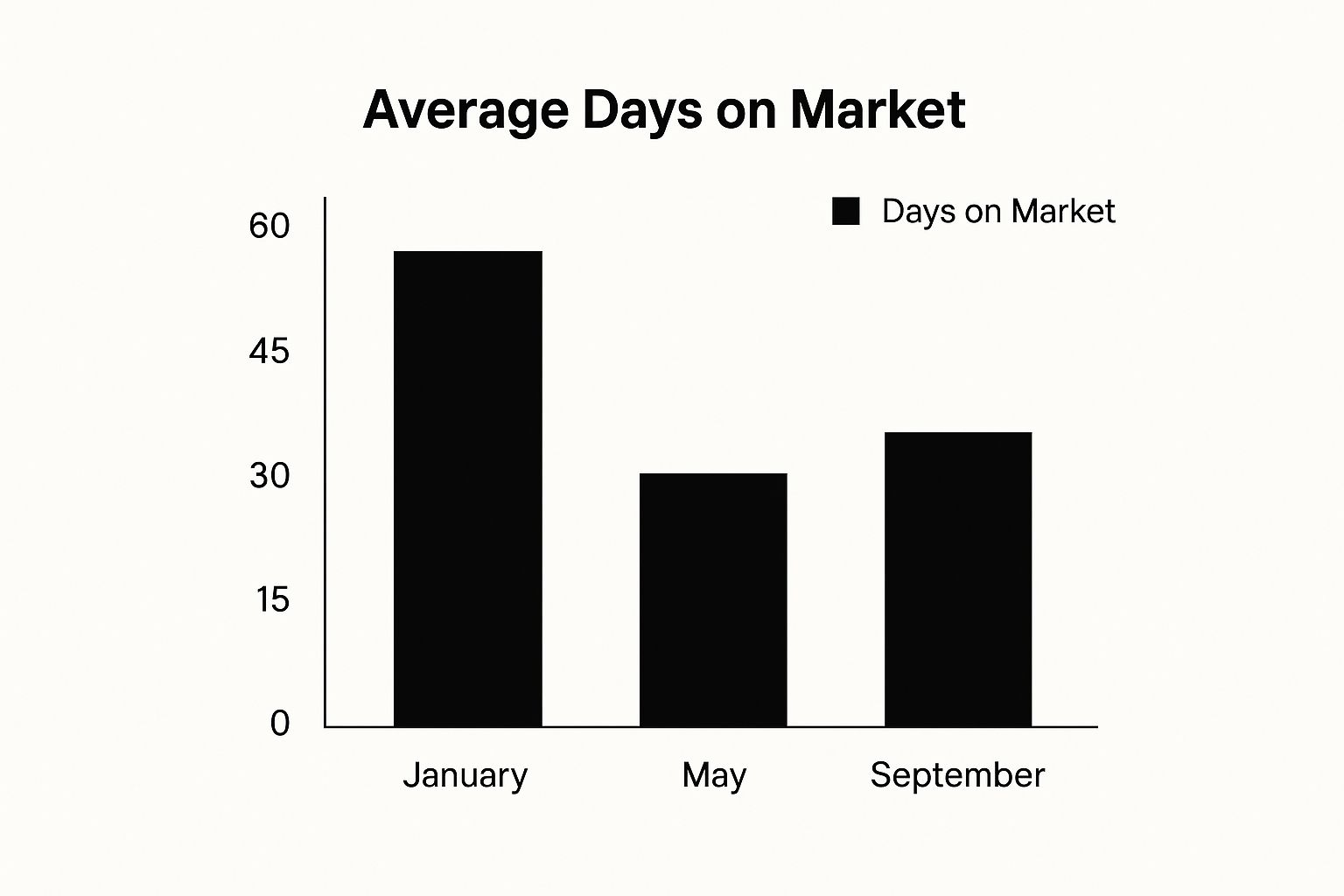
As you can see, homes listed in May sell way faster than those listed in the fall or winter. If you want to dive deeper into what influences this, you can learn more about the average time to sell a house in our detailed guide.
A Seasonal Snapshot of the Real Estate Market
To make it even clearer, let's break down what you can generally expect during each season. Think of this as your cheat sheet for understanding the annual rhythm of the real estate market.
| Season | Buyer Demand | Competition | Average Time on Market | Price Potential |
|---|---|---|---|---|
| Spring | Highest | High | Shortest | Highest |
| Summer | High | Medium | Short | High |
| Fall | Medium | Low | Longer | Medium |
| Winter | Lowest | Lowest | Longest | Lowest |
While spring often takes the top spot for price and speed, don't discount the other seasons entirely. Selling in the fall or winter means less competition, which can be a huge advantage if you have a standout property.
In fact, some in-depth analysis has even pinpointed the week of April 13-19 as potentially the single best time to list in 2025. Projections suggest that sellers listing during this prime window could see offers up to $27,000 higher than those who listed earlier in the year.
Of course, timing isn't the only thing that matters. You can boost your home's value and grab the attention of spring buyers by tackling projects like designing outdoor stone tile walls for timeless curb appeal to make your property truly shine.
Navigating the Four Seasons of Real Estate
If you've been around the block a few times, you know the housing market has a rhythm. It ebbs and flows with a predictability that feels a lot like the changing seasons. Getting a handle on this annual cycle is your first, best step toward timing your home sale just right.
Every season brings its own unique blend of buyer energy, seller competition, and general market vibe.
You can almost think of the real estate year as a four-act play. Each act has a different pace and mood, and knowing how to play your part can make all the difference in your final sale price.
The Spring Selling Frenzy
Let's be honest: spring is the blockbuster season for real estate. As the weather warms up here in Central California, buyers seem to come out of the woodwork, full of energy and ready to make a move. The days get longer, the flowers are blooming, and that natural boost to curb appeal doesn't hurt one bit.
Families, in particular, get serious this time of year. They're trying to lock down a home and get moved in before the next school year kicks off. All that demand translates into more showings, a higher chance of multiple offers, and, ultimately, better sale prices.
Historically, late spring through early summer is prime time. This window almost always lines up with the highest home prices and a frenzy of buyer activity.
The numbers don't lie. According to the National Association of Realtors, June 2024 saw the national median home sale price hit a record $426,900—the highest it's ever been. That peak is a direct reflection of the intense competition that defines the spring market. You can dig into more of these numbers in this detailed market analysis.
Summer's Strong but Steady Market
The momentum from spring definitely spills over into the early summer months. Buyers who struck out during the initial rush are still on the hunt, keeping demand high. But things can cool off just a tad as families start taking vacations and the initial frenzy dies down.
If you list in the summer, you're still playing in a very active market. The catch is, so is everyone else. Competition from other listings can get stiff, so making your home stand out is absolutely critical.
Autumn: A Second Chance Season
I've always seen fall as a fantastic "second chance" for sellers. The market is usually a bit quieter, meaning you aren't competing with a flood of other listings. The buyers still out there are the serious ones—they're motivated to find a place and close the deal before the holidays.
This creates a whole different dynamic. You might not get the sheer volume of traffic you'd see in April, but the buyers who do walk through your door are far more likely to be ready to write an offer. In a place like Central California, our mild weather extends this selling window even longer.
Winter: The Strategic Advantage
So many sellers write off winter as a dead zone, and that's a huge mistake. Yes, activity slows down, but that can actually work in your favor. With inventory at its lowest point all year, your home suddenly becomes a hot commodity with way less competition.
Winter buyers are almost never "just looking." They often have a pressing reason to move, like a job relocation. That high motivation, combined with the low supply of homes, can lead to a surprisingly fast and successful sale. It just goes to show that every season has its own opportunity if you know how to play it.
How Central California Rewrites the Rules
While national trends give you a decent playbook, the best time to sell a home in Central California often follows its own unique script. Our region’s distinct economy, weather patterns, and local growth mean that just copying the national "spring-frenzy" strategy can leave serious money on the table.
It helps to think of our market like a vineyard. Sure, there’s a main harvest season, but different grape varieties—and different neighborhoods—peak at completely different times.

Unlike places buried in snow every winter, Central California doesn't have a brutal cold season that brings the market to a screeching halt. Our mild, pleasant weather extends the prime selling season well into the fall, creating a much wider window of opportunity for anyone looking to sell. Buyers are out and about almost year-round.
This means that while the rest of the country is winding down in September and October, our market often stays surprisingly strong, attracting serious buyers who might have missed out during the spring rush.
Local Economic Rhythms Matter
Central California’s economy, with its deep roots in agriculture, creates unique market pulses that national data completely misses. For instance, the end of a major harvest season can bring a wave of financial stability to the region. That often translates into more confident homebuyers showing up in the fall and early winter.
This economic influence opens up specific windows of opportunity that a savvy seller can absolutely use to their advantage. A strong ag year could mean more local buyers with cash in hand, ready to upgrade or invest in a new property.
The key takeaway is this: local inventory levels and economic cycles in cities like Fresno, Clovis, or Bakersfield are far more predictive of your success than a national real estate report.
When local inventory is tight, listing your home—even in a nationally "slow" month like August or November—can spark a bidding war among motivated local buyers. An experienced local agent is invaluable here, as they can spot these micro-market trends and give you a powerful strategic edge.
Below is a quick look at how our local selling seasons can differ from what you might see on the national news.
Central California Selling Seasons vs National Averages
| Metric | Central California | National Average |
|---|---|---|
| Peak Selling Months | March – June & September – October | April – July |
| Strongest Price Premiums | Late Spring (+9.5%) & Early Fall (+6%) | Late Spring (+10.2%) |
| "Slow" Season | December – January (but less pronounced) | November – February (significant drop-off) |
| Primary Driver | Local Economy (Ag), Weather | School Schedules, Weather |
As you can see, our market has a "second wind" in the fall that many other parts of the country simply don't experience.
The Year-Round Advantage
The lack of a true "off-season" gives sellers in Central California incredible flexibility. Instead of feeling forced into listing in the spring, you can focus on what really matters: preparing your home properly and listing when your personal timeline and local market conditions align perfectly.
Just think about these local factors:
- Extended Curb Appeal: Our lawns stay green and flowers can bloom for much longer. This means your home's first impression is strong from March all the way through October, not just for a few months.
- Consistent Buyer Pool: We attract a steady stream of buyers relocating for jobs in healthcare, logistics, and agriculture. These folks move based on career timelines, not seasons.
- Less Seasonal Burnout: Buyers here don't feel that same frantic pressure to find a home before a harsh winter hits. This often leads to more measured and serious offers throughout the year.
Reading the Economic Weather Forecast
Timing your home sale isn't just about picking a season on the calendar; it's about reading the bigger economic climate. You can think of the economy as a weather system that can bring either sunny skies or stormy conditions to the housing market. Learning to read these patterns helps you list your property when the forecast is looking its best.
Just like a falling barometer hints at an approaching storm, certain economic indicators can predict big shifts in buyer behavior. The most important ones to watch are mortgage interest rates, inflation, and local employment data. When all three of these line up in your favor, they can create the perfect conditions for a fast and profitable sale.

Mortgage Rates: The Market's Accelerator
Mortgage rates are basically the gas pedal for the housing market. When rates are low, borrowing money is cheaper, which pushes that accelerator to the floor. This gives buyers a major boost in purchasing power, letting them afford more home and fueling some pretty intense demand.
On the flip side, when rates start to climb, it’s like someone’s tapping the brakes. Higher rates mean higher monthly payments, which shrinks what buyers can realistically afford. This can cool down a hot market in a hurry, reduce the number of active buyers, and leave homes sitting on the market for much longer. Keeping an eye on trends in https://edinhart.com/interest-rates-for-homes-in-california/ gives you a crucial heads-up on which way the market is about to turn.
Inflation and Employment Data
Inflation and local job numbers add another important layer to the forecast. High inflation can eat away at a buyer's savings and budget, making them much more cautious about making a big purchase. But a strong job market—especially right here in Central California—means more people have stable incomes and the confidence to buy a home.
A robust local economy with low unemployment often signals a seller's market, as confident buyers compete for a limited number of homes. This creates an ideal window to list your property for maximum return.
While you're sizing up these market conditions, it’s also a great time to think about which improvements offer the best home renovation return on investment to push your home’s value even higher.
By really understanding these key economic drivers, you can stop just reacting to the market and start making smart, strategic decisions. This is how you go from being a passive seller to an informed one, putting yourself in the best possible position for a great outcome.
Why Your Timeline Is the Most Important Factor
Sure, market data, seasonal trends, and economic indicators are fantastic tools, but they only ever tell part of the story. The absolute best time to sell your home is actually when it’s the best time for you. Life doesn’t pause for perfect market conditions, and your personal timeline is always the most critical piece of the puzzle.
Think of it like planning a big road trip. You can study weather forecasts and traffic reports for weeks trying to find that one "perfect" day to leave. But if you have to be at a wedding on Saturday, you’re leaving on Friday—rain or shine. Real estate works the same way; your personal needs often create their own non-negotiable deadlines.
When Life Dictates the Sale
Most home sales aren't triggered by market peaks, but by major life changes. These moments create a sense of personal urgency that easily outweighs waiting around for the ideal selling season to roll in.
Some of the most common personal drivers we see are:
- A New Job or Relocation: That fantastic career opportunity in another city simply won't wait for the spring selling season.
- A Growing Family: The arrival of a new baby has a funny way of making your current home feel a lot smaller, very quickly.
- Downsizing: The kids have finally moved out, and rattling around in a large, empty house just doesn't make sense anymore.
- Financial Needs: Sometimes, you need to tap into your home's equity to fund other important life goals.
The real magic happens when your personal readiness lines up with a market opportunity. Don't let the hunt for a "perfect" market paralyze you from making a move that's truly right for your life.
Your own circumstances are the real engine driving this decision. The market is just the road you happen to be traveling on.
Finding Your Personal Sweet Spot
So, how do you balance the realities of the market with your own needs? It starts by asking yourself a few honest questions to figure out where you stand. Getting clear on your motivations is the first real step toward a successful sale.
Give these questions some thought:
- Why am I selling? Is this a pressing need or more of a flexible desire?
- What is my ideal moving date? Work backward from that day to build a realistic timeline.
- Am I financially prepared for all the costs that come with selling and moving?
- Is my home truly ready for buyers to see it?
Answering these will help you and your agent build a strategy that fits your unique situation. For a more detailed guide, our checklist for preparing to sell your home can give you the clarity you need to move forward with confidence, no matter what the calendar says.
At the end of the day, a successful sale is one that perfectly aligns with both your financial goals and your life plans.
Let's Bust Some Common Home Selling Myths
There are a lot of old ideas floating around about the "perfect" time to sell a house, and honestly, a lot of them are just plain wrong. Believing these myths can be a costly mistake, causing you to list at the wrong time—or miss a golden opportunity altogether.
Let's clear the air and look at the facts. By understanding what’s really driving the market, you can stop guessing and start making smart, strategic decisions that actually work for you.
Myth 1: Spring is the Only Time to Sell
This is probably the biggest and most stubborn myth in real estate. Look, there's no denying that spring is a hot season for home sales. But it is far from the only game in town. Thinking you've missed your shot if you don't list by May is a surefire way to feel defeated.
The truth is, other seasons have some serious advantages. For instance, listing a cozy, well-staged home during the winter often means you have way less competition. The buyers who are out looking when it's cold are usually very serious, and they need to move. That can lead to a quicker sale and surprisingly strong offers.
The bottom line is that every season has its own unique pros and cons. It’s not about staring at the calendar; it's about understanding the supply and demand in your specific market at any given moment.
Myth 2: You Should Always Wait for the Absolute Peak
Trying to time the market perfectly is a dangerous game. It’s a bit like trying to catch a falling knife—you’re probably going to get hurt. If you hold out, waiting for that absolute peak price, things can turn on a dime. The economy shifts, interest rates change, and you could easily find yourself listing on the way down.
A much smarter strategy is to sell when the market is strong and, just as importantly, when you are personally ready to make a move. Listing in a solid, stable market is almost always better than gambling on hitting the jackpot.
In fact, some of the best windows of opportunity pop up when everyone else is looking the other way. While spring gets all the attention, data shows that early fall can be a fantastic "second chance" season for sellers. Research actually points to the week of late September to early October as a sweet spot with less competition from other sellers. Buyer demand might be about 31% lower than the spring peak, but the people who are looking are typically more focused and deliberate. You can discover more research about this fall selling window and see how it might just be the perfect time for your sale.
Your Questions Answered: Timing Your Sale
Even the best-laid plans can come with a few lingering questions. When it comes to selling your home, timing is everything, and it's natural to have some concerns. Let's tackle a few of the most common questions we hear from homeowners.
Is Selling My House During the Holidays a Bad Idea?
Not at all. In fact, it can be a surprisingly savvy move. The market definitely slows down, but the people out there looking during the holidays are usually very motivated. They often have a pressing reason to move—a job relocation, a family change—which means they're serious buyers ready to make a decision.
You'll also be dealing with far less competition from other sellers. A beautifully presented home, maybe with some tasteful holiday decor, can really stand out and capture a buyer's heart. This is especially true here in Central California, where our milder weather keeps the market chugging along year-round, unlike places that shut down for winter.
How Far Ahead Should I Prepare My Home for Sale?
Give yourself a good two to three months before you plan to put that "For Sale" sign in the yard. I know it sounds like a lot of time, but it’s the secret to getting everything done without feeling completely overwhelmed and stressed out.
This window of time gives you a comfortable buffer to:
- Declutter and Depersonalize: This is your chance to make your space feel bigger, brighter, and more inviting to potential buyers.
- Handle Necessary Repairs: Taking care of those little nagging issues now prevents them from becoming big sticking points during negotiations.
- Deep Clean Everything: A sparkling clean home sends a powerful message: this property has been loved and well-maintained.
- Consult with an Agent: Getting your agent involved early means you can hammer out a solid pricing and marketing strategy from the get-go.
Starting the prep work early is one of the single most effective things you can do. It ensures your home makes a fantastic first impression and helps you get the best possible price.
If I Miss the Spring Peak, Should I Wait a Full Year?
Absolutely not! Waiting a whole year is almost never the right call. The late summer and early fall often roll in as a fantastic "second chance" season for sellers. By then, a lot of the spring inventory has been snapped up, but there's still a strong pool of committed buyers out there.
These buyers are often trying to get into a new home and settled before the holidays kick off. And if inventory in your specific neighborhood happens to be low during this period, you could be in a prime position to field some very strong offers. The key isn't to be tied to a specific date on the calendar, but to adapt your strategy to what the market is doing right now.
Figuring out the ins and outs of the Central California real estate market really comes down to local experience. The team at Edinhart Realty and Property Management is here to help you pinpoint that perfect moment to sell, based on your own goals and what's happening in our market today. Contact us for a personalized consultation and let's get the conversation started.


