

If you own rentals in Fresno or anywhere in California, you probably know the pattern. Rent is due, one tenant mails a check late, another texts about a plumbing issue after hours, and somewhere in the middle you're trying to find the last lease addendum you swore you saved. None of that is complicated by itself. The problem is that it piles up, and once it does, ownership starts to feel like constant interruption instead of an investment.
That's where automation in property management becomes practical. Not flashy. Practical. The point isn't to turn your rental into a robot-run business. The point is to stop handling the same routine tasks by hand every month, especially the ones that create delays, missed follow-ups, accounting mistakes, and avoidable stress.
For California owners, that matters even more. You need clean records, timely communication, organized maintenance tracking, and a consistent process. Good automation helps with all of that. It protects your time, supports better tenant service, and gives you clearer visibility into what's happening at the property without requiring you to chase every detail yourself.
The End of Late-Night Calls and Lost Paperwork
A lot of owners start in the same place. One property becomes two. Then rent collection, repair calls, lease files, vendor invoices, and tenant questions start living in different places. Some are in email. Some are in text threads. Some are in a folder on your laptop. Some are in your glove box. That setup works right up until it doesn't.
The breaking point usually isn't dramatic. It's small failures repeated over time. A late payment reminder goes out late because nobody remembered. A maintenance request gets buried in a text chain. A repair invoice doesn't get entered until the end of the month. An owner statement takes too long to assemble because the numbers live in several systems, or in no system at all.
What owners are feeling right now
In real-world property operations, most stress comes from repeat tasks, not rare disasters. Owners don't lose sleep because a system sent a rent reminder on time. They lose sleep because they're still acting as the system.
That's why this shift isn't temporary. The property management software market reached $24.18 billion in 2024 and is projected to exceed $52 billion by 2032, with residential properties accounting for over 80% of activity, according to TenantCloud's property management statistics and trends. For rental owners, that tells you something important. Automation isn't fringe anymore. It's becoming standard operating procedure.
Practical rule: If a task happens every month, every lease cycle, or every maintenance cycle, it shouldn't depend on memory alone.
A lot of what owners call “management problems” are really process problems. The solution isn't more hustle. It's a cleaner operating system. That can mean automatic payment workflows, maintenance portals, scheduled notices, digital records, and support tools that keep communication from slipping through the cracks. For owners who want to understand how remote support fits into that mix, a property management virtual assistant model is one example of how repetitive coordination work can be handled without adding chaos.
What changes when the process is modernized
Once routine work is automated, the day feels different. You're not checking whether rent came in one tenant at a time. You're reviewing a status. You're not hunting down a maintenance note. You're looking at a tracked request with updates attached. You're not wondering whether a notice was sent. You can see it.
That's the promise of automation in property management. Less scrambling. More control. More peace of mind.
What Is Automation in Property Management Really
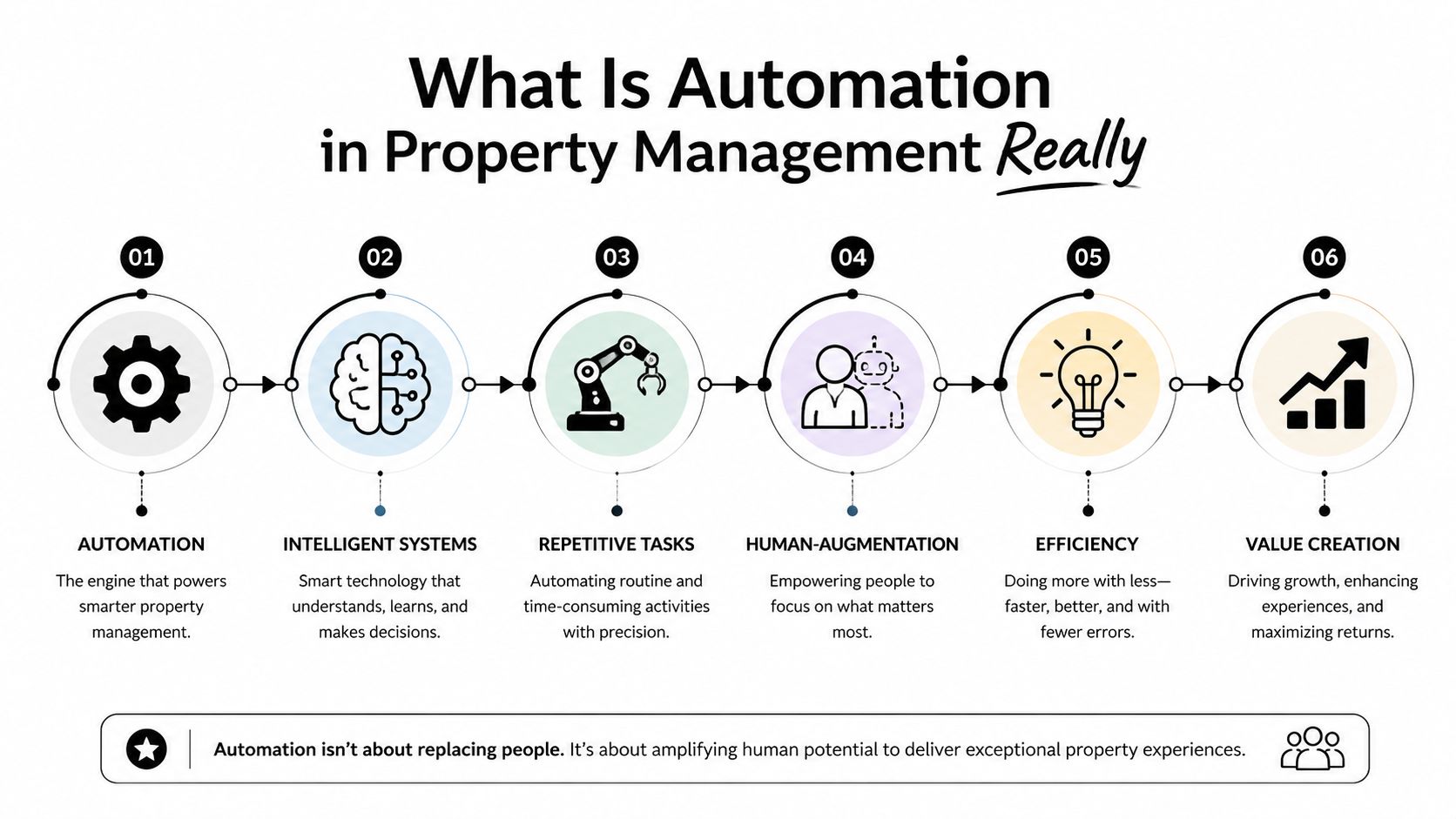
Automation in property management is best understood as autopilot for repeatable work. Not full autopilot for every decision. Just the kind that handles the predictable steps the same way, every time, so the human work can focus on judgment, exceptions, and relationships.
When owners hear “automation,” they sometimes picture a cold system replacing people. In practice, the useful version looks simpler. Software triggers a reminder. A payment posts and reconciles. A maintenance request gets logged, routed, and tracked. A leasing inquiry gets answered quickly instead of sitting overnight. Staff still manage the property. They just stop doing the same admin work by hand.
Here's the big picture visually.
Leasing and marketing
Leasing is one of the first places automation pays off because the work is repetitive and time-sensitive. Listings can be published across multiple channels from one system. Inquiry responses can go out automatically. Showing appointments can be coordinated through a portal or scheduling flow. Applications can be collected digitally instead of by email and attachment.
That doesn't mean standards get looser. It means the process gets tighter. Prospects move through the same sequence, and the owner or manager sees where each application stands.
Financial management
For many owners, immediate relief comes from automated processes. Rent collection, recurring charges, payment reminders, receipts, ledger entries, and monthly reporting all become more consistent when the system handles the repetitive pieces.
Instead of checking deposits manually and updating spreadsheets later, automated systems move money and records together. That matters because the operational side and the accounting side shouldn't drift apart.
Operations and maintenance
Maintenance is where weak processes become visible fast. Phone calls get missed. Notes get lost. Vendors don't get enough detail. Tenants feel ignored even when someone is trying to help.
With automation, the request starts in one place, gets documented, assigned, updated, and closed in the same chain. The workflow creates accountability because everyone is looking at the same record.
Tenant communication
Communication doesn't need to be personal to be effective, but it does need to be timely and consistent. Routine notices, payment reminders, move-in instructions, inspection scheduling, and renewal communication all work better when they aren't dependent on someone remembering to send them manually.
A simple way to understand it:
- Leasing automation handles inquiries, showings, and applications
- Finance automation handles rent flow, reconciliation, and reporting
- Maintenance automation handles requests, routing, and status updates
- Communication automation handles standard notices and recurring follow-up
Good automation doesn't remove the human side of management. It removes the repeated clerical work that gets in the way of it.
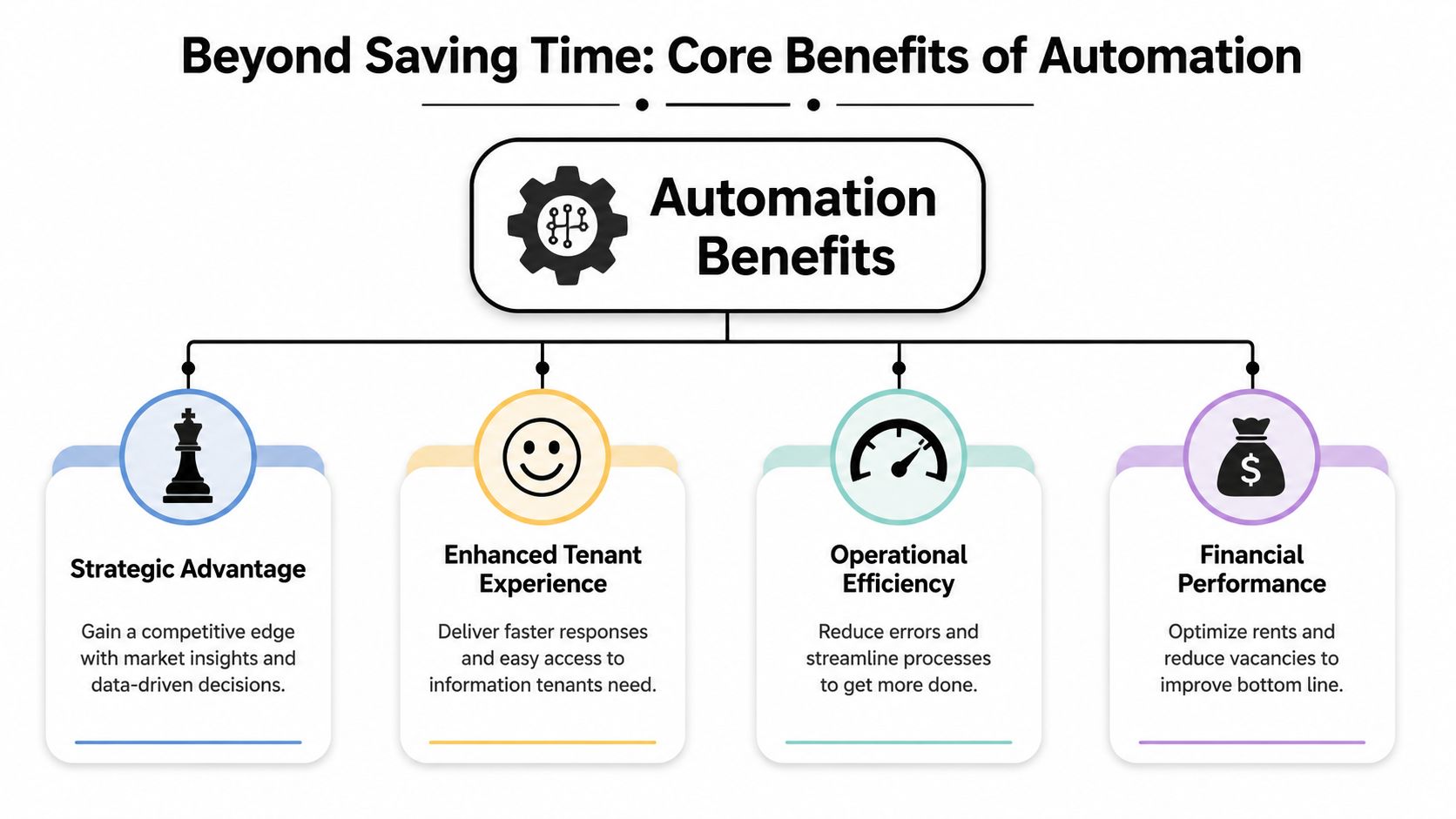
Four Core Benefits Beyond Saving Time
A Fresno owner usually notices the value of automation in a few specific moments. Rent posts without a stack of manual follow-up. A maintenance dispute has a clear record. Month-end reporting does not turn into a bookkeeping cleanup project. Those are operating wins, but they also protect income and reduce risk.
Lower operating friction
The biggest financial gain is not speed by itself. It is fewer dropped steps.
Manual processes create small leaks everywhere. Staff re-enter payment data. Vendors work from partial notes. Owners wait on reports that need correction before they are useful. Over a month or a quarter, that wasted labor shows up in higher admin cost and slower response times.
Automation cuts that friction by keeping work in one system from the start. For California owners, that matters because process discipline affects more than convenience. It affects whether the file is clear when a resident disputes a charge, asks for records, or claims a notice was never sent. If you are comparing platforms before making that change, this property management software comparison for California rental operations is a practical place to start.
Better tenant experience
Residents judge management by reliability. Can they pay without trouble? Can they submit a request at 9 p.m. without wondering whether it disappeared? Do they get clear next steps during a repair, renewal, or move-out?
Good automation improves those routine moments. It does not replace judgment or service. It helps your team respond in a consistent way, which is what reduces frustration and protects occupancy.
That matters in California, where turnover costs add up fast between vacancy, cleaning, make-ready work, leasing time, and compliance-sensitive notices. A process that feels organized to the resident usually feels more predictable to the owner too.
Faster and cleaner cash flow
Cash flow improves when the collection process has less drag. Payment reminders go out on schedule. Tenants have straightforward payment options. Transactions hit the ledger with fewer handoffs and fewer opportunities for error.
That cleaner trail also helps at reporting time. Owners do not just want money collected. They want accurate owner statements, reconciliations that tie out, and fewer questions at tax time. If you need outside accounting support connected to the operating side, a provider with experience in Xero bookkeeping services can help keep rent records and owner reporting aligned.
Stronger compliance habits
This benefit is easy to underestimate until something goes wrong.
California property management requires documentation. Lease files, maintenance records, invoices, notices, communication logs, inspection history, and timestamps all matter. In a full-service management model, that record supports day-to-day execution. In a placement-only model, it still matters during screening, lease preparation, and the turnover from leasing to owner management.
Automation does not make a bad process legal. It makes a good process repeatable. For owners, that means fewer gray areas and a clearer paper trail if a question comes up later.
| Owner concern | What automation changes |
|---|---|
| Missed follow-up | Scheduled tasks and status tracking reduce dropped steps |
| Messy accounting | Payments, fees, and records stay tied together from the start |
| Tenant frustration | Residents get easier payment, clearer updates, and faster routine responses |
| Documentation risk | Digital records create a usable history for disputes, audits, and compliance review |
Key Automated Property Management Workflows
A Fresno owner with six units usually feels the difference between manual management and automation in the same places every month. Rent follow-up slips a day or two. A maintenance text gets buried. An invoice shows up after owner statements go out. Automation works best when it fixes those repeat problems inside the actual workflow, not just by adding another app.
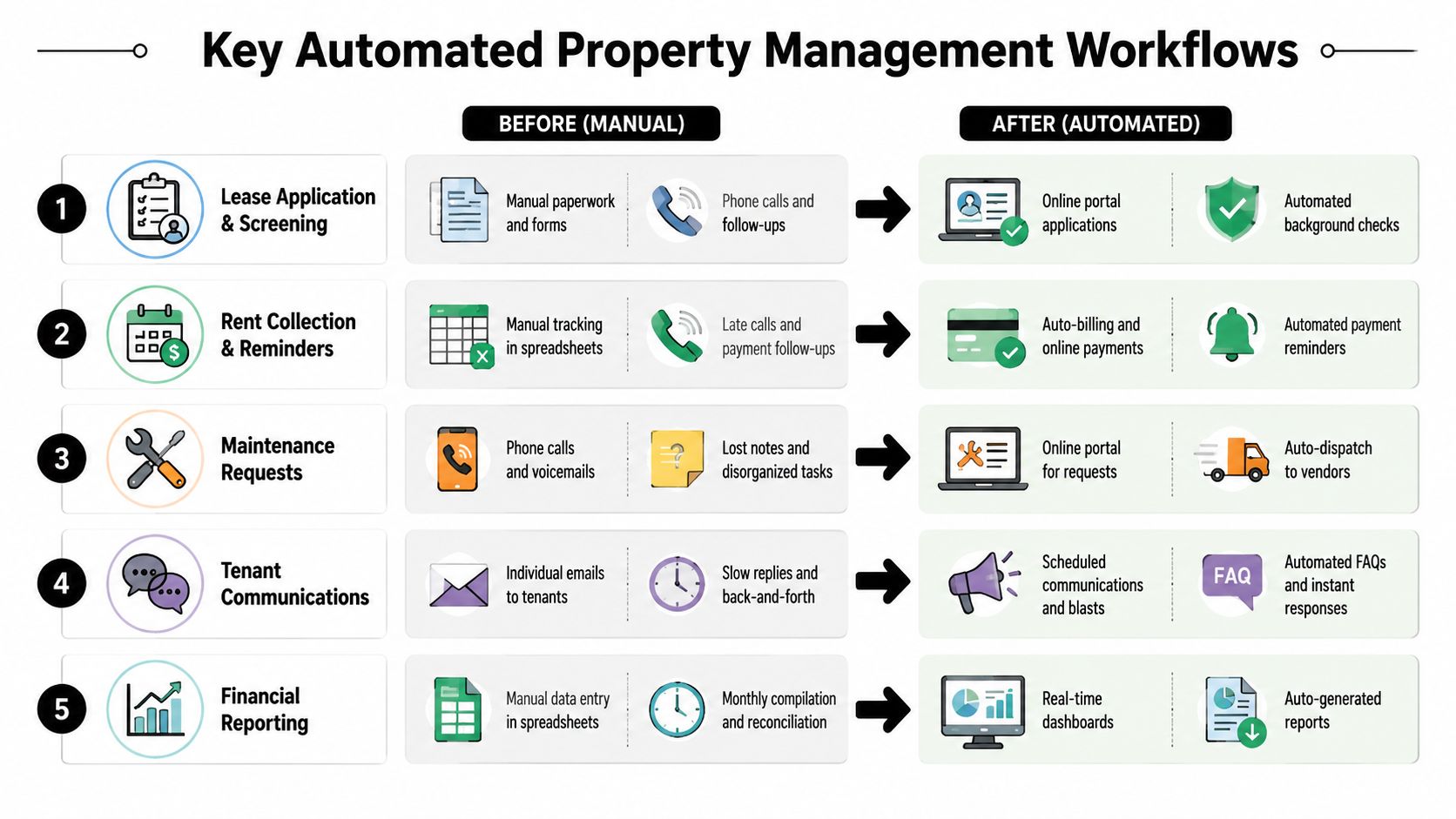
Rent collection and reminders
Manual collection depends too much on memory and follow-up. Someone checks the account, matches payments to tenants, sends reminders, answers payment questions, and then updates the ledger. That can work for one property. It usually gets messy once you have multiple units, partial payments, or late fees that need to be applied consistently.
An automated setup handles the repetitive steps on schedule. Residents receive reminders, pay through approved online methods, and the payment posts into the record tied to that tenant. For California owners, that matters beyond convenience. Cleaner payment records help with notices, reconciliations, and year-end reporting.
Maintenance requests and vendor coordination
Maintenance is often where owners lose the most time. A tenant sends a vague text. The owner forwards it to a vendor. The vendor asks for photos. Then everyone is working from different messages, and nobody has a clean timeline if the job drags out.
A better system starts with a portal request that requires the right details up front. Photos, category, urgency, and unit information go into one record. From there, the issue can be assigned, tracked, updated, and closed with the invoice attached. Owners comparing tools for that process should review a detailed property management software comparison before choosing a platform, because some systems are strong on leasing but weak on work order tracking.
Screening and onboarding
Leasing automation helps most when it creates consistency. Applications come in through one intake path, required fields are completed before submission, and the next step is triggered only after the prior one is complete. That reduces back-and-forth and helps keep placement decisions documented.
In California, that structure matters. Screening criteria, document handling, lease preparation, and move-in records all need to be managed carefully. In a placement-only model, this workflow carries much of the operational value. In a full-service model, it also sets up the resident record that accounting, maintenance, and communication will rely on later.
Routine tenant communications
A lot of resident communication is predictable. Payment confirmations, renewal notices, inspection reminders, and entry notices should not require fresh drafting every time.
Some firms also use an AI customer support platform for first-line responses to common questions. The trade-off is straightforward. It saves staff time on repetitive inquiries, but it should never be the final stop for habitability complaints, legal disputes, or anything that needs judgment and a documented human response.
If a message is routine, automate the draft, send, and recordkeeping. If the issue carries legal, financial, or emotional weight, hand it to a person quickly.
Financial reporting and accounting
Month-end reporting exposes weak systems fast. If rent activity, vendor bills, fees, and repairs are sitting in separate inboxes and spreadsheets, owner statements turn into a manual assembly project.
Automation works better when the bookkeeping starts during the work itself. Payments post when received. Bills attach to work orders. Fees and owner distributions follow predefined rules. That gives owners clearer statements and fewer cleanup questions later. For firms like Edinhart, that distinction also affects service model fit. Full-service management benefits from ongoing workflow automation across collections, maintenance, and reporting, while placement-only work gets the most value from automating screening, leasing documents, and turnover records at the front end.
A Practical Framework for Implementing Automation
Most owners make the same mistake at the start. They look for one system that does everything, buy too much at once, and then end up using only a fraction of it. A better approach is to automate one operational pain point first, then build from there.
Start with the workflow that causes the most drag
Don't begin with the most impressive feature. Begin with the task that repeatedly costs you time, creates tenant frustration, or introduces accounting risk.
For some owners, that's rent collection. For others, it's maintenance coordination. If you own in California, documentation-heavy workflows are often a smart place to start because recordkeeping protects you as much as efficiency does.
A useful first review usually looks like this:
- Identify one recurring bottleneck that happens often and causes avoidable follow-up
- Map the current steps so you can see where handoffs fail
- Choose a tool that fits the process instead of forcing a whole new operating model
Make sure systems connect cleanly
A tool that saves time in one area can create mess in another if it doesn't integrate with your accounting, communication, or maintenance process. That's why implementation is less about features and more about workflow fit.
For maintenance-heavy owners, a platform focused on property maintenance management software can be a strong starting point because maintenance usually touches tenant communication, vendor dispatch, cost tracking, and documentation all at once.
Keep the human handoff visible
One of the most useful cautions in this space comes from MRI Software's discussion of multifamily automation, which notes that the key question isn't just whether automation improves response speed, but whether it improves outcomes for tenants and owners. The strongest setups automate routine work while preserving clear escalation paths for issues like maintenance disputes or renewal negotiations.
That's the difference between helpful automation and frustrating automation.
Automate the predictable. Escalate the nuanced.
Train, test, then measure
A workflow isn't implemented just because the software is live. The team, owner, or manager has to use it the same way every time. Otherwise, the old manual habits creep back in and the system turns into a partial record instead of a reliable one.
Use a short rollout checklist:
- Train on actual scenarios such as a late payment, a plumbing request, or a lease renewal
- Test notifications and permissions before relying on them
- Review the first month closely to catch broken steps early
- Measure operational changes such as fewer manual reminders, cleaner records, or faster closure on routine requests
Don't automate every interaction
Some conversations should stay personal. Lease violations, repair disputes, non-routine accommodations, and sensitive renewal discussions usually need a person. Owners sometimes worry that automation will make management feel colder. Used correctly, it does the opposite. It removes the repetitive admin layer so the people involved can spend more attention where judgment matters.
How Edinhart Leverages Smart Automation for You
In California property management, the right use of automation depends on the service model. An owner who wants full operational support needs a different setup than an owner who only wants help leasing the property and screening applicants.
Full-service management
For a full-service relationship, automation works best when it supports the complete monthly cycle. That includes rent collection, repair coordination, tenant communication, move-in and move-out workflows, lease renewals, and owner reporting.
The owner benefit is straightforward. Instead of checking in to see whether something happened, you can review a documented process that's already in motion. Payment handling is more consistent. Maintenance communication is easier to track. Financial statements are easier to produce cleanly because the system captures activity as it occurs.
Placement-only service
Placement-only owners need a narrower type of automation, but it still matters. Marketing syndication, inquiry handling, application intake, screening workflow, and lease preparation all benefit from standardized digital steps.
That helps in two ways. First, it shortens the lag between vacancy and qualified applications. Second, it creates a more consistent screening and documentation process, which matters when you want strong tenants but still need a clean, defensible leasing file.
Why California process matters
California isn't a place where loose records are harmless. Owners need organized files, current forms, clear communication history, and disciplined maintenance documentation. In Fresno and the surrounding Central California market, practical management isn't just about filling a vacancy or collecting rent. It's about reducing risk while keeping operations steady.
That's where Edinhart Realty and Property Management fits the discussion as one operating model. Based on its published service structure, the firm applies automation differently depending on whether the owner chooses full-service monthly management or placement-only support, while also working within California Association of Realtors forms and ongoing legal updates.
Here's the distinction in simple terms:
| Service model | Where automation helps most |
|---|---|
| Full-service | Rent flow, maintenance tracking, tenant communication, renewals, accounting statements |
| Placement-only | Listing distribution, applicant workflow, screening coordination, lease drafting |
The important part isn't the label on the service. It's whether the process matches the owner's role. Some owners want to be hands-off. Others want help only at the front end. Good automation supports either model if the workflow is built deliberately.
Your Automation Questions Answered
Will automation make management feel impersonal
Not if it's used correctly. Routine tasks should feel easier, not colder. Tenants generally appreciate clear reminders, simple payment options, and a reliable maintenance request system. The mistake is trying to automate sensitive conversations that need judgment. Good systems handle the routine and flag the exceptions for a person.
Is this only useful for large portfolios
No. Small owners often benefit faster because they feel every interruption more directly. If you self-manage one home or a few units, a missed reminder or sloppy record can create outsized stress. Automation helps small portfolios by creating consistency, especially around rent, maintenance, and documentation.
What's the best first step
Start with rent collection and records. It's the cleanest entry point because the workflow repeats every month and affects both cash flow and bookkeeping. Once that process is stable, maintenance tracking is usually the next area to tighten up.
What should stay human
Keep a person involved when the issue is disputed, emotionally charged, legally sensitive, or outside normal workflow. That includes unusual maintenance complaints, lease violations, renewal negotiations, and anything where context matters more than speed.
How do I know if automation is actually helping
Look for operational signs, not hype. Are fewer things slipping through the cracks? Is rent easier to track? Are maintenance issues documented in one place? Are owner statements cleaner? Are tenants getting routine answers faster without creating more confusion? If those answers are yes, the system is doing its job.
Does California change the equation
Yes. California raises the value of process. Clean records, timely notices, consistent forms, and documented maintenance history all matter. Automation won't replace legal awareness, but it can support the habits that reduce avoidable mistakes.
If you want a practical look at how automation could fit your rental, Edinhart Realty and Property Management can help you evaluate where your current process is creating drag, what should be automated first, and whether a full-service or placement-only model makes more sense for your property and your level of involvement.


