

A Central California landlord can do everything right operationally, pay a dependable contractor on time, and still end up with a 1099 problem because the payment was coded incorrectly or never tracked by vendor. The 2026 tax year adds another layer: the federal reporting threshold for many contractor and rent-related payments has changed, so old year-end habits may no longer produce the right result.
Property managers handle a mix of owner disbursements, maintenance invoices, rent collections, ACH transfers, checks, card payments, and payment-app transactions. The practical answer to 1099 reporting requirements depends on three things: who received the money, what the payment was for, and how the payment was processed.
Why 2026 Changes Everything for 1099 Filing
Maria manages duplexes and small apartment properties in Central California. One of her plumbers repaired a water heater, then returned for three other service calls. By year-end, Maria had paid him $1,850. Under the old workflow, she would pull the vendor record in January and prepare a 1099-NEC because the plumber had crossed the familiar $600 benchmark.
Her CPA stopped that autopilot process. For payments made in 2026, the federal reporting threshold for qualifying payments reported on forms such as 1099-NEC and 1099-MISC is $2,000, compared with the former $600 threshold. The IRS instructions for information returns also state that inflation indexing begins in calendar year 2027, while payments made before 2026 generally remain subject to the earlier threshold.
Maria's $1,850 total falls below the new federal threshold for that payment category. That doesn't mean she should delete the plumber's W-9 or stop tracking the account. It means the property management system must distinguish between payments made in 2025 and payments made in 2026, and it must total payments by payee rather than treating each invoice as a separate decision.
The operational reset
The law changed the threshold, but the day-to-day controls still matter. Before the first contractor payment goes out, review:
- Vendor onboarding: Collect a completed W-9 and record the vendor's legal name, tax classification, address, and taxpayer identification number.
- Payment coding: Separate maintenance services, rent, attorney payments, reimbursements, and owner transfers instead of placing everything in one vendor expense category.
- Payee-level tracking: Total payments to each contractor across the calendar year. A low-value invoice can become reportable after several service calls.
- Year-end review: Reconcile the vendor ledger to the general ledger before forms are generated.
The shift also makes it risky to assume that every old accounting rule still works. A useful overview of how information-return obligations affect specialized entities appears in IRS 1099 requirements for CEFs, while landlords who are preparing their broader records can also use this rental-property tax-season guide.
Practical rule: Keep collecting W-9s even when a vendor appears unlikely to reach the threshold. The document supports accurate records, future payments may change the outcome, and missing tax information is difficult to repair in January.
What 1099 Forms Actually Are and Why They Exist
A 1099 isn't a tax bill. It's an information return used to tell the IRS and the payment recipient that a business made a particular type of payment during the year. The recipient generally handles the income on their own tax return, whether or not the payer ultimately issues a form.
For a property manager, the form follows the character of the payment, not merely the fact that money left the bank account. A plumber paid for services is different from an owner receiving rent proceeds, and both are different from a payment processed through a card network.
The three forms landlords encounter most often
Form 1099-NEC is used for qualifying nonemployee compensation paid in the course of a trade or business. That usually means payments to independent contractors who repair, maintain, clean, care for lawns, paint, inspect, or otherwise service rental property.
Form 1099-MISC covers certain other reportable payments, including qualifying rents, royalties, and specified miscellaneous categories. A property management company may encounter it when reporting rent paid in a business context to an appropriate recipient, rather than when collecting tenant rent for an owner.
Form 1099-K is different. A third-party settlement organization, payment app, online marketplace, or card network generally handles that reporting. The property manager shouldn't create a 1099-K for a contractor simply because the contractor accepted an electronic payment.
The IRS explanation of Form 1099-K distinguishes third-party settlement transactions from card payments. It also states that the current third-party settlement test is based on annual gross payments exceeding $20,000 and more than 200 transactions, while card payments have no threshold.
| Form | What it reports | Common property management use |
|---|---|---|
| 1099-NEC | Qualifying nonemployee compensation | Payments to contractors and service providers |
| 1099-MISC | Qualifying rents, royalties, and other specified payments | Business rent payments and other reportable categories |
| 1099-K | Payment-card and third-party network transactions | A form generally issued by the processor, not the property manager |
The nonemployee compensation category moved from Form 1099-MISC to Form 1099-NEC in 2020. That change still causes confusion when landlords rely on old bookkeeping templates. The safest approach is to ask what the payee did and which reporting party processed the payment, then select the form that matches those facts.
The New $2,000 Reporting Threshold Explained
For qualifying 2026 payments, the federal threshold for many Form 1099-NEC payments and several Form 1099-MISC categories is $2,000, replacing the long-standing $600 floor. The IRS Publication 1099 guidance says the new amount applies to tax years beginning after 2025, with inflation indexing beginning in calendar year 2027.
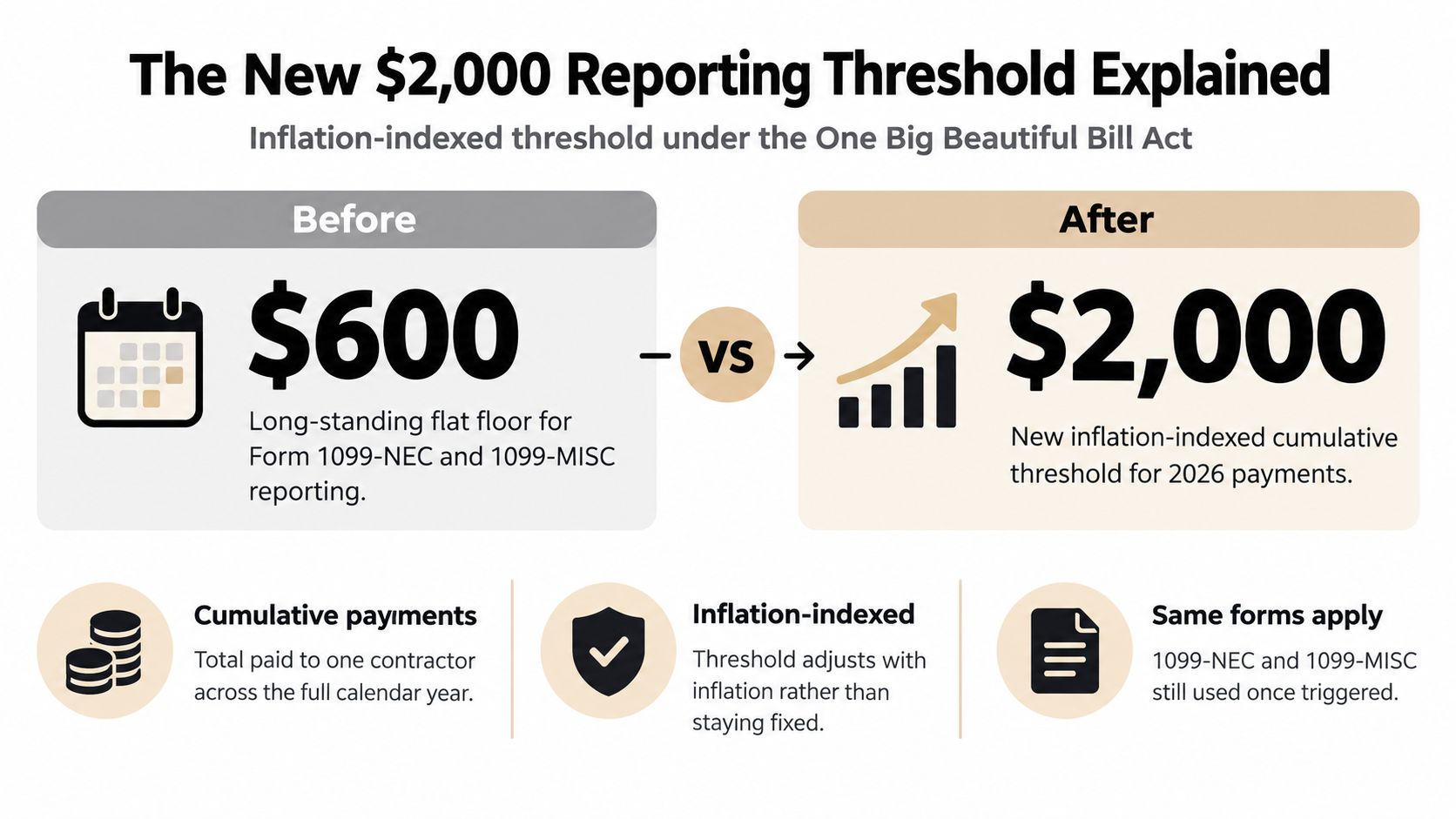
The threshold is applied by payee and calendar year. It isn't a test of whether one invoice reaches $2,000. Maria's plumber received $1,850 across four calls, so that total is below the federal threshold for qualifying 2026 service payments. A painting contractor who billed $2,400 for a unit turn crosses it, even if the work was completed under one project and paid in several installments.
What property managers should track
Create a cumulative vendor total that includes all payments that belong to the same reporting category. Don't let separate properties hide the total. If one contractor works at three houses managed by the same business, the accounting review should be able to identify the common payee and aggregate the relevant payments.
The threshold applies separately to each payee. A property manager who pays several handymen smaller amounts can't combine them into one total to decide whether a form is required. Conversely, a contractor who receives payments from several managed properties may reach the threshold even though no individual property appears to have a reportable amount.
The new rule also doesn't rewrite every 1099 threshold. Form 1099-K follows its own rules, and the $2,000 statutory change for qualifying 1099-NEC and 1099-MISC payments doesn't alter the separate processor reporting framework. Future inflation adjustments make vendor-level tracking more important, not less. A fixed spreadsheet copied from the prior year will eventually become stale.
The bookkeeping decision happens throughout the year. January should be a verification period, not the first time anyone totals contractor payments.
Which Payments Property Managers and Landlords Must Report
The rent-versus-service distinction solves many property management mistakes. Tenant rent collected for an owner is not automatically a 1099 event for the manager. The manager must instead examine whether the business paid a reportable amount to the owner, contractor, attorney, or other recipient in a category covered by an information return.
Services paid to independent contractors
A landlord or management company commonly reviews payments to plumbers, electricians, grounds maintenance workers, handymen, carpet cleaners, pest-control vendors, painters, roofers, and HVAC technicians for Form 1099-NEC treatment. The relevant question is whether the payment was for services performed by a nonemployee in the course of the business and whether the payee reached the applicable cumulative threshold.
The payment method doesn't turn a service into rent. Checks, ACH transfers, and other direct payments still need to be classified by purpose. Payments made by card or through a third-party network may also create separate processor reporting, so don't assume the property manager should issue a second form.
Rent, legal fees, and owner-related payments
Form 1099-MISC is the form to review for qualifying business rent payments, royalties, and other categories assigned to that form. Rent paid by a trade or business to a reportable recipient is different from rent collected from a tenant on behalf of a property owner. Agency arrangements require careful review of who legally made the payment and who received it.
Attorney payments have their own reporting treatment, and corporations, exemptions, and payment type can affect the outcome. Don't rely on a vendor's industry label alone. A company called “Property Repairs LLC” may be incorporated, while an individual operating under a trade name may not be.
| Payment type | Form to review | Box or threshold consideration |
|---|---|---|
| Contractor maintenance or repair services | 1099-NEC | Qualifying 2026 service payments reaching $2,000 |
| Business rent paid to a reportable recipient | 1099-MISC | Qualifying 2026 rent payments reaching $2,000 |
| Payment to an attorney | Form determined by the payment category | Some attorney reporting rules remain separate from the general service threshold |
| Card or third-party network collection | 1099-K | Generally handled by the payment processor under its own rules |
| Tenant rent collected for an owner | Usually not a manager-issued 1099 event by itself | Review the agency agreement and actual payment flow |
The IRS guidance on whether a business must file an information return is useful when a payment doesn't fit the normal maintenance pattern. For daily operations, clear vendor records and a disciplined contractor management process are more reliable than trying to reconstruct classifications from bank statements after year-end.
Filing Deadlines and How to Submit Correctly
For 2026 payments, furnish recipient copies of Forms 1099-NEC and 1099-MISC by January 31. Form 1099-NEC is also due to the IRS by January 31. Form 1099-MISC is due to the IRS by February 28 when filed on paper or March 31 when filed electronically, as reflected in the IRS instructions for Form 1099-MISC.
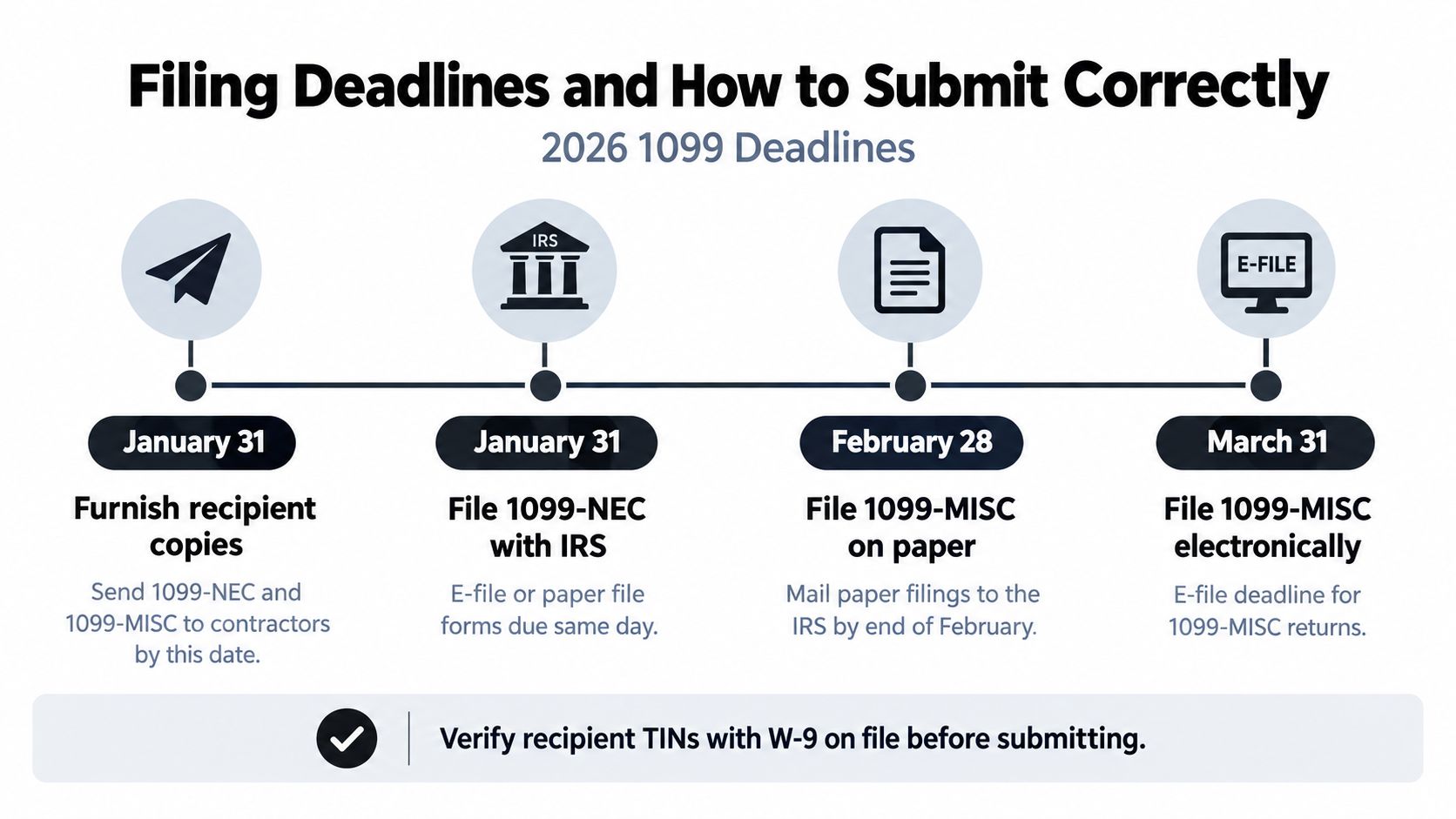
The recipient deadline deserves special attention. A form sitting in an accounting inbox isn't furnished until the payee receives it through the required delivery method. Confirm mailing addresses and electronic delivery permissions before the deadline week.
Choosing paper or electronic filing
The IRS requires electronic filing once a business reaches 10 or more information returns in aggregate. A property management office can reach that level quickly when it reports multiple contractors, owners, attorneys, or other recipients. Count the business's information returns together rather than assuming each form type has its own separate allowance.
Electronic filing can reduce manual transcription, but it requires an active process, accurate payer information, and a valid EIN. The IRS Filing Information Returns Electronically system is the relevant federal channel, and a business that hasn't prepared for electronic filing shouldn't wait until the last few days to discover that its account or authorization isn't ready.
Paper filing requires the correct official forms and the associated transmittal process. It can work for a small volume, but manual entry creates more opportunities for a mistyped TIN, wrong box, missing copy, or mismatched payer address. If paper is the right choice, order official forms through IRS.gov early enough to allow for delivery and replacement forms.
December sequencing: Close the books, reconcile vendor totals, verify W-9 information, prepare draft forms, and resolve exceptions before January begins. The January 31 deadline is manageable when the work is spread across the year.
Penalties for Late or Incorrect 1099s
Late or incorrect information returns create two separate problems. The IRS may assess a penalty against the payer, and the recipient may receive an income document that doesn't match their own records. Property managers then spend time tracing a payment, correcting a TIN, preparing a corrected form, and explaining the discrepancy to an owner or contractor.
The risk grows with volume. A manager with numerous contractors doesn't have one 1099 decision to fix. Each affected payee and each required recipient copy can create a separate compliance item, which is why a small bookkeeping shortcut can become an expensive administrative problem.
The mistakes that cause the most trouble
Missing W-9 information makes it difficult to verify the payee's legal name and taxpayer identification number. A trade name in the property management software may not match the name associated with the TIN.
Wrong payment classification can send a service payment to Form 1099-MISC when it belongs on Form 1099-NEC, or treat a processor-reported payment as though the property manager must issue a 1099-K.
Incomplete recipient delivery creates a separate operational failure. Filing with the IRS doesn't replace the obligation to furnish the appropriate copy to the payee.
Unresolved TIN issues can lead to notices, corrections, and backup-withholding questions. Don't wait for a notice to compare the vendor's W-9, accounting profile, and issued form.
| Filing status | Potential consequence | Practical response |
|---|---|---|
| Filed after the applicable deadline | IRS penalty exposure can increase with delay | Maintain a calendar with preparation dates before the legal deadline |
| Incorrect name or TIN | Corrections, notices, and additional administrative work | Verify the W-9 against the vendor record before filing |
| Recipient copy not furnished | Separate compliance exposure | Track delivery, mailing, or approved electronic transmission |
| Wrong form or payment category | Reconciliation problems for payer and recipient | Review the service, rent, attorney, or processor classification |
Most 1099 forms don't offer the same flexibility people associate with extending an income tax return. An extension may not solve the underlying recipient-copy or classification problem. The practical defense is a clean vendor file, an exception list, and an early review that gives the bookkeeper time to correct errors before submission.
Your Year-Round 1099 Compliance Checklist
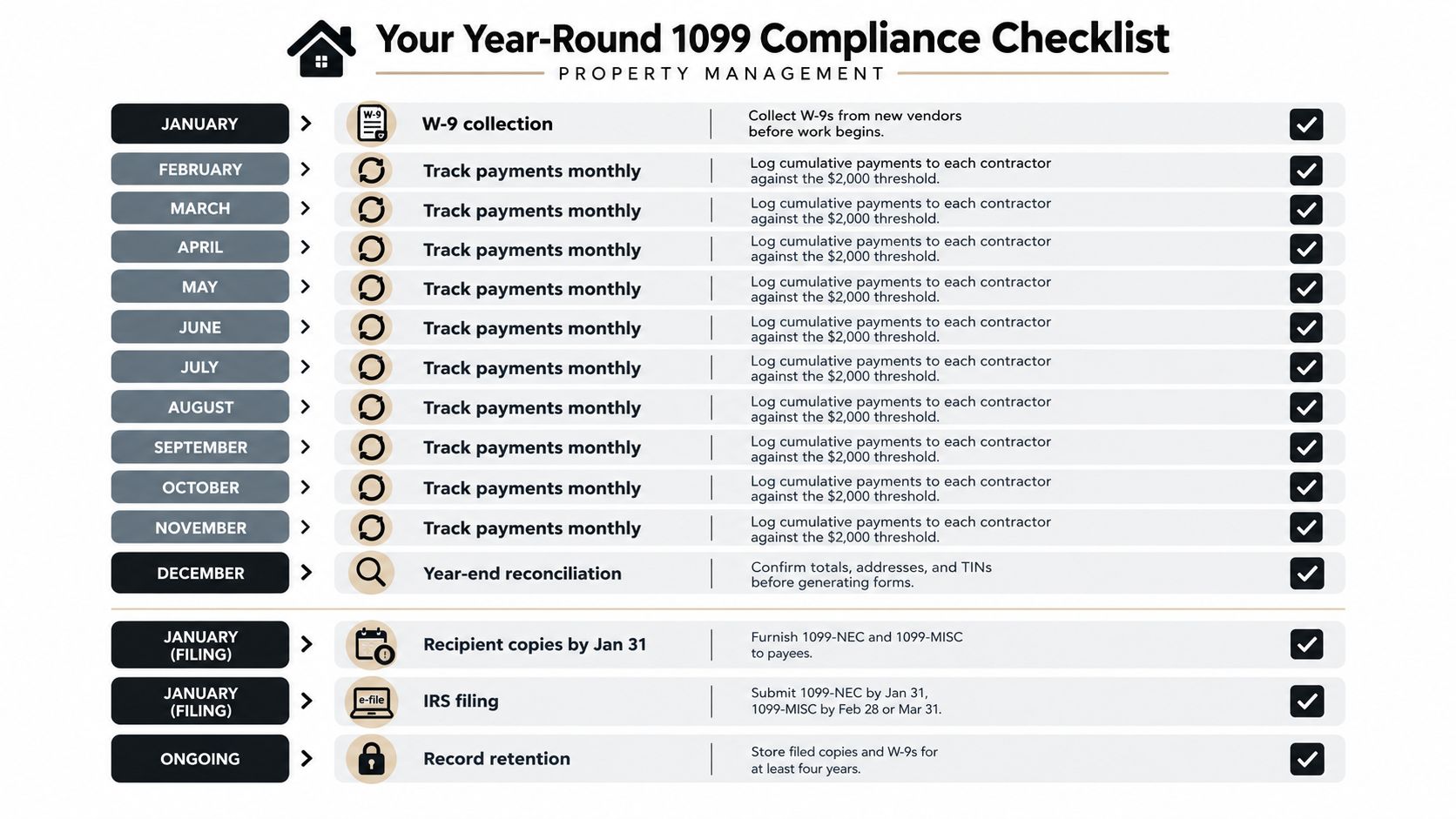
A property manager shouldn't have to rebuild the vendor ledger every January. Use a separate 1099 field in the property management software or maintain a dedicated ledger that follows each payee across every managed property handled by the same reporting business.
January through March
- Collect before work starts: Request a W-9 from every new contractor before the first service payment. Record the legal name and TIN exactly as supplied.
- Review existing vendors: Identify missing, outdated, or incomplete W-9s. Don't assume a long-standing vendor's profile is still accurate.
- Close prior-year corrections: Resolve returned mail, name mismatches, duplicate vendors, and payments assigned to the wrong property or category.
April through November
- Track by payee: Add every qualifying service payment to the vendor's cumulative total. Separate reimbursements and nonreportable items only when the records support that treatment.
- Run a threshold sweep: Review vendors approaching the federal threshold and confirm that multiple property ledgers aren't splitting the same payee.
- Update the file: If a contractor changes legal structure, address, or tax classification, obtain new documentation rather than overwriting history without an audit note.
December through filing
- Reconcile the ledger: Compare the 1099 report to the general ledger, bank activity, accounts payable records, and owner statements.
- Check the form choice: Confirm that service payments, qualifying rent, attorney payments, and processor transactions haven't been mixed together.
- Prepare recipient copies: Verify names, addresses, TINs, amounts, and delivery method before generating forms.
- Keep proof: Store filed forms, delivery records, and W-9 documentation in an organized vendor folder.
A practical 1099 compliance guide from Bookkeeping and Accounting of Florida can give a bookkeeper another checklist for the control process. For property managers, the most useful record-keeping practices are the ones that connect each payment to a vendor, property, category, and supporting document.
Hand this abbreviated list to a new bookkeeper:
- W-9 received before payment.
- Legal name and TIN entered exactly.
- Payment category reviewed.
- Vendor total updated during the year.
- December ledger reconciliation completed.
- Draft form checked against source records.
- Recipient copy delivery confirmed.
- IRS submission confirmation retained.
California-Specific Rules and Final Takeaways
Federal compliance is only one part of a California property manager's review. A California business may have state reporting, withholding, or information-matching responsibilities that don't line up perfectly with the federal form decision. The Franchise Tax Board can compare information reported by payers with state tax records, so a clean federal file is useful, but it doesn't answer every California question.
That matters near the Central Valley's property boundaries. A contractor may live in California, operate through an entity, or perform work across state lines. A property owner may also live outside California while owning a Fresno, Clovis, or surrounding-area rental. Those facts can affect the state forms and withholding analysis, particularly where California-source payments and nonresident recipients are involved.
A practical California review
Start with the vendor's legal identity and tax residence, not just the mailing address on an invoice. Ask whether the payee is an individual, partnership, corporation, or other entity, and keep the W-9 or equivalent documentation with the vendor record.
Then separate federal form preparation from California review:
- Federal classification: Decide whether the payment is a qualifying service, rent, attorney, or processor transaction.
- California connection: Determine whether the payee, property, or services create a California reporting or withholding question.
- State forms: Review whether forms such as FTB Form 592 apply to the payment and recipient facts.
- Backup withholding: Treat it as a specific compliance issue triggered by particular circumstances, not as a routine deduction from every contractor payment.
- CPA escalation: Send unusual owner, nonresident, entity, and cross-border situations to the business's tax professional before issuing forms.
Don't use the federal $2,000 threshold as a universal answer for every state obligation. The federal threshold change is the central 2026 reset, but California analysis may require a separate review of the payment and recipient.
For the next compliance cycle, confirm W-9s in the first quarter, run a midyear vendor-threshold sweep, reconcile the books in early January, and decide by mid-January whether electronic or paper filing fits the business's total return volume. That workflow is more dependable than relying on memory or copying last year's form settings.
Edinhart Realty and Property Management provides annual 1099 forms, yearly reports, and monthly property management statements that owners can give to their CPA. If you want help coordinating rental operations and year-end reporting for Central California properties, visit Edinhart Realty and Property Management.


