

Ever heard of a 1031 exchange? Think of it as a powerful tool in a real estate investor's kit that lets you swap one investment property for another without getting hit with an immediate capital gains tax bill.
This tax deferral is a game-changer. It unlocks your buying power by letting you roll your full sale proceeds into a new property, rather than handing over a chunk to the IRS right away.
Benefits of a 1031 Exchange for Investors

It’s almost like trading up in a video game. You swap a lower-level character for a stronger one but get to keep all your hard-earned experience points. A 1031 exchange works the same way for your equity, preserving it by pushing taxes down the road.
Suddenly, you have a lot more capital to work with on your next deal. It’s a strategy that allows you to:
- Defer Taxes: Postpone paying capital gains, giving your money more time to grow.
- Reinvest Everything: Put 100% of your sale proceeds into the next property.
- Scale Your Portfolio: Gradually trade up for bigger and better properties.
- Grow Flexibly: Keep your investment’s compounding potential firing on all cylinders.
Continuity of Investment Growth
At its core, a 1031 exchange is all about maintaining the continuity of your investment. When you sidestep that immediate tax bill, you keep your capital working for you, not sitting in government coffers. Over time, this creates a snowball effect that can seriously amplify your returns.
A deferred tax is like an interest-free loan from the government.
That little piece of wisdom sums it up perfectly. By delaying what you owe, you have more fuel to power your acquisitions. Keeping that deferred tax money in your pocket lets you chase bigger, more valuable deals much sooner than you otherwise could.
To put it simply, here are the main advantages at a glance:
Key Benefits of a 1031 Exchange
| Benefit | How It Helps You |
|---|---|
| Tax Deferral | Frees up your capital so you can reinvest it immediately. |
| Full Reinvestment | Lets you use 100% of your sale proceeds for the next purchase. |
| Portfolio Scaling | Makes it easier to upgrade from smaller properties to larger, higher-value assets. |
| Compounding Growth | Keeps your investment momentum going strong without interruption. |
It's a straightforward path to building wealth more efficiently.
Scaling Real Estate Holdings
With each successful exchange, an investor can methodically climb the property ladder. For instance, you could swap a single-family rental for a duplex, then later exchange that duplex for a fourplex, and so on.
The process itself is very structured:
- Identify the potential replacement properties you want to acquire.
- Engage a Qualified Intermediary to hold your funds during the transaction.
- Complete the entire exchange within the strict deadlines set by the IRS.
This turns what seems like a complex tax rule into a clear, tactical plan for growth. Every swap becomes a stepping stone to a stronger, more valuable portfolio.
If you need help finding the right kind of property to maximize your exchange, you might be interested in our guide on selecting investment homes.
Aligning with Long-Term Strategies
The 1031 exchange is tailor-made for investors who are in it for the long haul. It aligns perfectly with proven long-term investing principles that focus on steady, generational wealth-building.
This isn't a "get rich quick" scheme. It's a method best suited for those who see real estate as a lifelong endeavor. By deferring taxes indefinitely through one exchange after another, some investors are even able to pass their entire portfolios to their heirs with a stepped-up basis, potentially eliminating the deferred tax liability altogether.
At the end of the day, a 1031 exchange isn’t just a tax tactic. It’s a foundational strategy for continuously deploying your capital, scaling your holdings, and compounding your wealth over decades.
How the Modern 1031 Exchange Came to Be
To really get a feel for the strategic muscle behind a modern 1031 exchange, it helps to know where it came from. This powerful tool wasn't just invented overnight; it was shaped over decades, born out of the practical needs of American farmers and investors.
The original idea was refreshingly simple. In its earliest days, it was all about supporting the agricultural community. The logic was that swapping one productive farm for another wasn't a "cash-out" moment—it was just a continuation of the business. That commonsense foundation paved the way for its future in real estate.
The concept first popped up in the Revenue Act of 1918 to allow for tax-free swaps of livestock. By 1921, it had expanded to include like-kind real estate. But there was a huge catch: you basically had to do a simultaneous swap, which was almost impossible to pull off in the real world. You can get a deeper dive into how the 1031 exchange process has evolved over on Accruit.com.
The Game-Changing Starker Case
For years, that "simultaneous swap" rule kept the 1031 exchange on the sidelines. Let's be real, finding two people who want each other's property at the exact same time is a logistical nightmare. But that all changed thanks to one landmark court case.
Back in 1979, the Starker family took on the IRS in a battle that would completely reshape real estate investing. T.J. Starker sold timberland, but instead of getting a new property right away, the buyer agreed to find and transfer suitable properties to him down the road.
The IRS cried foul, saying this "delayed" exchange didn't count. But the Ninth Circuit Court of Appeals sided with Starker, ruling that an exchange didn't have to happen at the same time to qualify for the tax deferral. For investors, this was a massive win.
The Starker case was the catalyst that transformed the 1031 exchange from an obscure tax code section into one of the most powerful wealth-building tools in real estate.
This legal victory swung the door wide open for what we now call the delayed 1031 exchange. It finally gave investors the breathing room they needed to sell a property first and then go find a replacement, making the whole strategy infinitely more practical.
Congress Steps In With Clear Rules
While the Starker decision was a huge step forward, it also left things a bit murky. How long could you delay an exchange? To clear up the confusion, Congress stepped in and officially wrote the delayed exchange into law in 1984.
This is where the strict deadlines we live by today came from:
- The 45-Day Identification Period: You have exactly 45 days after selling your property to formally point out potential replacement properties.
- The 180-Day Closing Period: You have to seal the deal and acquire the new property within 180 days of your original sale.
These rules created a predictable, standardized playbook. The law also made the role of the Qualified Intermediary (QI) official—a required neutral third party who holds the cash from your sale. This prevents you from touching the money (or having "constructive receipt"), which is key. This history shows how a simple idea grew into the structured, reliable strategy investors use today to keep their capital working and growing.
Navigating the Critical Timelines and Rules

The real power of a 1031 exchange comes from its structure, but that power is protected by a set of strict, non-negotiable rules. Think of it as a high-stakes game where you have to follow the playbook perfectly to win. Just one slip-up or one missed deadline, and the entire tax-deferral benefit can disappear in a puff of smoke.
Success really boils down to three key things: the unforgiving timelines, understanding what "like-kind" property actually means, and the vital role of a Qualified Intermediary. Once you get a handle on these, what seems like a daunting process becomes a manageable and incredibly effective way to grow your investments.
The Unforgiving 45-Day Identification Period
The second the sale of your original property (the "relinquished property") closes, two clocks start ticking at the same time. The first and most urgent one is the 45-day identification period. This deadline is set in stone. There are absolutely no extensions for any reason—not for weekends, not for holidays, not for anything.
Within this tight 45-day window, you have to formally identify, in writing, the potential replacement properties you plan on buying. This isn't just a casual shopping list; it's a binding declaration you submit to your Qualified Intermediary.
The 45-day rule is where many unprepared investors get tripped up. It requires you to be proactive and decisive, often meaning you need to have potential properties already scouted before your original property even sells.
To keep the IRS happy, you have to stick to one of three specific identification rules:
- The Three-Property Rule: This is the most common path. It lets you identify up to three potential replacement properties, no matter their value. You only need to end up buying one of them to complete the exchange.
- The 200% Rule: If you need to identify more than three properties, you can, but there's a catch. Their total fair market value can't be more than 200% of the value of the property you sold.
- The 95% Rule: This one is pretty rare. You can identify as many properties as you want, but you are required to acquire at least 95% of the total value of all the properties you put on that list.
If you don't properly identify a property within this tight timeframe, your 1031 exchange is automatically disqualified. Game over.
The 180-Day Race to the Finish Line
The second clock that starts ticking is the 180-day closing period. You must purchase and close on one or more of your identified replacement properties within 180 days from the day you sold your original property.
It's crucial to understand that this 180-day period runs at the same time as the 45-day window. You don't get 45 days plus another 180. You get a total of six months to get the entire transaction done, from start to finish. This deadline has to account for everything—due diligence, securing financing, and all the closing paperwork.
To make it crystal clear, here’s how the timeline plays out.
Your 180-Day 1031 Exchange Timeline
| Day Countdown | Key Milestone | Action Required |
|---|---|---|
| Day 0 | Sale of Relinquished Property Closes | The clock starts now. Your exchange period has officially begun. |
| Day 1-45 | Identification Period | You must submit a written, signed list of potential replacement properties to your QI. |
| Day 46-180 | Acquisition Period | You must successfully close the deal on at least one of the properties from your list. |
Every day counts, so staying organized and working with a proactive team is essential to hitting these deadlines without any drama.
Defining Like-Kind Property
One of the most flexible—and often misunderstood—parts of a 1031 exchange is the idea of "like-kind" property. The term doesn't mean you have to trade a duplex for another duplex. It's much broader than that.
"Like-kind" actually refers to the nature or character of the property, not its quality or grade. When it comes to real estate, the rule is surprisingly generous. Basically, any real property held for productive use in a business, trade, or for investment can be exchanged for any other real property held for the same purpose.
This opens up a whole world of strategic moves. For instance, you could exchange:
- A duplex for a plot of raw land.
- An apartment building for a commercial office space.
- A rental condo for a retail storefront.
- Farmland for an industrial warehouse.
This flexibility lets you pivot your investment strategy, diversify your portfolio, or move into different markets, all without triggering a big tax bill. The only hard rule is that both the property you sell and the property you buy must be classified as investment or business-use properties. For a deeper dive, check out our guide on 1031 real estate exchange rules.
The Crucial Role of the Qualified Intermediary
Last but not least, you absolutely cannot do a 1031 exchange by yourself. IRS rules are very clear: you are strictly forbidden from touching the proceeds from your sale, even for a second. This is called preventing "constructive receipt."
To follow the law, you must hire a Qualified Intermediary (QI), who you might also hear called an accommodator or facilitator. The QI is a neutral, independent third party whose only job is to manage the exchange for you. They will hold your sale proceeds in a secure account and then use that money to buy your replacement property on your behalf.
Think of your QI as your safeguard, making sure every single step of the deal follows IRS guidelines to the letter. Choosing a reputable, experienced QI is one of the most critical decisions you'll make in the entire process.
A Step-by-Step Walkthrough of the Exchange Process
Knowing the rules of a 1031 exchange is one thing. But seeing how the pieces fit together during a real transaction is where confidence is truly built. Think of this guide as your roadmap, turning the abstract regulations into a clear, step-by-step plan you can follow from start to finish.
Let's walk through the entire journey, from the moment you sell your first property to successfully closing on the next one.
It all starts when you decide to sell your investment property, which is known as the "relinquished property." But before you even think about listing it, your very first move is crucial: you need to hire a Qualified Intermediary (QI). This isn't just a suggestion—it's non-negotiable. A QI must be in place before you close on your sale to make sure you never technically "touch" the money.
Phase 1: The Sale and the Ticking Clock
Once your property sells, the proceeds are sent directly to your QI. This is the starting gun. From this moment, two critical timelines begin: the 45-day identification period and the 180-day closing period. Your focus immediately pivots to finding your next investment.
You have exactly 45 calendar days to give your QI a written, signed list of potential replacement properties. This deadline is ironclad, with no extensions. To stay compliant, you'll need to follow one of these identification rules:
- The Three-Property Rule: This is the most popular choice. It lets you identify up to three properties, no matter their value.
- The 200% Rule: If you need more options, you can identify more than three properties, as long as their total value doesn't top 200% of what you sold your old property for.
- The 95% Rule: A less common choice for complex deals. You can identify as many properties as you want, but you must ultimately buy at least 95% of their total combined value.
This infographic breaks down these core rules that will guide your search during that critical 45-day window.
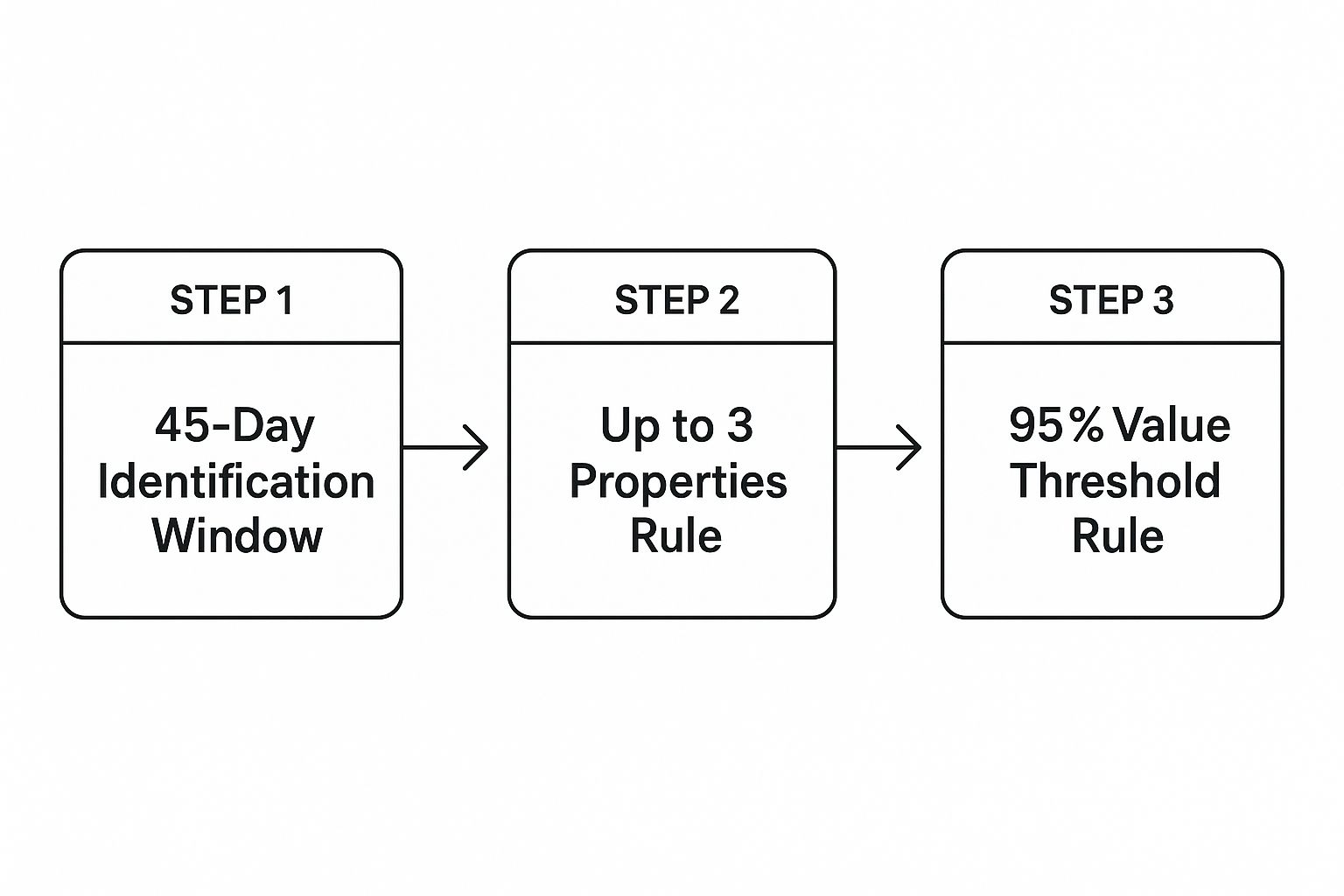
As you can see, most investors stick with the three-property rule. It offers the perfect blend of simplicity and flexibility for securing a great replacement asset.
Phase 2: Due Diligence and Making the Purchase
With your list of potential properties submitted, the second phase kicks off. You now have the rest of your 180-day total exchange period to do your homework, negotiate a deal, and close on one or more of the properties you identified.
This stage is all about seamless coordination between you, your real estate agent, your QI, and the title company. Once you have a replacement property under contract, you'll simply instruct your QI to wire the funds directly to the closing agent to seal the deal.
A successful 1031 exchange is a team sport. Clear and constant communication with your agent and Qualified Intermediary is the key to navigating the tight deadlines without costly errors.
These transactions are a huge part of the real estate market. Between 2008 and 2017, over 500,000 exchanges took place in the U.S., involving around $1.6 trillion in assets, with hubs like Los Angeles and New York City leading the way. The average replacement property price was about $1.32 million, which shows how investors at all levels use this strategy. You can discover more insights about these 1031 exchange statistics to see just how widespread the practice is.
Phase 3: Closing and Finalizing the Exchange
The final step is closing on your new "replacement property." To defer all of your capital gains tax, you have to follow two simple financial rules. First, the new property's purchase price has to be equal to or greater than the sale price of the old one. Second, you have to reinvest all the cash proceeds from the sale.
If you buy a cheaper property or don't reinvest all the cash, you'll have what's known as "boot," and that portion will be taxable.
Once the purchase is complete and all the funds from your QI have been used, your 1031 exchange is officially done. You’ve successfully kicked the tax can down the road and rolled your investment into a new, potentially more profitable asset.
Common Pitfalls and How to Avoid Them
A successful 1031 exchange is all in the details. One small misstep can trigger huge tax consequences, so it pays to be extremely careful. Navigating this process is about careful planning and knowing the common traps that can completely disqualify your exchange before you even get started.
The most painful part? Many investors get hit with an unexpected tax bill over a simple, avoidable mistake. The most frequent errors involve mishandling funds, blowing past deadlines, or just not understanding the strict property identification rules. The good news is, with a little prep and the right guidance, you can sidestep every single one of them.
The Problem of Receiving Boot
One of the easiest ways to mess up an exchange is by receiving "boot." Boot is simply any property you get back in the exchange that isn't "like-kind." Most of the time, this means cash, but it can be other assets, too.
Let’s say you sell your property for $500,000, but the new one you’re buying only costs $450,000. That extra $50,000 you get back from your Qualified Intermediary is considered boot, and you'll owe capital gains tax on it.
Think of it this way: The IRS wants to see a seamless continuation of your investment. Any cash you pull out or debt you don't replace is seen as cashing in on your gains, which immediately triggers a taxable event for that portion.
Another version of this is mortgage boot. This happens if the loan on your new property is less than the loan you paid off on the old one. To avoid this, you have to take on an equal or greater amount of debt on the new property or bring enough cash to the table to make up the difference.
Mishandling Funds and the QI Role
The IRS is incredibly strict on this point: you cannot have actual or constructive receipt of your sale proceeds. This means you can't touch the money or have any control over it while the exchange is in progress. The only way to legally avoid this is by using a Qualified Intermediary (QI).
A fatal mistake is waiting to hire a QI until after your sale has already closed. If those sale proceeds hit your bank account, even for a second, the 1031 exchange is dead on arrival. It's instantly invalidated.
Here’s what you need to remember about working with a QI:
- Hire Early: You must have your QI agreement signed and in place before you close on the property you're selling.
- Ensure Independence: The QI must be a neutral third party. It can't be your real estate agent, attorney, accountant, or anyone else you have a financial relationship with.
- Follow Instructions: Your QI will give the closing agents all the documents and instructions needed to make sure the funds are wired directly to them, not to you.
Violating Property Identification Rules
That 45-day identification deadline is where so many deals fall apart. The rules for identifying potential replacement properties are rigid, and you have to follow them to the letter. It’s not enough to just have a few places in mind; you have to submit a formal, signed, written declaration to your QI before midnight on the 45th day.
Common identification mistakes include:
- Missing the Deadline: Forgetting the date or miscalculating it is an automatic disqualification. No exceptions.
- Vague Descriptions: You must clearly describe the property, usually with a street address or legal description.
- Failing the Rules: You must strictly follow either the Three-Property Rule, the 200% Rule, or the 95% Rule. Messing this up will void your entire identification list.
The best way to avoid this is to start looking for your replacement property long before you even close on your sale. Knowing your target market and having potential properties lined up gives you a massive head start. This kind of proactive planning is also key to maximizing your financial benefits, like knowing which costs will qualify as deductions for your rental property once you own it. Being prepared ensures you can make a smart, compliant decision when the clock is ticking.
Answering Your Top 1031 Exchange Questions
Even when you've got a handle on the rules, real-world scenarios always pop up during a 1031 exchange. Getting the small details right is the difference between a smooth, tax-deferred deal and a costly mistake. Let's tackle some of the most common questions we hear from investors just like you.
Navigating these situations demands careful planning and a solid grasp of how the IRS rules apply on the ground. Whether it's about a vacation home or a deal that doesn't go as planned, the little things can make a huge impact.
Can I Use a 1031 Exchange for a Vacation Home?
This one comes up a lot, and the answer isn't a simple yes or no. The golden rule of a 1031 exchange is that both properties—the one you're selling and the one you're buying—must be held for business, trade, or investment. A house used purely for family getaways won't cut it.
But, a vacation home can qualify if you treat it like a genuine investment. To get the green light from the IRS, you need to limit your personal stays and rent it out at a fair market price for most of the year.
The IRS created a "safe harbor" to make this clear. To feel confident your vacation property qualifies, you must limit personal use to no more than 14 days a year or 10% of the total days it was rented—whichever is greater. You also need to have owned it for at least 24 months before the exchange.
What Happens If I Can't Find a Replacement Property in Time?
This is easily one of the biggest risks in any 1031 exchange. If you miss the 45-day deadline to identify properties or can't close on a new one within the 180-day period, the exchange fails. Period.
When that happens, the outcome is unavoidable. Your Qualified Intermediary (QI) has to return your sale proceeds, and the whole deal gets reclassified as a standard property sale. That means you’ll be on the hook for capital gains taxes on every dollar of profit, right in the year the sale happened.
To sidestep this stressful outcome, you have to be proactive:
- Start the hunt early: Don't wait until your old property sells. Begin scouting potential replacements long before you close.
- Line up your backups: Take full advantage of the three-property rule. Identify a few solid options so you're not left scrambling if your first choice falls through.
- Build a strong team: A great real estate agent who understands 1031s can be your best asset in finding the right properties fast.
What If I Buy a Property of Lesser Value?
If you want to defer 100% of your capital gains tax, you have to follow two non-negotiable rules. First, the new property's value has to be equal to or greater than the old one. Second, you have to reinvest every penny of the cash proceeds.
When you buy a replacement property that costs less than the one you sold, you’re "trading down." It won't kill the entire exchange, but it will trigger a taxable event. That leftover cash or value difference is called “boot,” and you’ll owe capital gains tax on it.
Say you sell a property for $600,000 and buy a new one for $550,000. You’ll have $50,000 in taxable cash boot. The rest of your gain stays deferred, but you'll need to plan for that partial tax bill if you decide to trade down.
How Does an Exchange Impact My Tax Basis?
A 1031 exchange is a tax-deferral tool, not a tax-elimination one. The capital gains you sidestep don't just disappear into thin air. They get carried over to the new property by adjusting its tax basis.
Here's how it works: you take the purchase price of your new property and subtract the deferred gain from your old one. This gives you a new, lower tax basis than if you had just bought the property outright.
Let's break it down with an example:
- You bought Property A years ago for $200,000.
- You just sold it for $500,000, giving you a $300,000 gain.
- You roll that into a 1031 exchange and buy Property B for $700,000.
Your new basis isn't $700,000. Instead, you subtract the $300,000 deferred gain, making the adjusted basis for Property B just $400,000. This lower basis means you'll have smaller depreciation deductions, and if you ever sell Property B without another exchange, your taxable gain will be much larger.
For ongoing discussions and further insights on investment topics, including complex tax strategies, you can find other helpful resources.
Managing the complexities of a 1031 exchange requires expert guidance. Whether you're selling an investment property or looking for the perfect replacement, the team at Edinhart Realty and Property Management can help you navigate every step with confidence. Contact us today to ensure your real estate transactions maximize your returns and align with your financial goals at https://edinhart.com.


